
Most deals stall for one of five reasons: poor qualification, a missing decision-maker, no clear urgency, a broken follow-up cadence, or a contract/diligence blocker. The first thing to do when a deal goes quiet is run a two-minute diagnostic: identify which of those five causes is blocking it, then reengage the right stakeholder or reframe the value around a time-sensitive business pain. Everything else in this article builds on that single action.
Fullcast reports that a majority of U.S. sales leaders cite lost revenue from undefined sales processes. That number points to a systemic problem, not a rep problem. Stalled deals are almost always symptoms of process gaps that compound across the pipeline.
Key Takeaways
Deals stall most often because of process failures, not product failures: poor qualification, missing stakeholders, and cadence breakdowns account for the majority of stalled opportunities across B2B pipelines.
| Point | Details |
|---|---|
| Diagnose before you act | Identify the specific stall cause before running a recovery play — the wrong play makes it worse. |
| Map stakeholders in discovery | Ask for the full decision committee in the first call, not after the proposal is sent. |
| Set a cadence threshold | Flag any deal with no two-way contact in 10+ business days as a confirmed stall. |
| Document every concession | Attach a condition and expiration to every discount or concession to protect margin. |
| Recognize structural stalls | When the blocker is procurement, financing, or M&A, pause formally and set a requalification trigger. |
Table of Contents
- What are the most common reasons deals stall?
- How do you tell a true stall from a normal delay?
- What's the step-by-step recovery playbook for a stalled deal?
- What processes prevent deals from stalling in the first place?
- When is a stall outside your control?
- Which tools help you track and prevent cadence breakdowns?
- What should managers look for in a pipeline review?
- The advice that's missing from most stall-recovery articles
- Sources
What are the most common reasons deals stall?
Here are the ten root causes, ranked by frequency, with the signals to spot and one fix to try immediately.
1. Poor qualification and weak discovery
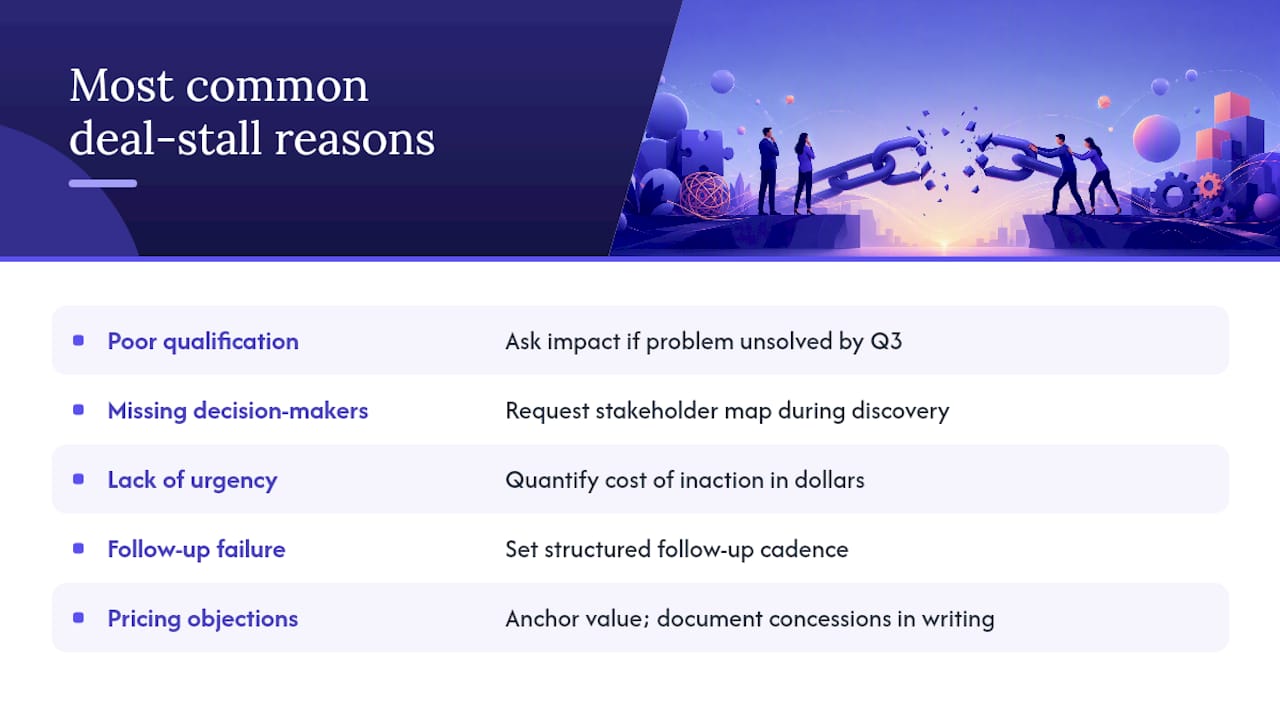
You advanced a deal before confirming the buyer has real budget, a real problem, and a real timeline. The signals: vague answers to budget questions, no internal sponsor, and a prospect who keeps asking for "more information" without committing to a next step. The fix: go back to basics. Ask directly, "What happens to your business if this problem isn't solved by Q3?" If they can't answer, the deal was never real. The owner of the next action is the rep, within 48 hours.
2. Missing decision-makers or stakeholder misalignment
Sales Gravy's analysis of consensus-driven buyers shows that prospects engage enthusiastically but cannot move without a committee they never mentioned. The signal: your champion says "I just need to loop in a few people" after you've already sent a proposal. The fix: ask for a stakeholder map in the discovery call, not after the proposal. The owner: the rep, with the AE manager reviewing the map before the proposal goes out.
3. Lack of urgency or unclear, unquantified value
If the buyer can't articulate what it costs them to wait, they won't act. Signals: the deal keeps getting pushed to "next quarter," the prospect is responsive but never moves forward, and no one on their side is asking about implementation timelines. The fix: quantify the cost of inaction. "Based on what you told me, this problem is costing your team roughly X hours per week. At your billing rate, that's $Y per month you're not recovering." The owner: the rep, with the manager reviewing the value calculation.
4. Passive or inconsistent follow-up
Cadence breakdowns are silent deal killers. A rep sends one email after a demo, waits ten days, sends another, then goes quiet. The prospect interprets silence as low priority. Signals: the last meaningful touchpoint was more than seven days ago, open rates on follow-up emails are dropping, and the prospect stopped responding to calendar invites. The fix: set a structured follow-up cadence with specific dates and outcomes logged after every call. The owner: the rep, with the manager checking cadence in the weekly pipeline review.
5. Pricing objections or renegotiation triggers
A competitor enters late, or the buyer uses the proposal as a negotiating anchor. Signals: sudden requests to "revisit the pricing," new stakeholders appearing only for commercial conversations, and requests for line-item breakdowns that weren't asked for earlier. The fix: pre-empt the retrade by anchoring value before price. Document every concession in writing with the condition attached ("We can offer X if you sign by [date]"). The owner: the AE manager, who should approve any discount before it's offered.
6. Contract, legal, or procurement blockers
Legal redlines, procurement cycles, and diligence findings are the most common late-stage killers. Axial's Dead Deal Report shows that non-QoE diligence findings drove a significant portion of broken LOIs in 2025. QoE EBITDA discrepancies drove another large share. Even in standard B2B sales, procurement delays and legal reviews can add weeks or months. The fix: ask about the procurement and legal review process in discovery, not after the contract is sent. The owner: the rep plus the solutions or legal team, escalated immediately when redlines appear.
7. Product or technical fit concerns
The prospect discovers a gap between what was demoed and what they actually need. Signals: new technical questions appearing after the proposal, requests for a second technical demo, or a sudden ask for a pilot or proof of concept. The fix: loop in a solutions engineer or technical resource before the proposal, not after. The owner: the AE, with the solutions engineer assigned within 24 hours of a technical objection.
8. Procurement timelines and internal politics
Budget cycles, approval hierarchies, and internal competition for resources can freeze a deal that everyone wants. Signals: "We love it, but we need to wait for budget approval" after you've already confirmed budget exists, or a champion who goes quiet because they're fighting internal battles you can't see. The fix: ask your champion directly, "What does the internal approval process look like, and who else needs to sign off?" Then map those steps to a timeline. The owner: the rep, with the manager reviewing the approval map.
9. Buyer risk aversion and psychological hesitation
HBR finds that many deals are lost to customer indecision rather than price or product fit. The buyer is afraid of making the wrong call. Signals: the prospect asks for more references after already receiving three, keeps revisiting objections you've already addressed, or says "we're still evaluating" weeks after the evaluation was supposed to end. The fix: reduce the perceived risk. Offer a phased rollout, a short pilot, or a performance guarantee. Frame the decision as reversible where possible. The owner: the rep, with the manager coaching the risk-reduction framing.
10. Internal sales team resource constraints
Sometimes the stall is on your side. A rep is carrying too many deals, a solutions engineer is overbooked, or a contract template is stuck in legal. Signals: internal response times to prospect questions are slipping, follow-up tasks are being logged but not completed, and the rep can't articulate the next step for the deal. The fix: audit the rep's pipeline load and reassign or deprioritize deals that aren't progressing. The owner: the manager, immediately.
Pro Tip: Ask your champion in the first discovery call: "Who else will be involved in evaluating this, and who has final approval?" Then ask, "Is there anyone who would push back on moving forward?" That second question surfaces the hidden veto players that consensus-driven buyers never volunteer.
How do you tell a true stall from a normal delay?
Not every quiet deal is dead. Some are just slow. The difference matters because the wrong response to a normal delay (aggressive follow-up, escalation, discounting) can actually kill a deal that was progressing fine.
Behavioral signals that indicate a true stall:
- No meaningful response in more than 10 business days despite two or more touchpoints
- A scheduled meeting canceled twice with no rescheduled date offered
- A new stakeholder introduced after the proposal with no explanation
- Sudden requests for additional references, case studies, or technical documentation after the evaluation was supposed to be complete
- The champion stops returning calls but is still active on LinkedIn or responding to other vendors (you'll hear this from your network)
- A request to "pause" the conversation without a specific restart date
KPI thresholds that flag a high-risk stall:
- Response rate below 30% across the last five touchpoints
- No meeting held in the past 21 calendar days
- More than three new information requests after the proposal was sent
- Deal age more than 1.5 times the average sales cycle for that segment
- Zero activity logged by the rep in the past seven days
Decision rule: diagnose, attempt one recovery play, then decide
- Days 1–3: Identify the stall type from the signals above. Is it a stakeholder gap, a cadence failure, a procurement delay, or buyer hesitation? Log your diagnosis.
- Days 4–10: Run one targeted recovery play matched to the cause (see the playbook below). Track every touchpoint.
- Day 11: If no meaningful engagement, escalate to the manager and make a binary call: attempt one more play with manager involvement, or disqualify and move the deal to a "nurture" status.
Gartner's buyer enablement research shows that poor clarity on next steps is one of the strongest predictors of a stalled opportunity. If neither you nor the prospect can name the next concrete step, the deal is stalled by definition.
Pro Tip: Track deal age against your average sales cycle in your pipeline dashboard. Treat it that way.
What's the step-by-step recovery playbook for a stalled deal?
Run these steps in sequence. Each step has a time box. If you don't get movement, escalate.
Step 1: Reconfirm pain and timeline (Days 1–3)
Send a short, direct email. Subject: "Quick question about [their stated problem]." Body: "When we last spoke, you mentioned [specific pain]. Has anything changed on your end, or is that still the priority?" No pitch. No attachment. Just a question that requires a one-sentence answer. If they respond, you have a live deal. If they don't, move to Step 2.
Step 2: Reframe value around a new trigger (Days 4–5)
Find a reason to reach out that isn't "just checking in." A relevant industry report, a case study from a similar company, or a change in their business (new hire, funding round, earnings call) gives you a legitimate hook. Lead with the trigger, not the product.
Step 3: Multi-thread to a new stakeholder (Days 6–7)
If your champion is unresponsive, go around them, carefully. Find a second contact at the company (a peer of your champion, their manager, or a technical stakeholder) and send a brief, professional note. "I've been working with [champion's name] on [problem]. I wanted to make sure I wasn't missing anyone who should be part of the conversation." This either reactivates the champion (who hears you reached out) or opens a new thread.
Step 4: Calendar a decision meeting with a specific agenda (Days 8–10)
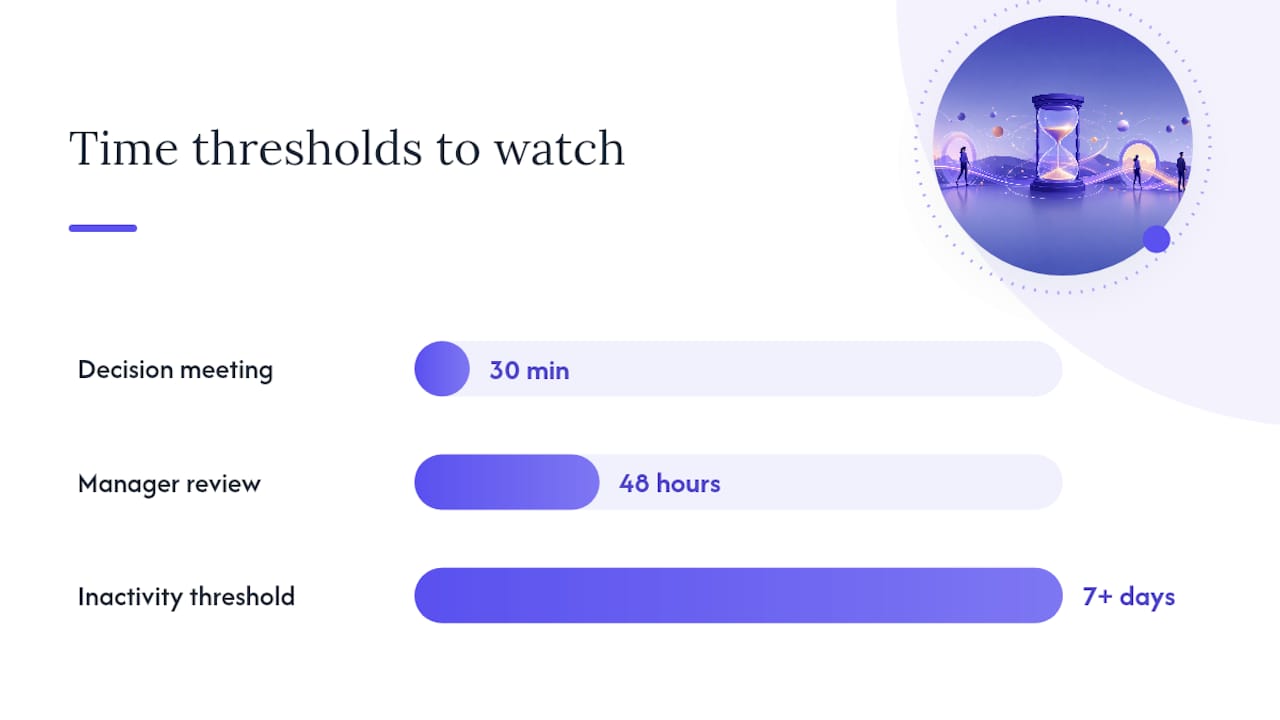
Don't ask for "a call to reconnect." Ask for a 30-minute decision meeting with a named agenda: "I'd like to walk through three things: where we are on [their stated problem], what a realistic timeline looks like, and whether this is still a priority for Q3." A specific agenda signals that you're treating their time seriously.
Sample meeting agenda:
- 5 minutes: Recap of their stated problem and success criteria
- 10 minutes: Updated value summary tied to their business metrics
- 10 minutes: Review of remaining concerns or open questions
- 5 minutes: Decision: move forward, pause with a defined restart date, or close the file
Step 5: Fix procurement or legal blockers directly (Days 11–14)
If the stall is in legal or procurement, get your own legal or procurement resource on the phone with theirs. Don't let the rep manage a legal negotiation by email. Escalation trigger: any redline that's been sitting for more than five business days without a response.
Step 6: Document concessions and protect margin (Ongoing)
Every concession you offer should be documented in writing with a condition and an expiration. Negotiation research from IMD shows that strong negotiators pre-define their walk-away points and plan multiple pathways before entering a renegotiation. Know your floor before the conversation starts.
Escalation triggers:
- No response after Step 3 (multi-thread): loop in the AE manager
- Legal redlines unresolved after five business days: loop in your legal team
- Discount request above your authority level: loop in the AE manager or CRO before responding
- Deal age exceeds 2x average sales cycle: CRO-level review and disqualification decision
What processes prevent deals from stalling in the first place?
Recovery is expensive. Prevention is cheap. These process changes reduce stall frequency across the pipeline.
Mandatory discovery questions before advancing any deal:
- What is the specific business problem, and what does it cost you today?
- Who else is involved in evaluating this, and who has final approval?
- What is your budget range, and has it been approved?
- What does your procurement and legal review process look like?
- What would need to be true for you to make a decision by [target date]?
Stakeholder mapping and multi-threading:
Before sending a proposal, the rep should be able to name every stakeholder involved in the decision, their role, and their likely objection. A simple stakeholder map has four columns: name, role, stance (champion/neutral/skeptic), and last contact date. If any cell is blank, the deal isn't ready for a proposal.
Qualification framework: MEDDIC
MEDDIC (Metrics, Economic Buyer, Decision Criteria, Decision Process, Identify Pain, Champion) is the most widely used qualification framework for complex B2B sales. Run every deal through it before advancing it past the discovery stage. A deal that can't answer all six elements is a deal that will stall.
Pipeline review template for managers:
Use this set of questions in every weekly pipeline review:
- What is the next concrete action, and who owns it?
- When did we last have a meaningful two-way conversation with this prospect?
- Have we confirmed budget, timeline, and decision authority?
- Who else is involved in the decision that we haven't met?
- What is the biggest risk to this deal closing on time?
For a full pipeline review checklist, including deal-stage criteria and red-flag triggers, use the Dialedsales pipeline review guide.
Good pipeline management starts with consistent data entry and ends with consistent manager review. Both have to happen every week, not just at quarter end.
Proof-of-value gating:
Before advancing a deal to the proposal stage, require the prospect to complete a defined action: attend a technical demo, provide a data sample for analysis, or sign a mutual action plan. Prospects who won't invest 30 minutes in a proof-of-value step won't sign a contract.
When is a stall outside your control?
Some stalls have nothing to do with your process, your product, or your rep's execution. Recognizing them early saves resources.
Structural causes that block deals regardless of seller effort:
- Procurement calendar windows: Many enterprise buyers have fixed procurement cycles. A deal that misses the Q2 window may not be reviewable until Q4, regardless of urgency. Ask about the procurement calendar in discovery.
- Buyer financing collapse: In lower-middle-market transactions, buyer financing falls through more often than sellers expect. Retrades, working-capital disputes, and financing problems are frequent causes of post-LOI failure. If your deal depends on the buyer securing financing, build a financing contingency check into your timeline.
- M&A activity on the buyer's side: A buyer going through an acquisition or being acquired will freeze all non-essential vendor decisions. Watch for signals: leadership changes, press releases, unusual delays in approvals.
- Legal or diligence findings: Harvard CorpGov analysis of 5,058 merger agreements shows deal breakage rates of roughly 9–12% depending on market conditions, driven significantly by structural features and contingencies. Even in standard B2B deals, a legal finding or a compliance issue on either side can freeze a deal that was days from closing.
- Market or economic shocks: Interest rate changes, regulatory shifts, or sector-specific downturns can freeze buyer budgets overnight. These are real and not recoverable on a short timeline.
When you hit a structural stall, run a pause plan:
- Confirm the specific blocker in writing with your champion.
- Agree on a restart trigger: "When your financing is confirmed" or "After your Q3 budget cycle opens."
- Set a check-in cadence: one touchpoint per month, no pitch, just a relationship maintenance call.
- Requalify fully when the blocker clears. Assume nothing about the deal's status from before the pause.
Early diligence and pre-disclosure reduce the chance of a late-stage surprise finding that kills a deal after significant time has been invested on both sides. If you're selling into a buyer who is themselves going through a transaction, surface that risk early.
Which tools help you track and prevent cadence breakdowns?
The right tooling doesn't close deals. It prevents the process failures that let deals die quietly while the rep is focused elsewhere.
What to track to catch stalls before they become losses:
- Days since last meaningful two-way contact (not just a sent email)
- Number of follow-up attempts with no response
- Meeting attendance rate (scheduled vs. held)
- Stakeholder count (single-threaded deals are high-risk by definition)
- Activity-to-outcome ratio: calls and emails logged vs. meetings booked
How Dialedsales fits into a stall-prevention workflow:
Dialedsales is built for exactly the cadence problem that kills deals quietly. A rep logs a call in 10 seconds, notes the outcome, and sets a follow-up date. That date surfaces automatically on the dashboard when it's due, so no deal goes quiet because a rep forgot to follow up. The pipeline dashboard shows every open deal, its last activity, and its next action, giving managers a real-time view of which deals are at risk before the weekly review.
The built-in AI assistant can draft a follow-up message or summarize recent call activity, which cuts the time between a stalled touchpoint and the next outreach attempt. For field teams and outbound reps who are managing 30 or more active prospects, that automation is the difference between a cadence that holds and one that drifts.
Pro Tip: Set a rule in your pipeline dashboard: any deal with no logged activity in seven days gets flagged automatically. Review those flagged deals first in every pipeline meeting. The ones with no next action scheduled are your stalls.
For a broader look at sales tracking tool categories and how to match them to your team's workflow, the Dialedsales blog covers the tradeoffs between lightweight activity trackers and full CRM platforms.
Pipeline visibility is the precondition for everything else in this article. You can't diagnose a stall you can't see.
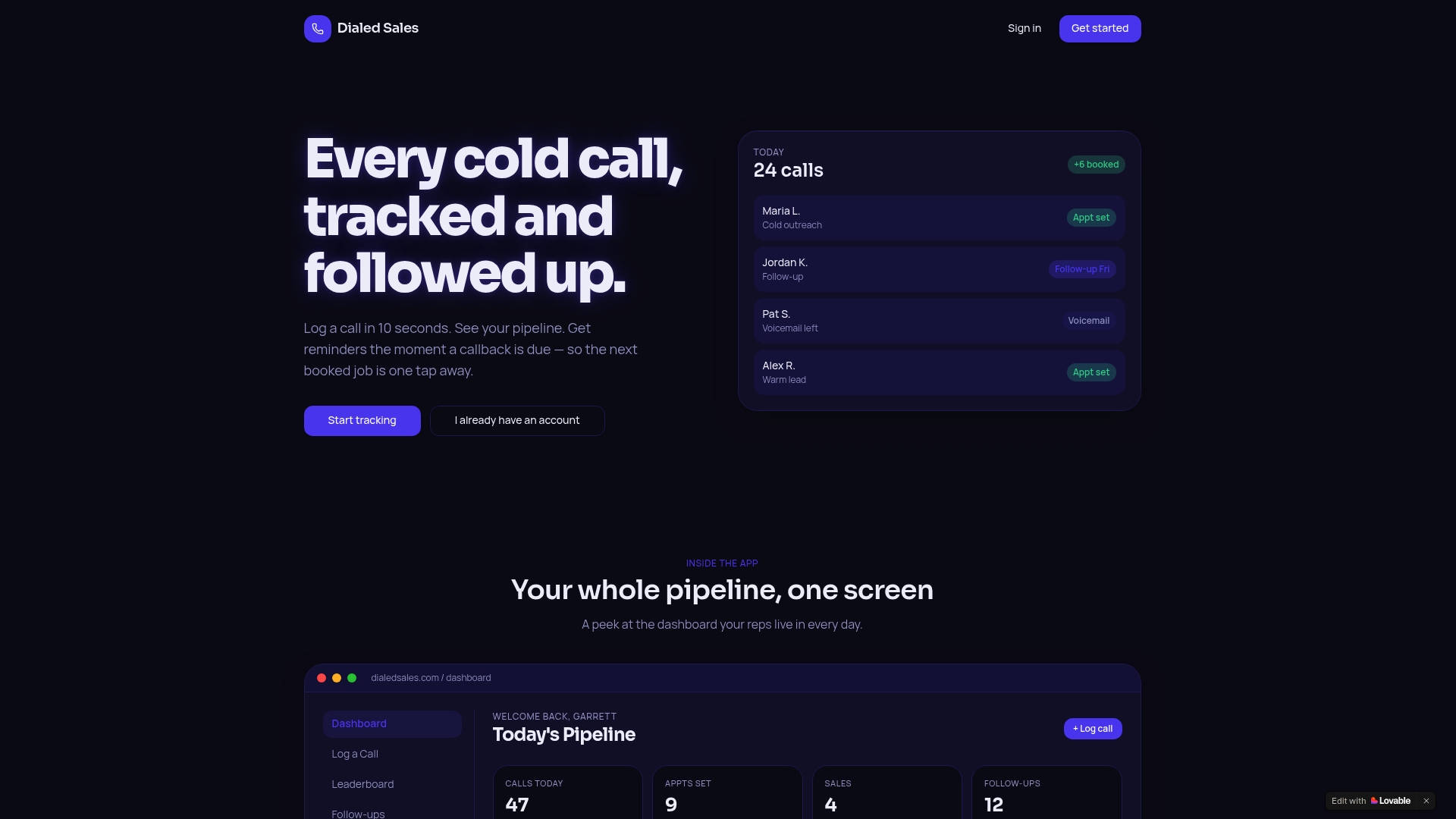
Stop letting deals go quiet. Dialedsales logs every call in 10 seconds, sets automatic follow-up reminders, and surfaces overdue actions on your dashboard before they become lost deals. Start your free trial and see which deals need attention today.
What should managers look for in a pipeline review?
A pipeline review that doesn't surface stalls isn't a review. It's a status update. Here's what to look for and what to do about it.
Red flags and immediate manager actions:
| Red Flag | Immediate Manager Action | 7-Day Expected Outcome |
|---|---|---|
| Single-threaded champion, no other contacts | Coach rep to multi-thread; review stakeholder map together | Second contact identified and outreach sent |
| No activity logged in 7+ days | Ask rep: "What's the next action and who owns it?" | Next action scheduled and logged |
| Repeated document requests after proposal | Diagnose whether this is a stall or a procurement process | Clarity on whether deal is progressing or stalled |
| Deal age 1.5x average sales cycle | Escalate to AE manager; run recovery play or disqualify | Binary decision: active recovery or nurture status |
| Discount request above rep authority | Manager joins next call; pre-define walk-away point | Concession documented with condition and expiration |
| Champion goes quiet, deal still "open" | Rep attempts multi-thread; manager reviews deal viability | Champion reengaged or deal disqualified |
Coaching scripts for managers:
When a rep says "I'm waiting to hear back," ask: "What specifically are you waiting for, and when did you last have a two-way conversation?" That question forces the rep to confront whether they're managing a deal or hoping one closes.
When a rep says "They're still evaluating," ask: "What are their evaluation criteria, and have you confirmed you meet all of them?" If the rep can't answer, the deal is single-threaded and under-qualified.
Role-play prompt for decision meetings:
Have the rep play the prospect. The manager plays the rep. Run through the 30-minute decision meeting agenda from the playbook above. The goal is to get the rep comfortable asking, "Based on everything we've covered, is there any reason you wouldn't move forward?" That question feels uncomfortable until you've said it 20 times in practice.
Escalation owners:
- Cadence failure: rep owns the fix, manager reviews in 48 hours
- Stakeholder gap: rep and AE manager co-own the multi-thread strategy
- Legal or procurement blocker: AE manager escalates to legal or procurement lead
- Discount above authority: AE manager or CRO approves before any response
- Deal age 2x average cycle: CRO-level review and disqualification decision
For a full set of rep accountability frameworks and coaching structures, the Dialedsales blog covers how to build accountability into weekly pipeline routines without turning reviews into interrogations.
The advice that's missing from most stall-recovery articles
Most stall-recovery content focuses on tactics: better subject lines, more touchpoints, a new angle on the pitch. That's not wrong, but it's treating the symptom. The real problem is almost always upstream.
A deal that stalls at the proposal stage was usually mis-qualified at discovery. A deal that stalls in legal was usually advanced without confirming the procurement process. A deal that stalls because the champion goes quiet was usually single-threaded from the start. The recovery play is necessary, but the prevention is where the leverage actually is.
The other thing most articles understate is the cost of keeping a dead deal "open" in the pipeline. A deal that has no realistic path to close in the next 90 days is consuming rep time, manager attention, and forecasting accuracy. Disqualifying it isn't failure. It's how you free up capacity for deals that can actually close.
The conventional advice is to "add value" in every follow-up. That's fine as far as it goes, but the more useful discipline is to be honest about what you're actually waiting for. If you can't name the specific blocker and the specific action that would unblock it, you're not managing a stall. You're managing your own discomfort with disqualifying a deal.
The reps who close the most aren't the ones who never let deals stall. They're the ones who diagnose stalls fast, run one targeted recovery play, and move on when it doesn't work. Pipeline health is a function of how quickly you make that call, not how long you hold on.
Sources
- Why Deals Stall in Your Pipeline (And How to Fix It) - Fullcast
- Why Your Deals Are Stalling and How to Fix It | Sales Gravy
- Dead Deal Report: Unpacking 2025’s Broken LOIs
- How deals die
- Gartner — buyer enablement
- Stop losing sales to customer indecision - HBR