
Why follow-up dates are the backbone of every sales process
The role of follow-up dates in sales is not about persistence for its own sake. It is about showing up at the exact moment a buyer is ready to move. A large majority of sales require multiple follow-up contacts to close, yet many salespeople quit after just one attempt. That gap between where reps stop and where deals actually close is where most revenue quietly disappears.
Follow-up dates are scheduled touchpoints built into a sales cadence to keep momentum alive between conversations. They are not generic check-ins. Done well, they reduce the buyer's cognitive load by proactively addressing questions, surfacing relevant information at the right time, and demonstrating organizational reliability.
The timing of those touchpoints matters as much as the content. A follow-up sent too early reads as anxious. One sent too late loses the thread entirely. The goal is to align your outreach with the buyer's decision-making rhythm, not your own comfort level.
Key follow-up facts every sales team should know:
- 44% of salespeople abandon follow-up after a single contact, leaving 92% of potential revenue untouched.
- Another 22% quit after two follow-ups, and only 8% of reps still reach the fifth-touch threshold where most deals actually close.
- Responding quickly to an inbound lead significantly increases conversion potential compared to longer delays.
- Multi-channel sequences mixing email, phone, and LinkedIn can improve response rates significantly compared to email alone.
Systematic follow-up timing is not a nice-to-have layer on top of selling. It is the mechanism that converts initial conversations into closed revenue.
Table of Contents
- 7 concrete advantages of running a disciplined follow-up system
- How to time your follow-ups: best practices that actually work
- Common challenges that kill follow-up execution
- Should you follow up after a successful sale?
- How Dialedsales makes follow-up management systematic
- Key takeaways
- The discipline gap no one talks about
7 concrete advantages of running a disciplined follow-up system
1. Higher closing rates across every deal size
The math is straightforward. 80% of sales close between the fifth and twelfth follow-up, and reps who reach that threshold consistently outperform those who stop at one or two. A structured cadence removes the guesswork about when to reach out next, so reps spend their energy on the conversation rather than deciding whether to send another email.
2. Stronger buyer trust through consistent communication
Buyers interpret follow-up speed and regularity as signals of how you will treat them as a customer. A rep who sends a recap within 24 hours of a meeting, then checks in on schedule, demonstrates the kind of reliability that enterprise buyers especially need to see before committing budget. Inconsistent follow-up, by contrast, raises doubts about post-sale support.
3. Better pipeline visibility for managers
When follow-up dates are logged and tracked, managers can see exactly where each deal sits in the cycle without relying on rep memory or status meetings. Stalled opportunities become visible before they die quietly. That visibility lets managers coach on specific deals rather than general habits.

4. Faster identification of unqualified leads
A disciplined cadence forces clarity. If a prospect has not responded to six well-spaced, value-added touches across multiple channels, they are telling you something. Structured follow-up gives you a defined point to stop active outreach and move the lead to a long-term nurture list, freeing time for prospects who are actually in a buying cycle.
5. More upsell and expansion opportunities
Follow-up does not end at the close. Reps who maintain contact after a deal is signed catch renewal conversations early, spot signals that a customer is ready for an upgrade, and position themselves for referrals. The relationship built through consistent pre-sale follow-up is the same relationship that opens post-sale expansion doors.
6. Reduced sales cycle length
Deals stall when buyers lose momentum between conversations. A follow-up date scheduled before the end of each meeting keeps the next step on both parties' calendars. Reps who book the next meeting before the current one ends close at measurably higher rates because they never let the deal go cold.
7. Competitive differentiation on process alone
Most buyers are talking to multiple vendors simultaneously. The rep who follows up on time, adds value with each contact, and never sends a generic "just checking in" message stands out immediately. In markets where products are similar, process discipline becomes a real differentiator.
How to time your follow-ups: best practices that actually work
The 24-hour rule is non-negotiable after any meeting
The single highest-leverage follow-up in any sales cycle is the recap sent within 24 hours of a meeting or demo. Buyers interpret speed as commitment. A same-day email summarizing what was discussed, confirming next steps, and naming the date of the next conversation keeps the deal moving while the conversation is still fresh. Missing this window does not just slow momentum. It signals disorganization.
For inbound leads specifically, the timing bar is even higher. Responding within five minutes of a form submission or inquiry increases conversion potential dramatically compared to waiting even half an hour. Every minute of delay lets the lead cool and gives a competitor a chance to respond first.
Use stage-specific cadences, not a one-size-fits-all schedule
The right follow-up interval depends on deal size, cycle length, and where the buyer is in their decision process. A $3,000 transactional deal closes on momentum; a five-day wait between touches is too long. A $200,000 enterprise deal involves committees and budget cycles; following up every three days signals you do not understand how their organization works.
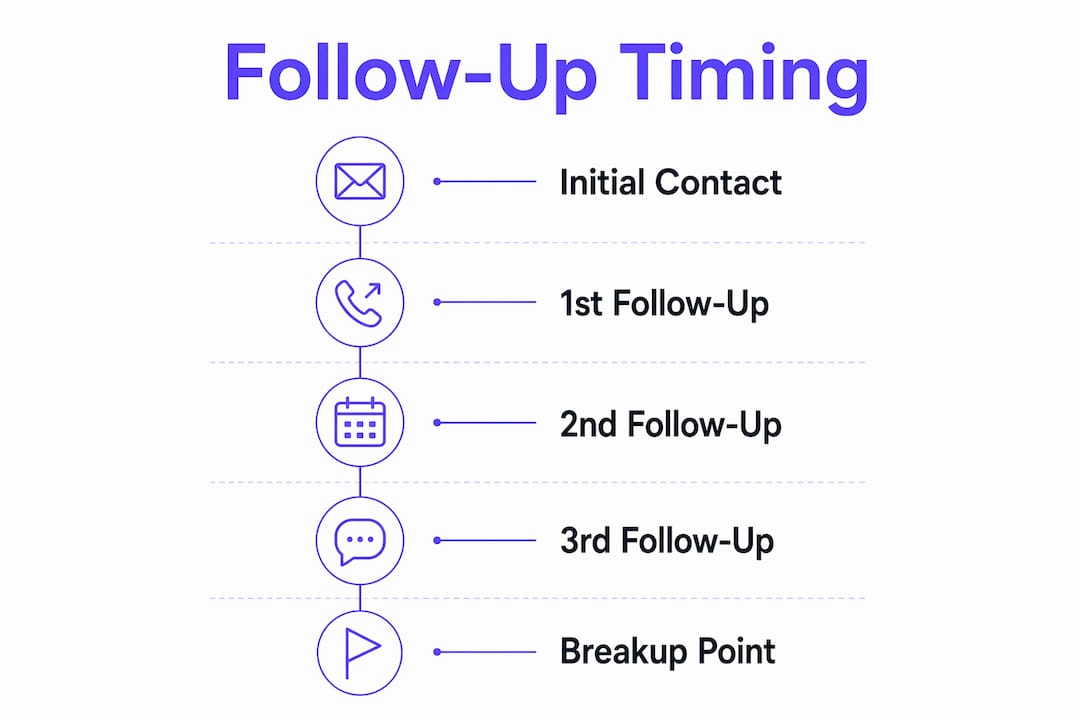
| Deal size | Touch 1 | Touch 2 | Touch 3 | Touch 4 | Breakup |
|---|---|---|---|---|---|
| Under $5k | Day 2 | Day 5 | Day 9 | — | — |
| $5k–$25k | Day 3 | Day 7 | Day 14 | Day 18 | — |
| $25k–$50k | Day 5 | — | — | — | — |
| $50k+ | Day 7 | Day 18 | — | Day 50 | Day 60 |
Baseline timing for B2B proposals with no engagement signal. Adjust when you detect opens, forwards, or re-reads.
The 5-7-14 method for B2B prospecting
A common effective cadence for B2B follow-up sequences involves contacts spaced days apart to keep context alive without overwhelming the prospect's inbox. The breakup email at the end of the sequence can be the highest-reply touchpoint, as announcing stopping removes reciprocity pressure and triggers the buyer's loss-aversion instinct.
Go multi-channel after two ignored emails
If two emails have produced no response, a third email almost certainly will not either. Switch to phone or LinkedIn. The channel change resets the prospect's context and delivers reply rates far above what a continued email thread can achieve. Cold calling connects with 18.6% of reached prospects and accounts for a third of all appointments booked, making it the most effective escalation channel when email has gone silent.
Pro Tip: Pause your automated sequence the moment a prospect replies. Continuing a pre-scheduled cadence after someone has engaged destroys trust faster than not following up at all. Trigger-based follow-up, responding to actual engagement signals, consistently outperforms fixed-interval timing.
Best days and times for outreach
Tuesday through Thursday, between 10:00 AM and 11:00 AM in the prospect's local time zone, produces the highest open and reply rates across major sales engagement platforms. A secondary window at 4:00–5:00 PM also performs well for calls. Monday mornings and Friday afternoons are the two worst windows, when inboxes are either overloaded or mentally abandoned.

Stop at eight touches with zero engagement
After eight multi-channel touches over three weeks with no response of any kind, the prospect is not interested right now. Move them to a long-term nurture list with monthly or quarterly touches, and re-engage only when an intent signal appears, such as a website visit, a job change, or a company announcement.
Common challenges that kill follow-up execution
Sales teams know follow-up matters. Most still struggle to do it consistently. The obstacles are predictable, and understanding them is the first step toward fixing them.
Premature abandonment. The 44% of reps who stop after one follow-up are not lazy. They are often uncertain whether reaching out again will feel pushy. Without a defined cadence and a clear stopping rule, doubt wins and the follow-up never gets sent.
Manual tracking failures. A rep managing 30–50 active prospects cannot reliably track day-2, day-5, day-9, and day-14 follow-ups across all of them without a system. Spreadsheets and memory fail. Leads fall through the cracks not because the rep forgot to care, but because the tracking method was not built for the volume.
Message fatigue from generic outreach. Sending "just checking in" repeatedly is not follow-up. It is noise. Buyers who receive the same vague message three times in a row will either unsubscribe or mark the sender as spam. Each touch needs a distinct angle, a new piece of information, or a specific question. When reps run out of things to say, they default to filler, and filler damages the relationship.
Ignoring engagement signals. A prospect who opens a proposal three times in one day is telling you something. A rep who does not notice, or does not have a system that surfaces that signal, misses the optimal moment to follow up. Trigger-based outreach, responding to actual buyer behavior rather than a fixed calendar, consistently outperforms rigid scheduling.
Lack of a defined stopping rule. Without a clear endpoint, reps either follow up forever (which reads as desperate) or stop too early (which leaves revenue on the table). A defined cadence with a breakup email and a re-queue rule after 90 days solves both problems at once.
No scheduled next step after meetings. Leaving a meeting with "I'll follow up" and no calendar invite is a promise to forget. Reps who book the next meeting before the current one ends remove the entire problem of deciding when to reach out next.
Should you follow up after a successful sale?
Yes, and the timing matters as much as it does during prospecting. Post-sale follow-up is where customer relationships either deepen into long-term partnerships or quietly erode into churn.
Well-managed post-sale follow-ups reduce churn by 15–25% and open direct pathways to expansion revenue through upsell and cross-sell conversations. The buyer who just signed is also the most likely source of referrals, but only if the experience after the close matches the experience before it.
Post-sale follow-up priorities:
- Day 1–3 after close: Confirm next steps, introduce the implementation or onboarding contact, and set expectations for the first 30 days.
- Day 14–30: Check in on early experience. Ask specific questions about what is working and what is not. This is not a sales call. It is a relationship call.
- Day 60–90: Assess progress against the goals the buyer stated during the sales process. If they are hitting targets, this is the natural moment to introduce an expansion conversation.
- Quarterly: Maintain a regular cadence for the lifetime of the account. Customers who hear from their rep only at renewal time feel like a transaction, not a partner.
The cadence for post-sale follow-up is slower and less urgent than prospecting, but the stakes are higher. Losing a customer who has already bought costs far more than losing a prospect who never committed.
How Dialedsales makes follow-up management systematic
Most follow-up failures are not attitude problems. They are system problems. Reps who want to follow up consistently still drop leads when the tracking method cannot keep pace with their pipeline volume. Dialedsales was built specifically to close that gap for field sales teams and cold callers across every industry.
The workflow is direct. Log a call in ten seconds with the customer name, outcome, and notes. Set a follow-up date, and that date auto-surfaces on your dashboard the moment it is due. No hunting through spreadsheets, no relying on calendar reminders buried in email. The callback appears when it is time to make it.
What Dialedsales does for follow-up execution:
- Surfaces follow-up reminders automatically when a callback is due, so no lead goes cold by accident.
- Tracks every call outcome, giving reps and managers a clear picture of where each prospect stands in the pipeline.
- Keeps the logging process fast enough that reps actually use it. Ten seconds per call is the difference between a system that gets adopted and one that gets abandoned.
- Gives managers pipeline visibility without requiring status meetings or manual reporting.
Sales reps who automate and structure their follow-up cadence with purpose-built software achieve conversion rates three to five times higher than those using unstructured approaches. The gap is not talent. It is process. Dialedsales provides the process layer that turns good intentions into consistent execution.
For teams exploring how AI can further predict and adjust ideal follow-up windows, Streamline AI offers complementary automation that pairs well with structured call tracking.
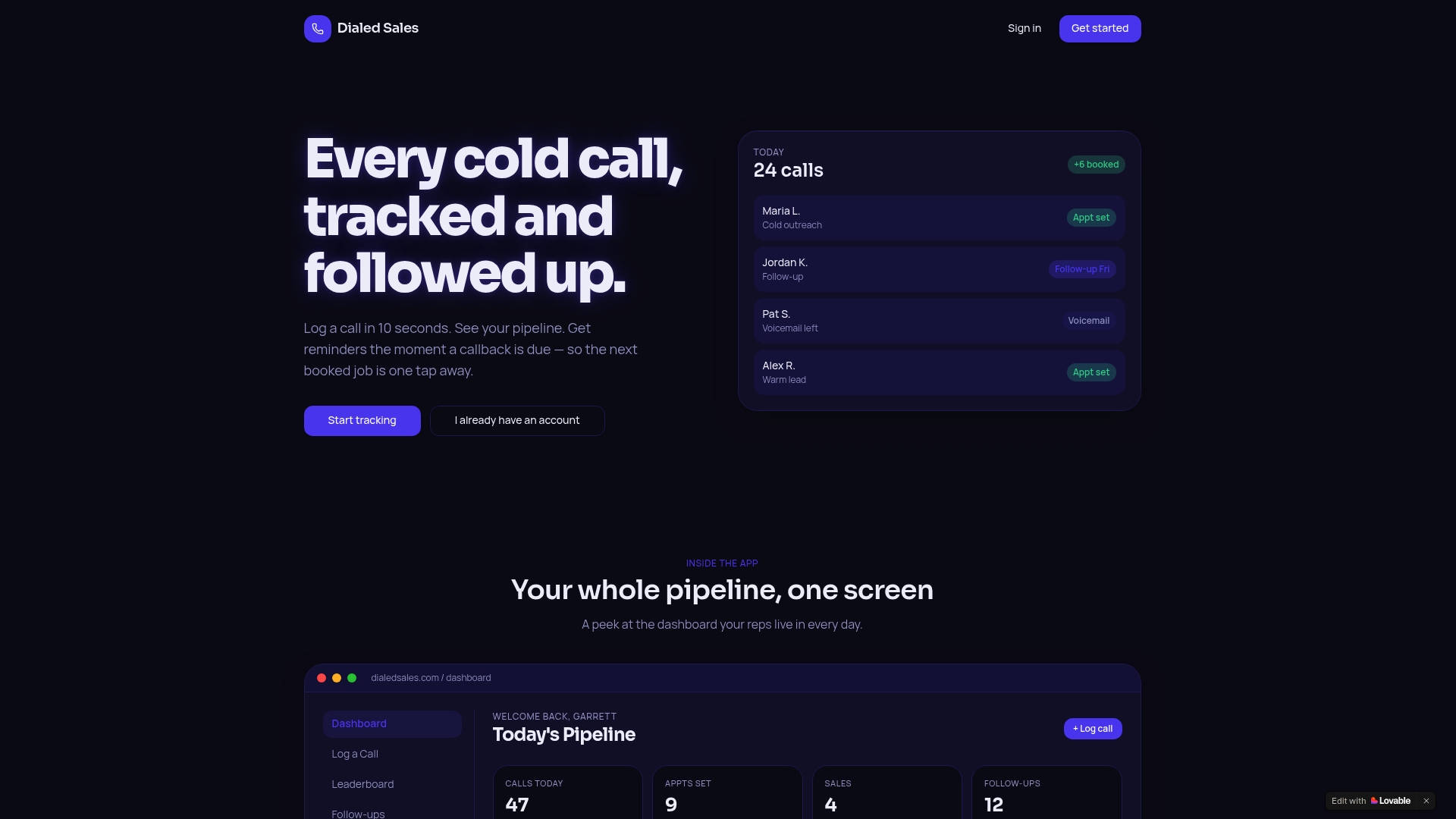
If you are managing a field sales team or running cold outreach at volume, Dialedsales gives you the tracking infrastructure to make every follow-up date count.
Key takeaways
Consistent, well-timed follow-up is the single most controllable variable in a sales team's closing rate, and most teams are leaving the majority of their revenue on the table by stopping too early.
| Point | Details |
|---|---|
| Most deals need 5+ touches | 80% of sales require five to twelve follow-ups to close, but 44% of reps quit after one and only 8% reach the fifth touch where most deals close. |
| Timing varies by deal size | Small deals need follow-up on day 2–3; enterprise deals warrant day 7–10 for the first touch. |
| Multi-channel lifts response significantly | Mixing email, phone, and LinkedIn outperforms email-only sequences significantly. |
| Post-sale follow-up reduces churn | Well-managed post-sale contact reduces churn by 15–25% and opens expansion opportunities. |
| Tools enforce the cadence | Dialedsales auto-surfaces follow-up dates so no lead slips through due to manual tracking failures. |
The discipline gap no one talks about
There is a version of the follow-up conversation that focuses entirely on tactics: which day to send, which channel to use, how to write a breakup email. That conversation is useful. But it misses the deeper problem most sales teams actually have.
The real issue is not that reps do not know they should follow up five or more times. They know. The issue is that knowing and doing are separated by a system gap. Without a tool that surfaces the right lead at the right moment, the rep who intends to follow up on Thursday will get pulled into other calls, other meetings, other urgencies, and Thursday becomes the following Monday, then never.
What I find most interesting about the data is not the 80% figure on its own. It is the shape of the abandonment curve: 44% quit after one follow-up, another 22% quit after two, and only 8% of reps are still in the conversation by the fifth touch, where most deals actually close. That is not a motivation problem. That is a structural problem. The reps who make it to touch five are almost always the ones with a system forcing them to show up.
The other thing worth saying plainly: persistence without value is just noise. Every follow-up needs a reason to exist beyond "I want this deal." A new case study, a relevant industry development, a specific question about their situation. The reps who understand this stop thinking about follow-up as chasing and start thinking about it as curating. They are not pushing the buyer toward a decision. They are reducing the friction between where the buyer is and where they want to go.
Technology like Dialedsales handles the structural side, surfacing the right callback at the right moment. The content side, what you actually say when you show up, is still on the rep. Both have to work. One without the other is either a well-organized silence or a chaotic burst of activity that burns the relationship.
The teams that consistently close at the highest rates are not the ones with the most aggressive cadences. They are the ones who show up on time, say something worth hearing, and do not stop before the deal has had a real chance to close.