
Sales rep accountability is defined as a structured framework where reps take ownership of their performance by meeting clear expectations, tracking measurable behaviors, and accepting consistent consequences tied to results. This is the standard industry term for what many managers loosely call "holding people responsible." Done right, it drives real productivity gains. Transparent tracking systems with rep access to their own data can increase team productivity by 15–25% and achieve 72% acceptance among employees. Those numbers reflect a simple truth: when reps can see their own performance clearly, they manage it better. Sales rep accountability explained properly is not about surveillance or punishment. It is about building a system where every rep knows what is expected, can measure their own progress, and receives consistent coaching to improve.
What are the four pillars of effective sales rep accountability?
Every durable accountability framework rests on four pillars: clear expectations, transparent measurement, consistent consequences, and a supportive culture. Remove any one of them and the system breaks down.
Clear expectations define what reps are responsible for at three levels: activity, pipeline, and outcomes. Activity expectations cover daily call volume, outreach attempts, and follow-up completion. Pipeline expectations cover deal progression, qualification discipline, and stage advancement. Outcome expectations cover quota attainment and close rate targets. Reps who know exactly what is expected at each level can self-manage without waiting for a manager to flag a problem.

Transparent measurement means reps and managers see the same data at the same time. This is not about watching reps. It is about giving reps the visibility they need to course-correct before a bad week becomes a bad quarter. Leading indicators such as activity completion, pipeline advancement, and follow-up discipline allow proactive coaching and accurate forecasting. Lagging indicators like quota attainment tell you what already happened. Both matter, but leading indicators are where coaching actually changes outcomes.
Consistent consequences are what give the system credibility. Lack of consequences undermines faith in the entire framework. Consequences do not have to be punitive. They should be proportional and graduated: a missed week triggers a coaching conversation, a missed month triggers a performance plan, a pattern of misses triggers a formal review. The key word is consistent. If top performers are exempt from the same standards as everyone else, the system loses its authority immediately.
Supportive culture is the pillar most managers skip. Accountability without coaching, training, and accessible leadership creates a punitive environment that kills motivation. Reps need the tools, skills, and support to actually meet the expectations set for them.
Pro Tip: Write expectations down and share them with every rep before the quarter starts. Verbal agreements fade. Documented standards hold.
| Pillar | What it requires |
|---|---|
| Clear expectations | Defined activity, pipeline, and outcome targets per rep |
| Transparent measurement | Shared dashboards with real-time rep and manager access |
| Consistent consequences | Graduated, proportional responses applied equally to all reps |
| Supportive culture | Coaching, training, and leadership availability built into the rhythm |
How does transparent tracking boost sales rep productivity?
Transparent tracking is the engine that makes accountability work in practice. The goal is not to monitor reps. The goal is to give reps a clear picture of where they stand so they can adjust their own behavior without waiting for a manager to intervene.
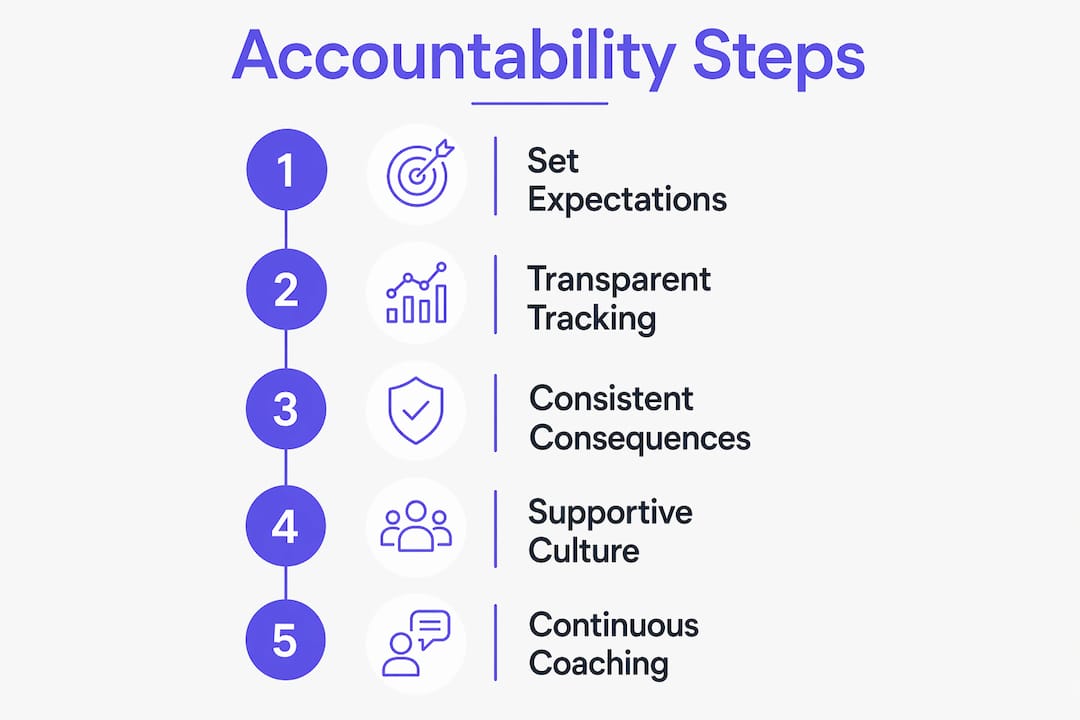
Transparent tracking systems that give reps access to their own data produce 15–25% productivity increases and 72% employee acceptance rates. That acceptance rate matters as much as the productivity gain. When reps trust the system, they use it. When they distrust it, they work around it. The difference between those two outcomes is almost always whether reps can see their own data or only managers can.
Modern tracking for sales revenue focuses on leading indicators first. Call volume, follow-up completion, and pipeline stage movement are all visible before a deal is won or lost. That visibility shifts coaching from reactive to proactive. Instead of reviewing why a rep missed quota last month, a manager can spot a drop in follow-up activity mid-month and address it before it affects results.
The most common pitfall is over-monitoring. Tracking 20 metrics creates noise. Reps stop paying attention to all of them. Pick five to seven metrics that directly connect to outcomes, make them visible to reps daily, and review them weekly. Data friction is the second pitfall. If logging a call takes five minutes, reps skip it. If it takes ten seconds, they do it consistently.
Pro Tip: Track leading indicators daily and lagging indicators weekly. Daily quota-attainment alerts create anxiety without giving reps anything they can act on.
What behaviors define true sales accountability beyond numbers?
Numbers tell you what happened. Behaviors tell you why. True sales rep performance accountability targets the behaviors that produce results, not just the results themselves.
Accountability linked to behaviors like pipeline discipline, preparation, qualification, and follow-up gives managers something to coach. Quota attainment is an outcome. You cannot coach an outcome directly. You can coach the behaviors that drive it. A rep who consistently skips follow-ups will miss quota. Coaching the follow-up behavior fixes the root cause. Coaching the quota number just creates pressure.
"Healthy accountability creates clarity, fairness, and progress. It is a supportive framework focused on coaching behaviors rather than assigning blame for outcomes."
Avoiding accountability as punishment is the single most important behavioral principle for managers. Vague criticism like "you need to do better" is not accountability. It is noise. Specific, behavioral feedback like "you completed 40% of your scheduled follow-ups last week, and the target is 90%" gives the rep something concrete to act on. The accountability conversation framework that works follows four steps: state the observation, explain the impact, ask for the rep's perspective, and agree on a path forward with a documented commitment.
Consistency across the team is non-negotiable. Applying standards selectively destroys trust faster than any other management mistake. If your top performer skips pipeline updates without consequence while a mid-level rep gets a coaching conversation for the same behavior, every rep on the team notices. Consistency across all team members, including top performers, is what maintains trust in the system.
Public shaming, inconsistent enforcement, and ambiguous feedback are the three behaviors that turn accountability into a morale problem. Each one signals to reps that the system is arbitrary, and arbitrary systems produce compliance at best and resentment at worst.
How to build a sales accountability system that drives consistent results
Building a system that lasts requires more than good intentions. It requires documented structure, predictable rhythms, and a clear process for closing accountability loops.
-
Document expectations before the quarter starts. Write down activity targets, pipeline requirements, and outcome goals for each role. Share them with every rep and get written acknowledgment. Undocumented expectations are unenforceable expectations.
-
Establish a weekly rhythm. Regular one-on-ones, team huddles, and monthly performance reviews normalize accountability and prevent surprise confrontations. A weekly one-on-one should cover the rep's documented commitments from the previous week, current pipeline status, and one behavioral focus for the coming week.
-
Close every accountability loop. One-on-one meetings must focus on documented rep commitments with follow-up. If a rep commits to completing 50 follow-up calls by Friday and the manager never checks, the commitment was meaningless. Closing the loop signals that commitments matter.
-
Apply graduated consequences consistently. A single missed week is a coaching conversation. A pattern of misses is a written performance plan. A sustained pattern after a performance plan is a formal review. Every step should be documented and applied equally across the team.
-
Balance accountability with support. Every accountability conversation should include a question: "What do you need from me to hit this target?" That question separates accountability from punishment. It signals that the manager's job is to remove obstacles, not just track failures.
-
Review the system quarterly. Metrics that made sense at the start of the year may not reflect current priorities. Drop metrics that no longer connect to outcomes. Add metrics that reflect new behaviors you want to reinforce.
Pro Tip: Use pipeline visibility tools to make pipeline discipline a shared daily habit, not a monthly review exercise.
Key Takeaways
Sales rep accountability works when it combines documented expectations, transparent metrics, consistent consequences, and coaching support applied equally across the entire team.
| Point | Details |
|---|---|
| Define expectations clearly | Document activity, pipeline, and outcome targets before each quarter begins. |
| Track leading indicators | Monitor follow-up completion and pipeline movement daily to enable proactive coaching. |
| Apply consequences consistently | Use graduated responses applied equally to all reps, including top performers. |
| Coach behaviors, not outcomes | Target pipeline discipline, follow-up, and preparation to fix root causes of missed results. |
| Close every accountability loop | Follow up on every documented commitment to signal that standards are real. |
Why most accountability systems quietly fail after 90 days
I have watched a lot of sales organizations launch accountability initiatives with real energy and real intention. By the end of the first quarter, most of them have quietly reverted to the same patterns they started with. The reason is almost never a bad framework. It is inconsistent execution.
The most common mistake I see is managers who hold reps accountable but exempt themselves. Leaders who model accountability build credibility and encourage their teams to follow. Leaders who demand accountability from reps while missing their own commitments destroy it. Reps notice everything. If you cancel one-on-ones, skip pipeline reviews, or give vague feedback, you have communicated that the system is optional.
The second mistake is treating accountability as a periodic event rather than a continuous practice. A quarterly performance review is not an accountability system. It is a report card. Real accountability happens in weekly conversations, in daily data visibility, and in the small moments when a manager follows up on a commitment a rep made three days ago. That follow-up is what makes the system real.
Technology helps when it reduces friction. Dialedsales is built around that principle. A rep who can log a call outcome in ten seconds will actually log it. A rep who has to navigate five screens will not. The data you never collect cannot drive accountability. Keep the system light enough that reps use it without thinking about it.
Accountability done right feels less like surveillance and more like clarity. Reps know where they stand, know what is expected, and know that their manager is invested in helping them succeed. That combination produces performance. Punishment produces compliance, and compliance is the floor, not the ceiling.
— Garrett
How Dialedsales supports sales rep accountability every day
Accountability frameworks only work when the data behind them is accurate and current. Dialedsales gives sales reps and field teams a lightweight way to keep that data clean without adding friction to the workday.
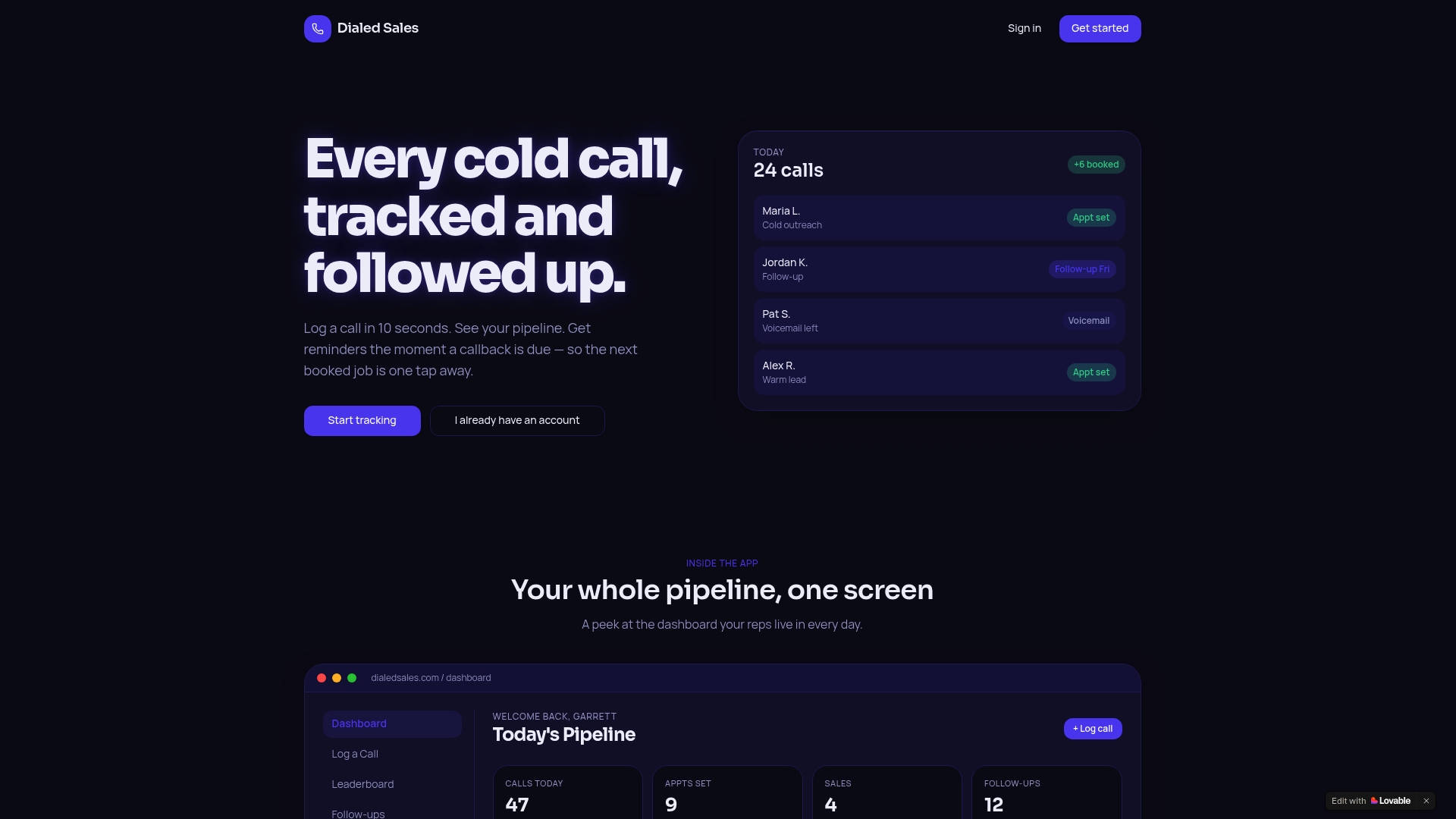
Log a call in ten seconds, set a follow-up date, and watch your pipeline update in real time. Every outcome is tracked automatically, so managers have the leading indicator data they need for coaching conversations and reps have the visibility they need to self-manage. The dashboard surfaces callbacks the moment they are due, which means follow-up discipline becomes a built-in habit rather than a manual effort. For teams building or rebuilding a sales accountability system, Dialedsales removes the data friction that causes most systems to fail.
FAQ
What is sales rep accountability?
Sales rep accountability is a structured framework where reps take ownership of their performance through clear expectations, transparent metrics, and consistent consequences. It focuses on behaviors and outcomes equally, with coaching as the primary tool for improvement.
How do you hold sales reps accountable without hurting morale?
Accountability focused on coaching behaviors rather than punishing outcomes preserves morale. Specific, behavioral feedback paired with consistent support gives reps clarity and a path forward instead of pressure without direction.
What metrics should you track for sales rep accountability?
Track leading indicators like call volume, follow-up completion rate, and pipeline stage advancement daily. Lagging indicators like quota attainment and close rate belong in weekly and monthly reviews where patterns are visible.
How often should accountability conversations happen?
Weekly one-on-ones combined with monthly performance reviews create the right rhythm. Weekly conversations catch problems early. Monthly reviews identify patterns and adjust expectations.
Why do sales accountability systems fail?
Most systems fail because consequences are applied inconsistently, accountability loops are never closed, or managers exempt themselves from the same standards they apply to reps. Consistency and leadership modeling are the two factors that determine whether a system holds.