
Sales pipeline visibility is defined as the real-time ability to see the current status, health, and trajectory of every deal in your pipeline. Without it, forecasts are guesses, coaching is reactive, and stalled deals go unnoticed until it's too late. This article covers sales pipeline visibility explained in full: what it means, how it differs from pipeline management and reporting, which metrics matter most, and how to build the kind of process transparency that produces forecasts you can actually trust. Whether you lead a field team or manage a full sales org, this is the foundation your pipeline decisions should rest on.
What is sales pipeline visibility explained?
Sales pipeline visibility is the capability to see every deal's real status at any given moment, not just what reps report in a weekly call. The industry term for this capability is pipeline transparency, and it has three non-negotiable properties: completeness, accuracy, and timeliness. All three must be present for visibility to be real. Miss one and you're working from a distorted picture.
Completeness means every interaction, call, email, and meeting is captured and attached to the right deal. Accuracy means the data reflects actual buyer behavior, not rep optimism. Timeliness means updates happen in near real time, not in a Friday afternoon data dump. These three properties separate genuine pipeline transparency from a spreadsheet that someone updates when they feel like it.

Pipeline visibility also differs from two concepts it's often confused with. Visibility, management, and reporting are three distinct functions: visibility shows you the current state, management is the act of advancing deals, and reporting looks backward at what already happened. You can only manage what you can see. Reports tell you where you've been. Visibility tells you where you are right now, which is the only place you can act from.
What are the key metrics for measuring pipeline health?
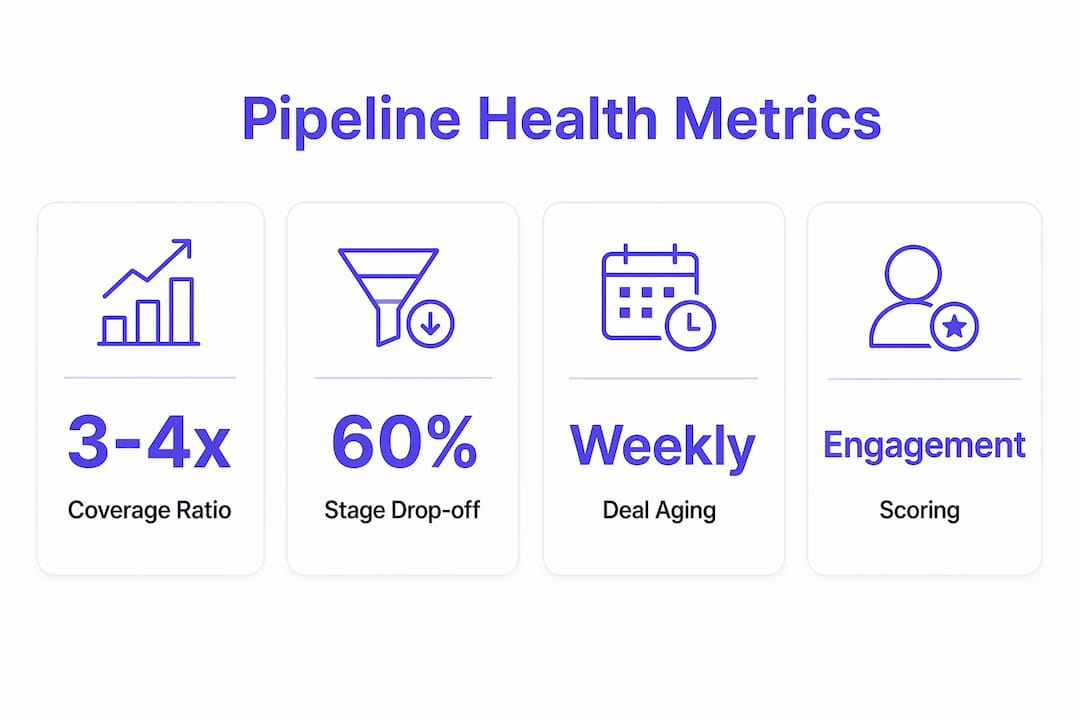
The most useful pipeline metrics are pipeline coverage ratio, stage conversion rates, deal aging, engagement scoring, and forecast accuracy. Each one answers a different question about deal health and pipeline quality.
Pipeline coverage ratio is the ratio of total pipeline value to quota. The ideal coverage ratio is 3–4x quota to account for natural deal attrition. A ratio below 3x signals your pipeline is too thin to hit the number. A ratio above 5x often means the pipeline is bloated with deals that should have been disqualified weeks ago.
| Metric | What it measures | Healthy benchmark |
|---|---|---|
| Pipeline coverage ratio | Total pipeline value vs. quota | 3–4x quota |
| Stage conversion rate | % of deals advancing per stage | Varies by industry |
| Deal aging | Days a deal has sat in a stage | Depends on average sales cycle |
| Engagement scoring | Buyer activity and response rate | Trending up toward close |
| Forecast accuracy | Predicted vs. actual closed revenue | Within 10% of target |
Stage conversion rates reveal where deals consistently die. If 60% of your deals stall at the proposal stage, that's a product fit or pricing signal, not a coincidence. Deal aging flags deals that have stopped moving without anyone noticing. Engagement scoring tracks whether buyers are still active participants or have gone quiet.
Pro Tip: Review deal aging weekly, not monthly. A deal that has sat in one stage for twice your average sales cycle length is almost certainly dead. Remove it before it inflates your coverage ratio.
How should you structure pipeline stages for better visibility?
Effective pipelines use 5–7 clearly defined stages with strict, binary exit criteria for each one. "Binary" means a deal either meets the criteria or it doesn't. There's no partial credit and no judgment calls.
A typical B2B pipeline might look like this: Prospecting, Qualified, Discovery Complete, Proposal Sent, Negotiation, and Closed Won or Closed Lost. Each stage transition requires a verifiable buyer action, not a rep's feeling about the deal. "The prospect seemed interested" is not an exit criterion. "The prospect confirmed budget and requested a proposal" is.
The risk of skipping strict exit criteria is real. When reps advance deals based on optimism rather than evidence, pipeline values inflate. Inflated pipelines produce overconfident forecasts. Overconfident forecasts lead to missed quarters and reactive management. The discipline of stage criteria is what keeps the whole system honest.
- Define exit criteria using observable buyer actions, not rep sentiment
- Embed mandatory fields in your CRM that must be completed before a stage advances
- Train the team on criteria during onboarding, not just at rollout
- Audit stage distribution monthly to catch patterns of premature advancement
- Purge stalled deals from active pipeline during every pipeline review
Pro Tip: Treat your pipeline review as a deal inspection, not a status update. Ask "what has the buyer done since last week?" If the answer is nothing, the deal doesn't move.
What technology practices improve pipeline data quality?
Automated activity capture is the single most effective technology practice for improving pipeline completeness. Capturing emails, calls, and meetings automatically reduces stale data and increases new-logo pipeline by 25%. Manual entry, by contrast, reflects what reps choose to log, which often reflects hope rather than reality.
The goal is to minimize the gap between what happens in the real world and what appears in your CRM. Every hour of lag between an activity and its logging is an hour where decisions get made on incomplete data. Automated capture closes that gap without adding work to the rep's day.
Tiered pipeline views are the second major technology practice worth implementing. Operational, diagnostic, and strategic views serve different audiences and different time horizons. Operational views answer "what should I do today?" in under 10 seconds. Diagnostic views support weekly deal reviews. Strategic views inform monthly planning and resource allocation.
Limiting your active dashboards to five or fewer views is a discipline that drives adoption. Dashboards with too much noise get ignored. Reps stop trusting them. Managers stop using them. The result is a CRM that's technically full of data but practically useless for daily decisions.
AI adds a useful layer on top of clean data. AI flags deals missing key stakeholders or showing declining engagement, and it automates routine logging tasks. That said, AI works best as a signal layer. Humans still own deal advancement and coaching decisions.
Pro Tip: Start with one operational dashboard that answers "what do I need to do today?" before building anything else. Complexity kills adoption.
How does pipeline visibility improve forecasting and sales management?
True pipeline visibility is the foundation for trusted forecasts and confident coaching. When data is complete, accurate, and current, forecast calls become data reviews rather than negotiation sessions between managers and reps.
Dirty pipeline data produces unreliable forecasts, and unreliable forecasts undermine every downstream decision: hiring, resource planning, marketing spend, and inventory. The cost of poor visibility compounds over time because every bad forecast makes the next one harder to trust.
Visibility also changes how managers coach. Without it, coaching is reactive: a manager hears about a problem after a deal is lost. With it, coaching is proactive: a manager sees a deal aging in the proposal stage and intervenes before the prospect goes cold. That shift from reactive to proactive is where visibility pays its biggest dividend.
True pipeline visibility doesn't just improve your forecast number. It changes the quality of every conversation you have about deals, resources, and team performance. When the data is trustworthy, decisions get faster and better. When it isn't, every meeting becomes a debate about whose version of reality is correct.
Pipeline visibility also connects directly to resource and delivery planning. Teams that can see which deals are likely to close in the next 30 days can staff projects, allocate inventory, and schedule onboarding in advance. Teams that can't see their pipeline clearly often win deals they aren't ready to deliver on, which erodes margin and damages client relationships.
Understanding the role of data in sales decisions is what separates teams that forecast with confidence from teams that guess and hope. Visibility is the input. Forecasting accuracy is the output.
Key Takeaways
Sales pipeline visibility requires completeness, accuracy, and timeliness working together. Without all three, your pipeline data misleads more than it guides.
| Point | Details |
|---|---|
| Define visibility correctly | Visibility shows current deal state; management advances deals; reporting looks backward. |
| Use the 3–4x coverage benchmark | Pipeline below 3x quota is too thin; above 5x signals bloat and poor qualification. |
| Enforce binary exit criteria | Deals advance only when verifiable buyer actions occur, not rep optimism. |
| Automate activity capture | Automated logging reduces stale data and closes the gap between reality and CRM records. |
| Limit dashboards to five views | Fewer, focused views drive adoption and keep teams acting on current data. |
What I've learned about pipeline visibility after years in the field
Most sales teams treat pipeline visibility as a reporting problem. They build more dashboards, add more fields, and run more reviews. The data gets bigger and the trust in it gets smaller. That's the wrong direction entirely.
The real problem is almost always data quality at the source. Reps log what makes them look good, not what's actually happening. Managers accept optimistic stage placements because challenging them creates friction. The result is a pipeline that looks healthy on paper and falls apart at the end of the quarter.
The fix isn't more technology. It's discipline around exit criteria and a culture where accurate data is valued over comfortable data. I've seen teams with basic tools outperform teams with expensive platforms because the basic-tool teams actually trusted their data. They made faster decisions, coached earlier, and removed dead deals without sentiment.
AI is genuinely useful for flagging risk and automating logging, but it can't fix a culture that rewards optimism over accuracy. Leaders have to model the behavior: inspect deals hard, remove the ones that don't qualify, and reward reps who keep their pipeline clean over reps who keep it large.
The sales conversion funnel only works when the data feeding it is honest. Pipeline visibility isn't a feature you turn on. It's a discipline you build.
— Garrett
How Dialedsales supports real-time pipeline tracking
Field sales reps and cold call teams lose pipeline visibility the moment a call ends and nothing gets logged. Dialedsales solves that with a cold call tracking app built for speed: log a call in 10 seconds, set a follow-up date, and watch your dashboard surface callbacks the moment they're due.
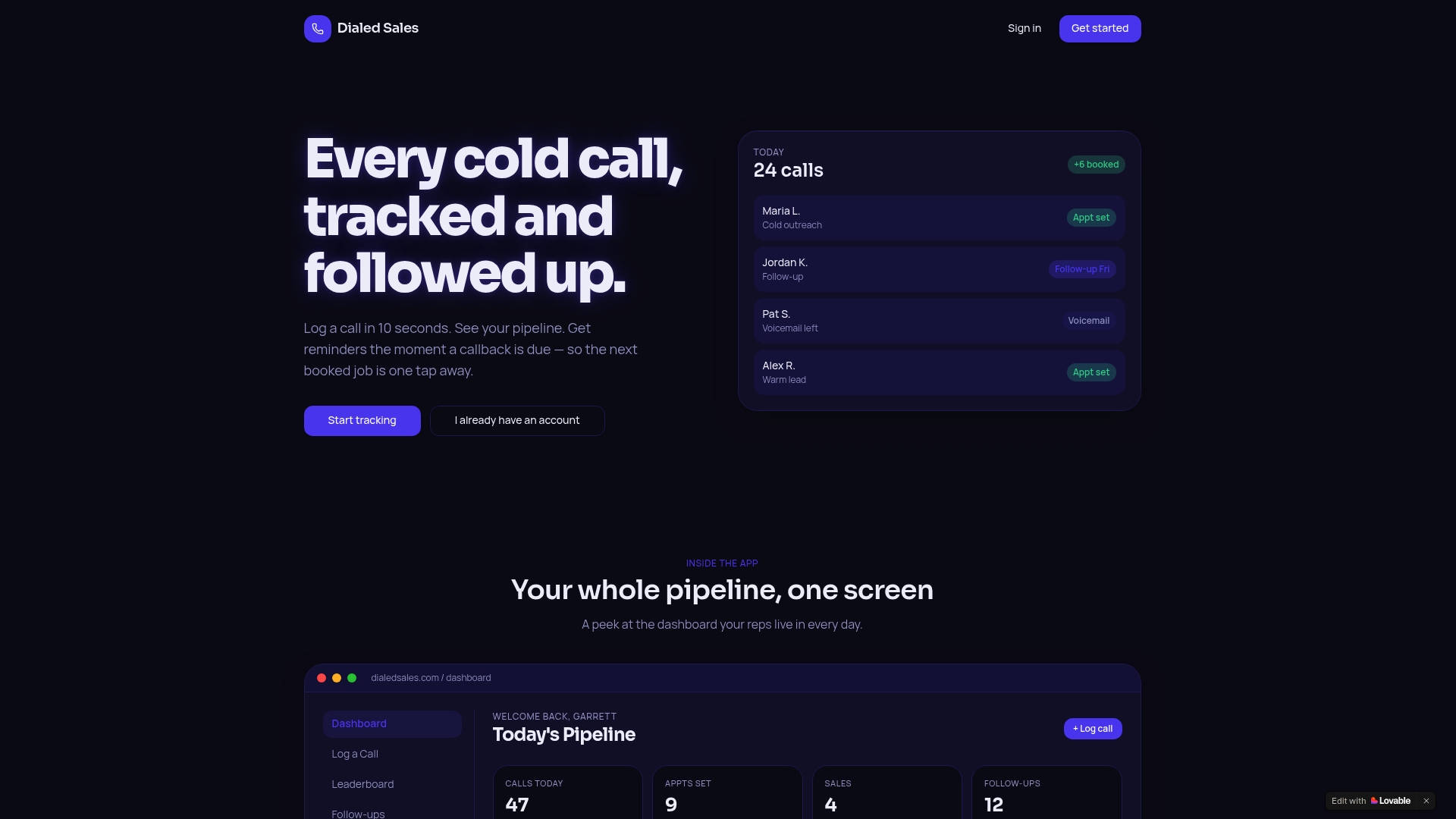
Every call outcome feeds directly into your pipeline view, so your data stays current without manual cleanup. Dialedsales works across industries, from field sales to inside teams, and gives managers the real-time activity data they need to coach proactively. If your pipeline visibility breaks down at the call level, that's exactly where Dialedsales picks it up.
FAQ
What is sales pipeline visibility?
Sales pipeline visibility is the real-time ability to see the current status, health, and trajectory of every deal in your pipeline. It requires completeness, accuracy, and timeliness to be genuinely useful.
How is pipeline visibility different from pipeline management?
Visibility shows you the current state of your pipeline; management is the act of advancing deals through stages. You can only manage what you can see, which makes visibility the prerequisite for effective management.
What is a healthy pipeline coverage ratio?
A pipeline coverage ratio of 3–4x quota is the standard benchmark. Coverage below 3x signals insufficient pipeline volume; coverage above 5x often indicates deals that should have been disqualified.
Why does pipeline data quality affect forecast accuracy?
Dirty pipeline data, including inaccurate stages, stale close dates, and inflated values, produces unreliable forecasts. Unreliable forecasts undermine hiring, resource planning, and every other downstream business decision.
How many stages should a sales pipeline have?
Most effective pipelines use 5–7 stages with clear, binary exit criteria for each transition. Fewer stages oversimplify complex deals; more stages create confusion and inconsistent data entry across the team.