
Sales close rate, formally called the win rate or conversion rate, is the percentage of qualified opportunities a rep converts into paying customers. The average B2B close rate sits at roughly 30%, while top performers consistently land above that threshold and average reps hover between 12–18%. That gap is not a talent gap. It is a systems gap. The sales close rate improvement tips in this article are built around that reality: structured discovery, proactive objection handling, and disciplined activity tracking move the needle far more than charisma or pressure tactics ever will.
1. Sales close rate improvement tips start with better discovery
The single highest-impact change most reps can make is spending more time in discovery. Reps who dedicate 40–60% of call time to structured discovery close 34% more deals than reps who rush to pitch. That number is striking because most reps do the opposite. They spend the first ten minutes talking about their product and leave the prospect with nothing to respond to except price objections.
Effective discovery follows a clear structure:
- Open with a situation question to confirm context ("Walk me through how your team currently handles X.")
- Follow with a problem question to surface pain ("Where does that process break down for you?")
- Use an implication question to deepen urgency ("What does that cost you per quarter?")
- Close discovery with a need-payoff question to let the prospect articulate the value of solving it.
This sequence, drawn from the SPIN Selling framework developed by Neil Rackham, keeps the prospect talking and builds the case for your solution in their own words.
Pro Tip: Record your calls and measure your actual talk-to-listen ratio. Most reps who think they listen 60% of the time are actually talking 65% of the time. The data does not lie.

2. Address objections before the prospect raises them
68% of lost deals involve at least one objection the rep never addressed. That statistic points to a fixable problem. Proactively surfacing and handling objections before they become deal-breakers increases closure likelihood by up to 18%.
The value-bridge technique is the most reliable method for price objections. When a prospect signals concern about cost, do not defend the price. Instead, bridge back to the business impact they described in discovery. "You mentioned this problem costs your team roughly $40,000 a quarter. Our solution runs $8,000 annually. Does that math work for you?" That reframe turns a price objection into a return-on-investment conversation.
Unspoken objections are harder to catch. Use these tactics to draw them out:
- Ask directly: "What concerns do you have that we haven't talked about yet?"
- Use silence after presenting a solution. Prospects fill silence with their real hesitations.
- At the end of a call, ask: "On a scale of one to ten, how likely are you to move forward? What would make it a ten?"
Pro Tip: Build an objection map for your top five most common objections. Write out the objection, the bridge response, and the follow-up question. Run it before every call until the responses are automatic.
3. Track leading indicators, not just outcomes
Most reps track wins and losses. That is outcome tracking, and it is reactive by definition. Tracking leading indicators like calls made, emails sent, discovery meetings completed, and proposals delivered gives you data you can act on before a deal is lost.
The distinction matters because leading indicators are controllable. You cannot change last quarter's win rate, but you can change how many discovery calls you run this week. When you track activities consistently, patterns emerge. You might find that deals with two or more discovery touchpoints close at twice the rate of single-call pitches. That insight changes how you structure your pipeline.
| Indicator type | Examples | When it helps |
|---|---|---|
| Leading (activity) | Calls made, emails sent, meetings booked | Enables real-time coaching and course correction |
| Lagging (outcome) | Win rate, revenue closed, deal size | Measures results after the fact |
Automated activity capture from your dialer, email, and calendar removes the manual logging burden and makes your data reliable. Reps who log manually tend to under-report, which distorts coaching conversations and hides the real bottlenecks.
Dialedsales is built around this principle. You log a call in ten seconds, attach an outcome and notes, and set a follow-up date. The dashboard surfaces due callbacks automatically, so no deal goes cold because a rep forgot to follow up. That kind of call outcome tracking turns raw activity into a visible pipeline.
4. Use a 3-part closing sequence instead of a single ask
One-time ask closes fail because they put all the pressure on a single moment. Top-performing reps use a 3-part closing sequence, combining assumptive, trial, and direct closes, that achieves 42% higher success rates than single-ask approaches.
Here is how the sequence works in practice:
- Assumptive close: Speak as if the decision is already made. "When we get you onboarded, we'll start with your highest-volume territory." This tests commitment without forcing a yes or no.
- Trial close: Check alignment before asking for the final decision. "Based on what we've covered, does this solve the problem you described?" A yes here means the direct close will land.
- Direct close: Ask clearly and stop talking. "Are you ready to move forward?" Silence after this question is not awkward. It is the prospect making a decision.
Timing matters as much as sequence. Responding to buyer signals like questions about implementation, billing, or timeline within the same conversation raises close rates by 31%. Those questions are buying signals. Treat them as the green light to move into your closing sequence.
Effective closing techniques also require you to adapt to the buyer's decision style. A data-driven buyer needs ROI numbers before the direct close. A relationship-driven buyer needs to feel heard before they commit. One-size-fits-all closing methods fail because buyers are not identical.
5. Design your pipeline around decision readiness
Most pipelines are built around rep activity, not buyer decisions. A deal moves to "proposal sent" because the rep sent a proposal, not because the buyer is actually ready to evaluate one. Pipeline stages should reflect decision milestones like budget confirmed, authority identified, and timeline committed, not task completion.
The practical fix is an advance-or-exit rule at each stage. If a deal cannot meet the criteria to advance, it either gets the attention it needs or exits the pipeline. This prevents the most common close rate killer: a pipeline full of stalled deals that consume follow-up time without ever converting.
Here is a simple advance-or-exit framework:
- Discovery stage: Advance only if the prospect has confirmed a specific problem and a timeline for solving it.
- Evaluation stage: Advance only if budget authority is identified and a decision date is set.
- Proposal stage: Advance only if the prospect has reviewed the proposal and raised at least one specific question.
- Close stage: Advance only if the prospect has verbally committed to moving forward pending final approval.
Pro Tip: Review your pipeline weekly and apply the advance-or-exit rule to every deal. Deals that have sat in the same stage for two or more weeks without meeting criteria should be flagged for immediate action or removed.
A clean sales conversion funnel with enforced criteria does more for your close rate than any individual closing technique. It forces honest assessment of where deals actually stand.
6. Build a follow-up system that runs on schedule, not memory
Most deals are lost not because the prospect said no, but because the rep stopped following up. A structured cold call follow-up system removes the reliance on memory and keeps deals moving.
The follow-up sequence should be tied to the prospect's stated timeline, not the rep's calendar. If a prospect says they will have a decision in two weeks, the follow-up schedule should include a check-in at day seven, a value-add touchpoint at day ten, and a direct ask at day fourteen. Each touchpoint should add something: a relevant case study, a specific answer to a question they raised, or a summary of the ROI calculation from discovery.
Multi-touch follow-up across channels also matters. A phone call followed by an email that references the call creates a coherent thread. It signals persistence without being pushy. Reps who follow up across two or more channels consistently outperform those who rely on a single channel.
Key Takeaways
The most effective way to improve your sales close rate is to fix the system around the sale, not just the close itself.
| Point | Details |
|---|---|
| Discovery drives close rate | Spending 40–60% of call time in discovery produces 34% higher close rates. |
| Proactive objection handling | Addressing objections before they surface increases closure likelihood by up to 18%. |
| Track activities, not just wins | Leading indicators like calls and meetings enable coaching before deals are lost. |
| Use a 3-part closing sequence | Assumptive, trial, and direct closes combined outperform single-ask closes by 42%. |
| Pipeline criteria prevent stalling | Advance-or-exit rules at each stage keep your pipeline honest and your close rate climbing. |
What I've learned after years of watching reps close
The reps I've seen improve the fastest share one trait: they treat their close rate as a diagnostic, not a verdict. When their numbers dip, they ask where in the process the deal fell apart, not whether they are cut out for sales. That mindset shift changes everything.
The biggest mistake I see managers make is labeling a low close rate as a skill problem when it is almost always a system problem. The rep is pitching too early because the pipeline stage doesn't require discovery to be complete. The rep is losing on price because nobody built an objection map. The rep is forgetting to follow up because there is no automated reminder. Fix the system and the numbers follow.
Technology matters here, but not in the way most people think. The best tools are not the ones with the most features. They are the ones reps actually use. A lightweight tracker that logs a call in ten seconds and surfaces follow-ups automatically will outperform a complex platform that reps avoid because it takes five minutes to update. Simplicity drives adoption, and adoption drives data quality, and data quality drives coaching that actually works.
The reps who will close the most deals in 2026 are not the ones with the sharpest pitch. They are the ones with the clearest picture of their own pipeline.
— Garrett
How Dialedsales helps you put these tips into practice
Tracking your activities and outcomes is the foundation of every tip in this article. Dialedsales makes that tracking fast enough that reps actually do it.
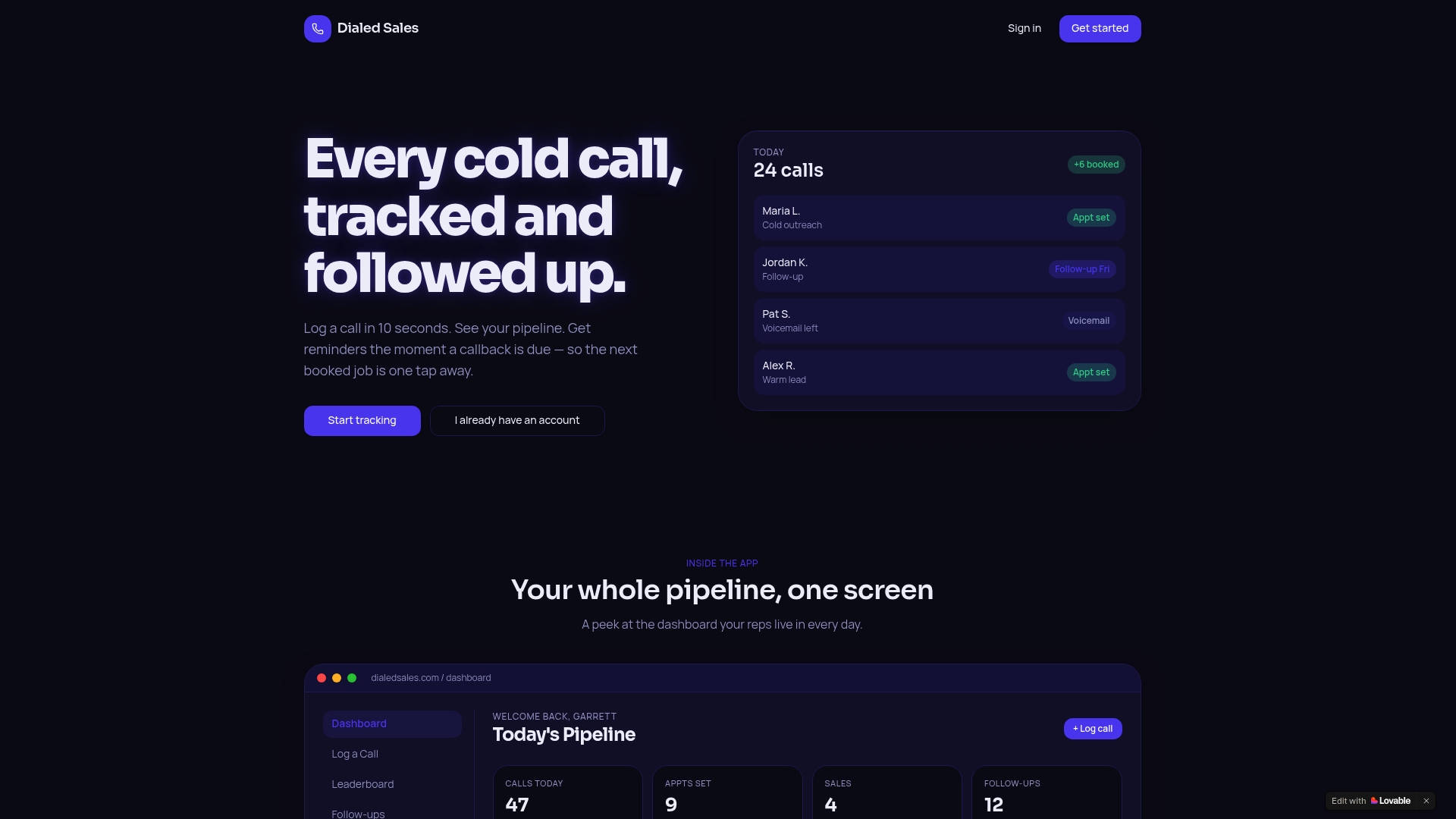
Log a call in ten seconds, attach the outcome, and set a follow-up date. The dashboard surfaces every due callback automatically, so nothing slips through. Over time, your logged outcomes build a clear picture of where your close rate is strong and where it is leaking. That data is what turns a coaching conversation from guesswork into a specific fix. If you want a cold call tracker built for field reps and sales teams in any industry, Dialedsales is worth a look.
FAQ
What is a good sales close rate?
The average B2B close rate is approximately 30%. Top-performing reps consistently close above 30–40%, while average performers land between 12–18%.
Why does discovery call time affect close rate?
Reps who spend 40–60% of call time in structured discovery close 34% more deals. Discovery builds the business case in the prospect's own words, which makes the close far easier.
What are leading indicators in sales tracking?
Leading indicators are activities like calls made, emails sent, and meetings booked. They are controllable in real time and enable proactive coaching before deals are lost.
How does the 3-part closing sequence work?
The sequence combines an assumptive close, a trial close, and a direct close in order. This approach achieves 42% higher success rates compared to a single-ask close.
Why do most deals stall in the pipeline?
Deals stall when pipeline stages are defined by activity completion rather than buyer decision milestones. Enforcing advance-or-exit criteria at each stage keeps deals moving toward a real decision.