
A well-run cold-call pipeline moves through six stages: Identified, First Touch, Engaged, Meeting Booked, Qualified (SQL), and Active Opportunity. Before you log a single dial, define binary entry and exit rules for every stage so handoffs are consistent and measurable, not a judgment call.
Why binary rules matter:
- A lead either meets the entry criteria or it doesn't. No gray zone means no sandbagging.
- Exit criteria create a clear trigger for the next action, so nothing stalls in limbo.
- Repeatable rules let you spot exactly where leads drop off and fix that stage specifically.
Table of Contents
- What are the core cold-call pipeline stages?
- What entry and exit criteria should each stage have?
- How should you structure each individual cold call?
- What mistakes quietly kill cold-call programs?
- How do you operationalize the pipeline day to day?
- Copyable stage templates and call cadence
- Key Takeaways
- Why rigid pipelines fail field teams
- Dialedsales puts your pipeline rules to work
- Sources and further reading
What are the core cold-call pipeline stages?
Six stages cover the full outbound motion for most sales teams. High-performing pipelines typically use 5–7 stages with clear, binary criteria, and this six-stage structure hits the sweet spot between granularity and simplicity.
| Stage | One-line definition |
|---|---|
| 1. Identified | A prospect matches your ICP and has been added to the call list. |
| 2. First Touch | At least one outreach attempt has been made (call, email, or LinkedIn). |
| 3. Engaged | The prospect responded or picked up and had a real conversation. |
| 4. Meeting Booked | A specific date and time for a discovery call is confirmed. |
| 5. Qualified (SQL) | Budget, authority, need, and timeline are confirmed. |
| 6. Active Opportunity | A formal proposal or next commercial step is in motion. |
Each stage name maps to a concrete outcome, not a feeling. "Engaged" doesn't mean you left a voicemail they might have heard. It means they talked back.

What entry and exit criteria should each stage have?
Binary rules turn stage names into operational checkpoints. The table below gives you the exact criteria, the KPI to track, and a realistic time-in-stage expectation for each step in the sales pipeline.
| Stage | Entry criteria | Exit criteria | Primary KPI | Typical time in stage |
|---|---|---|---|---|
| Identified | Added to verified list; ICP score confirmed | First outreach attempt logged | List quality / contacts added per week | 1–2 days |
| First Touch | Attempt logged with date and channel | Prospect responds OR max attempts reached | Dial-to-connect rate | 3–7 days |
| Engaged | Live conversation of 60+ seconds occurred | Meeting scheduled OR disqualified | Connect-to-meeting rate | 1–3 days |
| Meeting Booked | Calendar invite sent and accepted | Meeting held OR rescheduled/no-show logged | Meeting show rate | 2–7 days |
| Qualified (SQL) | BANT criteria confirmed in discovery | Proposal sent OR disqualified | Meeting-to-SQL rate | 3–7 days |
| Active Opportunity | Proposal or commercial step initiated | Deal closed-won, closed-lost, or recycled | SQL-to-close rate | 7–30 days |
Pro Tip: Set a maximum time-in-stage rule. If a lead sits in "First Touch" for more than seven days without a response, auto-move it to a recycled list rather than letting it clog your active pipeline.
Verified direct-dial numbers and fresh lists are the invisible ceiling on your connect rate. Stale data makes every stage downstream harder.
How should you structure each individual cold call?
Every dial should follow the same four-step flow. Predictable structure keeps calls short and outcome-focused, which is exactly what works. Successful cold calls average about 93 seconds — the goal is curiosity and a committed next step, not a full pitch.
-
Pattern-interrupt opener. Skip "Is this a good time?" and open with something that earns a second of attention. "Hey [Name], this is [Rep] — I'll be quick." Or reference something specific: "I saw you just opened a second location in Austin."
-
Reason for the call, anchored to a trigger. Trigger-event-based outreach converts better than generic value props. Tie your reason to something observable: a hire, a funding round, a market move. "The reason I'm calling is that we work with HVAC teams who just expanded their field crew and need a faster way to track callbacks."
-
Open-ended discovery questions. Don't give them a yes/no exit. Ask how they're currently handling the problem, not whether they have it. "How are your reps currently logging follow-ups after a door knock?" Even a short answer opens the conversation.
-
Handle objections with curiosity. When a prospect pushes back, get curious rather than defensive. "Not interested" often means "I don't see the relevance yet." Ask: "Totally fair — what would have to be true for this to be worth a 15-minute call?"
-
Specific, time-bound next step. Close with a concrete ask, not a vague promise. "I have Tuesday at 10 AM or Wednesday at 2 PM — which works better?" Vague follow-ups die in inboxes.
Pro Tip: Dial mid-morning (10–11 AM) or late afternoon (4–5 PM) in the prospect's local time zone. Tuesday through Thursday are the most productive windows; avoid Monday mornings and Friday afternoons.
What mistakes quietly kill cold-call programs?
Most pipeline problems trace back to five fixable errors.
Treating the script as a script. Scripts are a compass, not a tether — internalize the flow so you can sound human when the conversation goes sideways. Reps who read word-for-word lose rapport fast.
Generic reasons for calling. "I wanted to introduce myself" is not a reason. Tie every call to something specific and recent. A rep who says "I noticed you're hiring three field techs" will always outperform one who says "we help companies like yours."
Stale or unverified data. Bad phone numbers waste more time than any other single variable. Audit your list before a campaign, not after your connect rate tanks.
Wrong cadence. 93% of connects happen by the third attempt and over 98% by the fifth. Three to five attempts, spaced across several days, is the efficient range. Fewer than three and you're leaving conversations on the table; more than five and you're burning time on dead leads.
Ambiguous next steps. "I'll follow up next week" is not a next step. Every call should end with a specific date, time, and channel confirmed by both parties.
Pro Tip: When a prospect objects, treat it as a discovery signal. "We already have something" tells you they're aware of the category — ask what they're using and what they'd change about it. Objections often contain the exact pain point you need.
How do you operationalize the pipeline day to day?
Tracking discipline is what separates a repeatable program from random dialing. The daily workflow is straightforward:
- Log every call within 60 seconds: prospect name, outcome (connected/voicemail/no answer), and one-line note.
- Set a binary outcome at the end of each call: advance the stage, schedule a follow-up, or disqualify. No "maybe" bucket.
- Schedule the follow-up reminder before you hang up or close the tab. Automated follow-up workflows catch the callbacks that manual systems miss.
- Measure four metrics per rep: dial-to-connect rate, connect-to-meeting rate, dials per meeting, and average time in stage.
Multichannel sequences outperform single-channel outreach. A LinkedIn view before the first dial and an email after a voicemail make the follow-up call feel less cold. Coordinate touches so the prospect recognizes your name before you ask for their time.
Dialedsales logs a call in under 10 seconds, auto-surfaces follow-up reminders on your dashboard when they're due, and gives managers a live view of where every lead sits in the pipeline. That's the enforcement layer most teams are missing.
Copyable stage templates and call cadence
Use this table as a starting point for your CRM or Dialedsales setup.
| Stage | Entry checklist | Exit checklist | Time in stage | Sample next-step phrase |
|---|---|---|---|---|
| Identified | ICP confirmed; direct dial verified | First attempt logged | 1–2 days | "Adding to outreach sequence today." |
| First Touch | Attempt logged with channel and date | Response received OR 5 attempts exhausted | 3–7 days | "Sending follow-up email now." |
| Engaged | 60+ second live conversation | Meeting booked OR disqualified | 1–3 days | "I'll send a calendar invite for Tuesday at 10." |
| Meeting Booked | Invite accepted | Meeting held; notes logged | 2–7 days | "I'll send a recap and next steps within the hour." |
| Qualified (SQL) | BANT confirmed | Proposal sent OR disqualified | 3–7 days | "Expect the proposal by end of day Thursday." |
| Active Opportunity | Proposal sent | Closed-won, closed-lost, or recycled | 7–30 days | "Let's reconnect Friday to address any questions." |
Recommended cadence: Attempt 1 on day 1 (call + voicemail), attempt 2 on day 3 (email), attempt 3 on day 5 (call), attempt 4 on day 8 (LinkedIn + email), attempt 5 on day 12 (final call). After five attempts with no response, move to recycled.
Sample voicemail (First Touch): "Hey [Name], this is [Rep] from [Company]. I'm calling because [trigger event]. I'll send a quick email — if it's relevant, a 15-minute call would be worth your time. Talk soon."
Sample follow-up email (post-voicemail): "Hi [Name], left you a voicemail a moment ago. [One-sentence trigger context]. Worth a 15-minute call this week? Here's my calendar: [link]."
For deeper qualification techniques at the First Touch and Engaged stages, the high-volume prospecting playbook covers ICP scoring and list-building in detail.
Key Takeaways
A cold-call pipeline only produces consistent results when every stage has a binary rule, a measurable KPI, and an enforced follow-up workflow.
| Point | Details |
|---|---|
| Six-stage sequence | Use Identified, First Touch, Engaged, Meeting Booked, Qualified, and Active Opportunity as your canonical stages. |
| Binary entry/exit rules | Every stage transition must be a yes/no decision, not a judgment call, to keep handoffs consistent. |
| 3–5 attempt cadence | 93% of connects happen by attempt three; cap at five attempts before recycling the lead. |
| Four metrics to track | Measure dial-to-connect, connect-to-meeting, dials per meeting, and average time in stage per rep. |
| Dialedsales for enforcement | Log calls in 10 seconds, get automatic follow-up reminders, and view your live pipeline dashboard to enforce stage rules. |
Why rigid pipelines fail field teams
The conventional wisdom is that more pipeline stages mean more control. In practice, the opposite is often true. Teams that build eight or nine stages usually end up with reps who skip stages entirely because the system feels like paperwork, not a tool.
The six-stage structure in this playbook was designed around one constraint: a rep in the field should be able to log a call and advance a stage in under 30 seconds. If the system takes longer than that, reps stop using it, and you lose the data that makes the whole thing work.
The other thing most pipeline guides miss is the difference between a stage and an activity. Sending a follow-up email is an activity. "Engaged" is a stage, and it only opens when a real conversation happened. Conflating the two is how pipelines fill up with leads that look active but are actually dead weight.
Binary rules fix both problems. They make the system fast to use and honest to read.
Dialedsales puts your pipeline rules to work
Knowing the six stages is one thing. Enforcing them across a team of reps making 50 dials a day is another problem entirely.
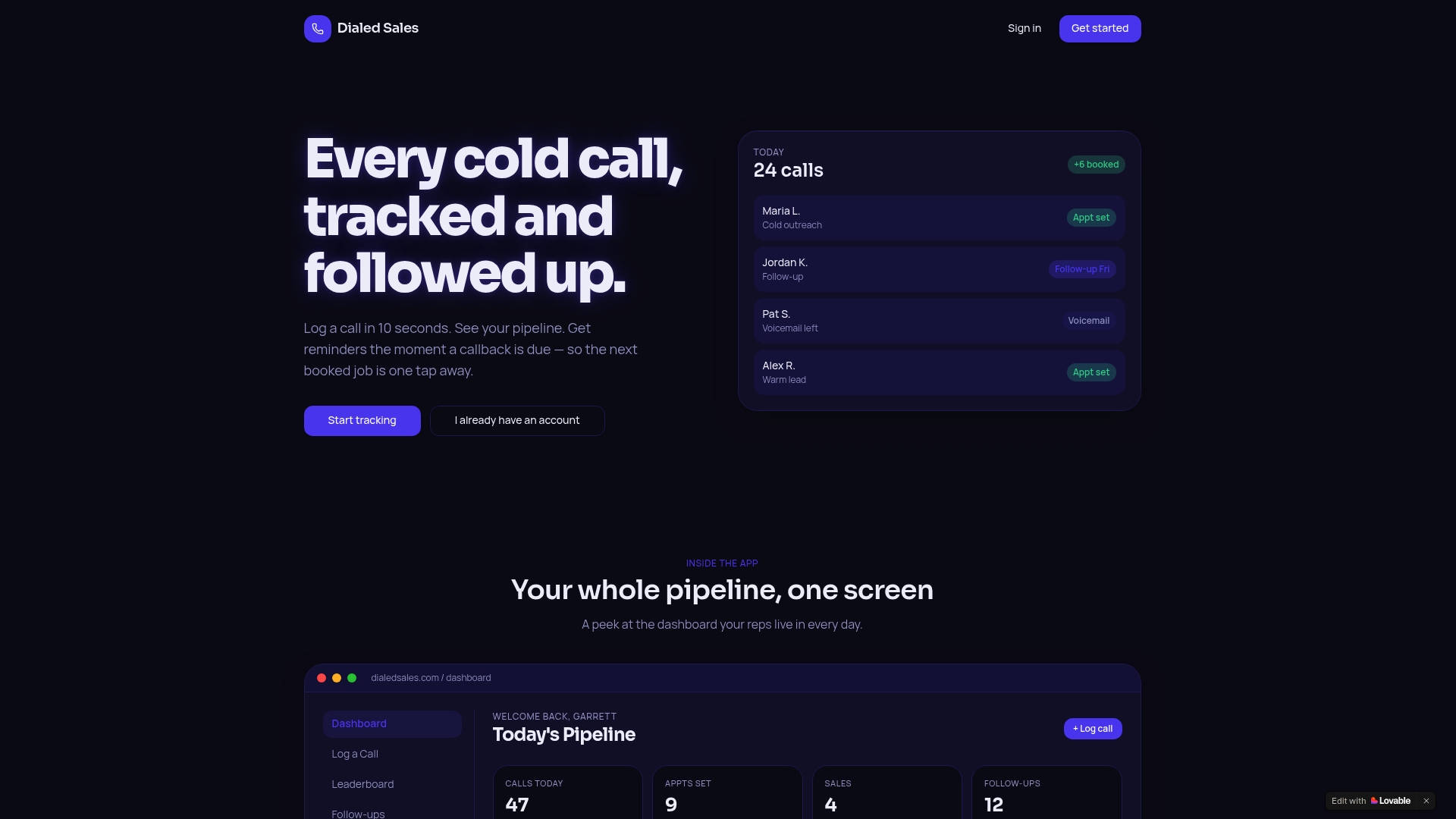
Dialedsales was built for exactly that gap. Log a call in 10 seconds with the outcome and notes, set a follow-up date, and the app surfaces that reminder automatically when it's due. The live pipeline dashboard shows every rep's stage distribution in real time, so managers can see where leads are stalling before it becomes a quota problem. The built-in AI assistant helps reps draft follow-up messages and summarize activity without switching tools.
The automated follow-up feature enforces the binary rules you set: no lead sits in "First Touch" past its time-in-stage limit without triggering a reminder. That's the enforcement layer that turns a playbook into a repeatable program.
Start a free trial at Dialedsales and have your pipeline stages live before your next dial session.
Sources and further reading
- Cold Calling in 2026, An Operator-Grade Playbook Guide — The Outbound Game: cadence data (93% connects by attempt 3, 98% by attempt 5), average call length (93 seconds), trigger-event outreach, and multichannel sequencing.
- Cold Calling Process: A Data-Backed Guide — Prospeo: individual call flow structure and data quality / direct-dial impact on connect rates.
- CRM Pipeline Stages Guide — Prospecting Manual: 5–7 stage standard for high-performing pipelines and binary entry/exit criteria.
- Cold Calling: What It Is & How to Do It Right — HubSpot: script-as-compass principle and flexible scripting guidance.
- What Is Cold Calling? Tips, Techniques & Tools — Zoom: best dial windows (10–11 AM, 4–5 PM; Tuesday–Thursday) and objection-handling as discovery.
- Cold Calling in Sales: Techniques That Work — Highspot: opener structure, permission-earning, and next-step language.
- Dialed Sales — Cold Call Tracker for Any Industry — Dialedsales: product features referenced throughout (call logging, reminders, pipeline dashboard).