
The fastest way to build long-term prospect relationships is a repeatable, trust-first playbook you can execute every week. Relationship selling prioritizes customer lifetime value over one-off wins, and the research is clear: trust forms through predictable behaviors, consistent follow-through, and genuine alignment with your prospect's goals. Here is the four-step playbook you can start this week:
- Research: Spend 10 minutes on each prospect before any outreach. Know their role, their company's recent moves, and one specific challenge.
- Connect: Open with a personalized, insight-led message tied to something real in their world. Skip the generic pitch.
- Deliver: Add value before you ask for anything. A relevant article, a warm intro, a quick benchmark. Something they did not ask for but will use.
- Track and follow through: Log every interaction, set a concrete next-step date, and keep every promise you make. Predictability plus competence plus alignment is what converts a prospect into a long-term partner.
Table of Contents
- What makes relationship selling actually work?
- How do you make a strong first impression with a new prospect?
- A predictable follow-up system: cadences, logging, and response SLAs
- How to deliver value before the sale
- Building emotional connection through listening and empathy
- What should you automate and what should you personalize?
- What KPIs actually measure relationship health?
- Practical playbook: cadences, templates, and scripts you can use today
- Common mistakes that break long-term relationships (and fast fixes)
- What does the research actually say about trust-building behaviors?
- How do you segment prospects to tailor your approach?
- How do you re-engage a cold or dormant prospect?
- Key Takeaways
- The part of relationship selling nobody talks about
- Why Dialedsales is worth a look if you are serious about follow-through
- Useful sources and further reading
What makes relationship selling actually work?
Relationship selling is not a style. It is a methodology built on the premise that a prospect who trusts you will buy from you repeatedly, refer others, and forgive the occasional mistake. The one-off transactional approach optimizes for this quarter; relationship selling optimizes for the next three years.

Three principles underpin every tactic in this guide.

Predictability means your prospect can count on you to do what you said, when you said it. Harvard Business School Online identifies predictability and consistent follow-through as the core drivers of trust, and frames trust as a capability you build through observable behaviors, not a personality trait you either have or lack. In practice, this means calendar-based promises ("I'll send that by Thursday at noon") rather than vague commitments ("I'll get that over to you soon").
Competence means your prospect believes you understand their world well enough to help them. You earn this by asking sharp questions, referencing specifics from their industry, and admitting what you do not know rather than bluffing. A single overconfident claim that turns out to be wrong costs more trust than a dozen correct ones build.
Alignment means your prospect feels you are working toward their outcome, not just your quota. This shows up in the questions you ask: interest-based questions that surface their actual priorities rather than leading questions designed to qualify them for your product.
Pro Tip: Make predictability visible. When you commit to a follow-up, name the exact day and time out loud or in writing. The "Sundown Rule" is a useful anchor: respond to every prospect request by end of day, even if only to confirm you received it and will follow up tomorrow. Prospects notice the pattern within two or three interactions.
How do you make a strong first impression with a new prospect?
The first contact sets the ceiling for the relationship. A generic opener signals that every future interaction will be equally generic. A personalized, well-researched opener signals that you pay attention, and attention is the first form of respect.
Quick pre-contact research checklist
- Company news: Check their website, LinkedIn, and Google News for recent announcements, funding rounds, leadership changes, or product launches in the past 90 days.
- Role and tenure: How long have they been in this role? A new VP of Sales has different priorities than one who has been there four years.
- Shared connections: Do you have a mutual contact on LinkedIn? A warm intro from someone they trust is worth ten cold messages.
- Recent content: Did they post, comment, or publish anything recently? Referencing their own words is the highest-signal personalization move available.
- Trigger events: Contract renewals, team expansions, or new budget cycles are natural entry points. Timing matters as much as message.
Three personalization moves that lift reply rates
PON's negotiation research shows that rapport-building before the pitch and transparency about your intent are two of the five most reliable trust-building behaviors. Translate that into first-contact outreach:
- Relevance: Tie your opener to something specific in their world, not your product's features.
- Mutual connection: Name the shared contact or shared context explicitly. "Sarah Chen mentioned you're expanding your field team" is a door-opener; "I came across your profile" is not.
- Short insight: Offer one observation they have not heard before. A benchmark, a pattern you have noticed across similar companies, or a counterintuitive data point. Keep it to two sentences.
Sample first-touch openers you can adapt
- "Saw your team just opened a third territory in the Southeast. Most reps I talk to in that expansion phase say follow-up consistency is the first thing that breaks. Worth a 15-minute call?"
- "[Mutual contact] mentioned you're rebuilding your outbound process. I've worked through that with a few teams in [industry]. Happy to share what worked and what didn't."
- "Your post on pipeline visibility last week was spot-on. We've been tracking the same pattern. One thing that surprised us: [brief insight]. Curious if you're seeing it too."
- "Noticed [Company] just launched [product/service]. That usually means the sales team is under pressure to ramp fast. I have a few ideas that might be relevant."
- "No pitch here. I read your interview in [publication] and had a follow-up question I think you'd find interesting."
For timing: Tuesday through Thursday between 8:00 AM and 10:00 AM local time tends to produce the highest response rates for both email and calls. Avoid Monday mornings and Friday afternoons.
A predictable follow-up system: cadences, logging, and response SLAs
Memory is not a system. A rep who relies on mental notes to manage 30 active prospects will miss follow-ups, repeat themselves, and eventually go quiet on accounts that needed one more touch. Research on relationship selling consistently shows that many prospects require multiple touches before converting, and most reps stop at two or three touches, even though research shows that many prospects require at least five to seven touches before converting.
A system solves this. Here is a compact cadence matrix to run across any active prospect:
| Touch | Channel | Timing | Purpose |
|---|---|---|---|
| 1 | Day 1 | Personalized opener with one insight | |
| 2 | Phone/voicemail | Day 3 | Introduce yourself, reference email |
| 3 | Day 7 | Deliver a piece of value (article, benchmark, template) | |
| 4 | LinkedIn DM | Day 10 | Short, low-pressure check-in tied to their content |
| 5 | Phone | Day 14 | Direct ask for a short call; reference prior touches |
| 6 | Day 21 | New angle or trigger-based message | |
| 7 | Day 30 | Graceful "last touch" with an open door |
Logging standards that keep the system honest
Every call or contact should be logged with four fields: call result code (connected, voicemail, no answer, callback requested), a one-line note on what was said or promised, the next-step date, and the owner. That is it. Anything more and reps stop logging consistently.
Sales rep accountability depends on this data being clean. A follow-up date that lives only in someone's head is not a commitment; it is a wish.
Pro Tip: Replace "check-in" messages with callback promises or trigger-based outreach. Tying every touch to a promise or a relevant trigger is the operational secret to signal-to-noise management. "I said I'd follow up after your Q2 close" lands differently than "Just checking in to see if anything has changed."
How to deliver value before the sale
The fastest way to shift from "vendor" to "trusted resource" is to give something useful before you ask for anything. This does not require a major investment of time. It requires knowing what your prospect actually cares about and matching the format to their bandwidth.
Value types you can deliver at any stage of the relationship:
- Industry insight: A short summary of a trend, report, or data point relevant to their role. Two paragraphs, no attachment required.
- Warm referral: Introduce them to someone in your network who can help with a problem they mentioned. This costs you nothing and signals that you listen.
- Competitive intelligence: A brief, factual note on what a competitor just announced and what it might mean for their team. Neutral tone, no spin.
- Benchmarking data: If you work with similar companies, share anonymized patterns. "Teams your size typically see X when they do Y" is genuinely useful.
- Templates or checklists: A one-pager they can use immediately. A call script, a proposal outline, an onboarding checklist.
The packaging matters as much as the content. A two-paragraph email with one clear takeaway gets read. A five-page PDF does not. Trust builds through small, consistent behaviors accumulated over time, not through a single impressive gesture.
Here is an example outreach that delivers value without asking for a meeting:
That message takes 90 seconds to write and costs nothing. Done consistently, it is what separates reps who get called back from reps who get ignored.
Building emotional connection through listening and empathy
Most sales training focuses on what to say. The bigger skill gap is in what to hear. Prospects signal their real priorities, fears, and constraints constantly, and most reps miss it because they are already planning their next talking point.
Three diagnostic questions that surface what actually matters
- "What would have to be true for this to be a priority for you in the next 90 days?" This surfaces the conditions under which they will act, not just whether they are interested.
- "What's the biggest risk you see in making a change right now?" This opens the door to their real objections before they become deal-killers.
- "If this works exactly as you hope, what does that change for you personally?" This gets at the emotional stake, not just the business case.
After they answer, reflect before you respond. Repeat the key phrase back in your own words: "So the real concern is less about the cost and more about the disruption to the team during rollout. Is that right?" This does two things: it confirms you understood, and it signals that you were actually listening.
DDI's research on high-trust sellers frames this as the shift from selling to consulting. The difference is not the product you offer; it is whether you explain your reasoning and acknowledge trade-offs honestly.
On vulnerability: admitting a limit builds more trust than pretending you have none. "That's outside my area, but I know someone who handles exactly that" is a stronger trust signal than a confident answer you are not sure about. Measured honesty accelerates reciprocity.
Short example dialogue
Rep: "What's the biggest risk you see in switching tools right now?"
Prospect: "Honestly, my team is already stretched. I don't want to add a learning curve on top of everything else."
Rep: "That makes sense. Most of the teams I work with say the same thing. The ones who made it work kept the first 30 days to one new behavior, not five. Would it help to walk through what that looked like for a team your size?"
Notice the structure: listen, validate, reframe with a concrete example, offer a next step. No pitch. No pressure.
What should you automate and what should you personalize?
Technology should handle the memory work so you can focus on the relationship work. The mistake most reps make is automating the parts that require a human touch and then manually doing the parts that a tool could handle in seconds.
Here is the dividing line:
Automate:
- Follow-up reminders and callback alerts
- Call logging prompts and result code capture
- Sequence scheduling and next-step date surfacing
- Activity dashboards and rep performance summaries
- Calendar booking links
Personalize:
- Every message you send, even if you start from a template
- The specific insight or trigger you reference in each touch
- The tone and framing based on where the prospect is emotionally
- Any message that follows a difficult conversation or a missed commitment
Multithreading adds another layer of complexity that technology manages better than memory. Establishing connections with at least three stakeholders inside a target account and tracking each relationship's cadence independently is nearly impossible without a tool surfacing who is due for a touch and when.
The role of CRM in sales teams is to hold the data so you can make better human decisions, not to replace the judgment call. A sequence tool that fires a generic "just following up" email every seven days is not relationship selling; it is noise with a schedule.
Pro Tip: Write your own first line for every email, even when the rest is templated. One personalized sentence at the top signals that this message was written for them specifically. Prospects notice the difference, and it takes 30 seconds.
What KPIs actually measure relationship health?
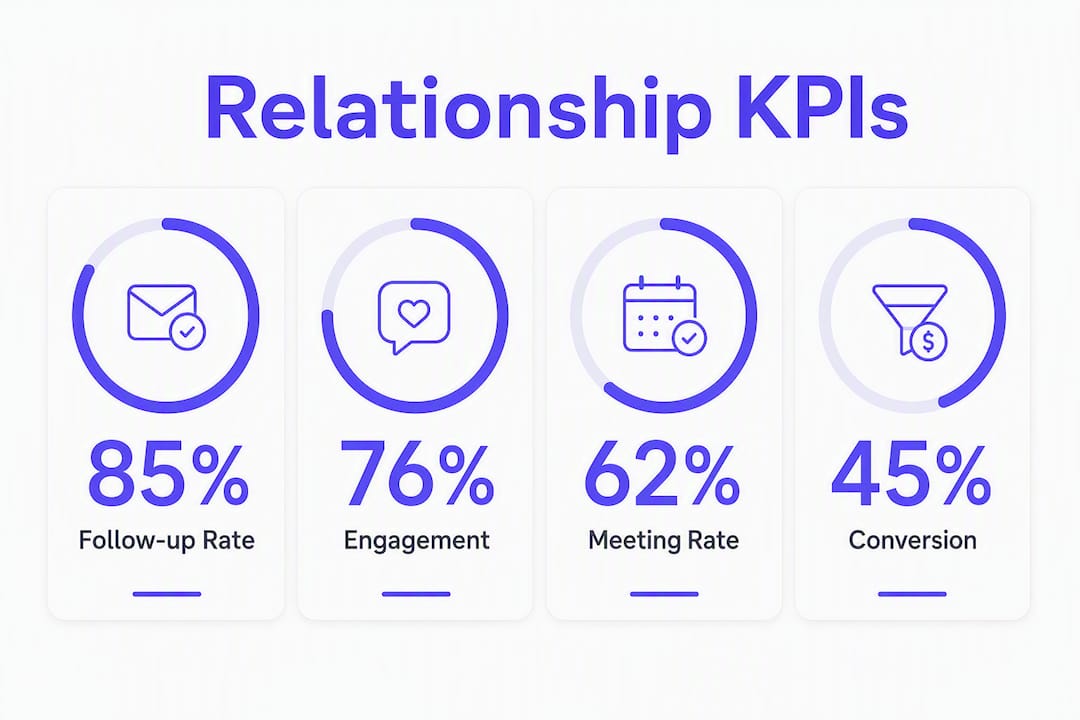
Most sales dashboards measure activity: calls made, emails sent, meetings booked. Those numbers tell you what your reps are doing, not whether the relationships they are building will convert and retain. Add these relationship-focused KPIs alongside your standard activity metrics.
| KPI | What it measures | Source | Review cadence |
|---|---|---|---|
| Follow-up compliance rate | % of promised follow-ups completed on time | Call logs / CRM | Weekly |
| Multi-thread coverage | % of target accounts with 3+ active contacts | CRM activity records | Monthly |
| Response rate by touch | Reply rate per channel and touch number | Email/call logs | Weekly |
| Time-to-first-value | Days from first contact to first value delivered | CRM timestamps | Monthly |
| Referral rate | % of closed accounts that generate a referral | CRM / manual tracking | Quarterly |
| Onboarding NPS | Prospect satisfaction at handoff to onboarding | Short survey (3 questions) | Per deal |
| Re-engagement rate | % of dormant prospects reactivated per quarter | CRM segment reports | Quarterly |
| Cadence completion rate | % of 7-touch sequences completed without dropping | Sequence tool logs | Weekly |
Follow-up compliance rate is the one to watch first. If reps are not keeping their follow-up promises, every other metric is built on a shaky foundation. A tiered relationship framework helps you allocate measurement effort: Tier 1 accounts get full dashboard review; Tier 3 accounts get a lighter monthly check.
For a practical view of how these metrics connect to pipeline outcomes, the sales pipeline management guide covers relationship-stage mapping in detail.
Practical playbook: cadences, templates, and scripts you can use today
Seven-touch cadence
- Day 1 (Email): Personalized opener with one specific insight tied to their world. No ask yet.
- Day 3 (Phone/Voicemail): Reference the email. Keep it to 20 seconds. Name a clear reason to call back.
- Day 7 (Email): Deliver value. One useful resource, benchmark, or intro. No meeting request.
- Day 10 (LinkedIn DM): Short, low-pressure message referencing something they posted or shared.
- Day 14 (Phone): Direct ask for a 15-minute call. Reference the value you delivered. Be specific about what you want to discuss.
- Day 21 (Email): New angle. A trigger event, a case note from a similar company, or a question you genuinely want their take on.
- Day 30 (Email): Graceful close. Leave the door open without pressure.
For a deeper look at multi-touch outreach sequencing and timing, that guide covers channel mix and spacing in detail.
Three copy-paste email templates
Template 1: Short opener (Day 1)
Subject: Quick thought on [specific topic]
Hi [Name],
Noticed [specific trigger or recent news]. Most [role] I talk to in that situation are dealing with [specific challenge]. Happy to share what's worked for a few teams.
Worth a quick call this week?
[Your name]
Template 2: Value delivery (Day 7)
Subject: Something that might be useful
Hi [Name],
No ask here. Came across [resource/data point] and thought of your team immediately given [specific context from prior research].
The short takeaway: [one sentence]. Full link below if you want the detail.
[Link]
[Your name]
Template 3: LinkedIn/DM variant (Day 10)
Hi [Name], your post on [topic] last week was sharp. One thing I'd add from what I've seen: [brief insight]. Curious if that matches what you're seeing.
Two call openers and a voicemail script
Call opener 1 (cold): "Hi [Name], this is [Your name] from [Company]. I'll be quick. I've been working with a few [industry] teams on [specific challenge] and I think there's something relevant to what you're building. Do you have 90 seconds?"
Call opener 2 (warm, post-email): "Hi [Name], I sent you a note last [day] about [topic]. I wanted to follow up directly because I think there's a specific angle worth a quick conversation. Is now a bad time?"
Voicemail script: "Hi [Name], this is [Your name] from [Company]. I'm calling because [one specific reason tied to their world]. I'll send a follow-up email in the next hour with the detail. If you'd rather just call me back, I'm at [number]. Either way, I'll follow up [specific day]. Talk soon."
Personalization tokens to use: company name, role title, recent trigger, shared contact, specific challenge they have mentioned publicly.
Avoid: "Just checking in," "I wanted to touch base," "Hope this finds you well," and any opener that could apply to any prospect on your list.
Common mistakes that break long-term relationships (and fast fixes)
Most relationship failures in sales are not dramatic. They are quiet. A missed follow-up here, a generic message there, a single-threaded account that goes cold when the one contact leaves. Here are the patterns to watch for and the one-line fix for each.
| Mistake | Fix |
|---|---|
| Over-contacting without value | Tie every touch to a promise or trigger; cut frequency before cutting quality |
| Single-threading one contact | Add two more stakeholders within 30 days of first contact |
| Promising a follow-up and missing it | Use the Sundown Rule: log the call and set the reminder before you hang up |
| Pretending expertise you do not have | Say "I'll find out and get back to you by [day]" instead |
| Ignoring small commitments | Treat every micro-promise as a trust deposit; missing small ones signals you'll miss big ones |
| Generic "check-in" messages | Replace with a specific trigger, a piece of value, or a callback promise |
When a prospect goes cold without explanation, do not chase with more of the same. Use a disengagement script instead:
That message does three things: it removes pressure, it acknowledges their reality, and it leaves the door open without burning the relationship. Rebuilding trust after a misstep is harder than building it the first time, so the goal is to exit gracefully rather than create a negative final impression.
What does the research actually say about trust-building behaviors?
Two bodies of research translate directly into sales behavior changes you can implement and measure.
From Harvard Business School Online: Trust is a capability, not a trait. That reframe matters because capabilities can be trained and tracked. The specific intervention it points to is follow-through visibility: making your commitments explicit and your completion of them observable. In practice, this means stating your next step out loud at the end of every call, logging it immediately, and confirming it in writing.
From DDI: High-trust sellers act like consultants. They listen with empathy, acknowledge mistakes, and explain their reasoning rather than just presenting conclusions. The behavioral shift is from "here is what I recommend" to "here is what I'm seeing, here is why I think that, and here is the trade-off you should know about." Prospects who understand your reasoning can trust it; prospects who only hear your conclusion have to take it on faith.
Three behavior changes and a 30-day habit plan
- Behavior 1: End-of-call commitment statement. Before hanging up, say out loud: "I'll [specific action] by [specific day]." Log it immediately. Track completion rate weekly. Target: 90%+ follow-up compliance within 30 days.
- Behavior 2: Explain-your-reasoning habit. In every proposal or recommendation, add one sentence that starts with "The reason I'm suggesting this is..." Track whether prospects ask fewer clarifying questions over time.
- Behavior 3: Multithread one new account per week. Identify a second or third stakeholder in each target account and initiate contact. Track multi-thread coverage monthly. Target: 60%+ of Tier 1 accounts with three or more active contacts by day 90.
Report progress on these three behaviors in your weekly one-on-one. They are observable, measurable, and directly tied to the close rate improvements that follow from stronger relationship foundations.
How do you segment prospects to tailor your approach?
Not every prospect deserves the same level of relationship investment. Treating a low-probability, low-value prospect the same way you treat a strategic account wastes time and dilutes the quality of your high-value outreach.
A simple three-tier framework works for most sales teams:
Tier 1 (Strategic): High revenue potential, strong fit, active buying signals. These accounts get the full seven-touch cadence, executive touchpoints, personalized value delivery, and quarterly relationship reviews. You multithread aggressively here.
Tier 2 (Developing): Moderate fit or longer buying cycle. These accounts get a lighter cadence, value-first outreach, and a check-in every 30 days. You are building familiarity without over-investing.
Tier 3 (Nurture): Low near-term probability but worth keeping warm. Monthly or quarterly touches, mostly content-based. One personalized note per quarter is enough to stay on their radar without burning your time.
Segment by three variables: deal size potential, strategic fit (how well your solution matches their actual problem), and buying timeline. Review the segmentation every 90 days, because a Tier 3 prospect who just got promoted or whose company just raised a round may belong in Tier 1 immediately.
The practical benefit of segmenting is that it forces you to be honest about where your time goes. Most reps discover they are spending 60% of their relationship-building effort on Tier 3 accounts.
How do you re-engage a cold or dormant prospect?
A prospect who went quiet is not a lost cause. They are a warm lead with a timing problem. The mistake most reps make is either giving up entirely or resuming the same outreach that did not work the first time.
Re-engagement requires a new angle, not more volume. Three approaches that work:
The trigger-based re-entry. Wait for a real change in their world: a new role, a company announcement, a regulatory shift, a competitor move. Then reach out with a message tied specifically to that trigger. "Saw [Company] just announced [news]. Given what we talked about last [month], I thought this might be relevant" is a natural re-opener that does not feel like a cold call.
The honest reset. Acknowledge the gap directly without over-explaining. "It's been a while since we connected. I wanted to reach back out because [specific reason]. No pressure, just wanted to make sure I hadn't missed a better moment." Honesty about the gap signals confidence, not desperation.
The value-first return. Send something genuinely useful with no ask attached. A benchmark report, a relevant case note, a quick intro to someone in your network. Let the value do the re-engagement work. If they respond to the value, you have a natural conversation starter.
What does not work: a generic "checking in" email after six months of silence, a LinkedIn connection request with no message, or a re-engagement sequence that looks identical to the original sequence. Prospects remember more than reps assume.
For dormant accounts that have been quiet for more than 90 days, use the disengagement script from the pitfalls section as a reset. Sometimes the most effective re-engagement is giving someone explicit permission to say no, because it removes the social pressure that was keeping them from responding at all.
Key Takeaways
Long-term prospect relationships are built through predictable follow-through, consistent value delivery, and a structured cadence that keeps you present without becoming noise.
| Point | Details |
|---|---|
| Trust is a capability | Build it through observable behaviors: named commitments, logged follow-ups, and the Sundown Rule for same-day replies. |
| Cadence beats memory | A seven-touch sequence with logged outcomes keeps you persistent without relying on recall; most prospects require at least five to seven touches before converting. |
| Segment to prioritize | Use a three-tier framework to allocate relationship effort; Tier 1 accounts get multithreading and executive touchpoints, Tier 3 gets monthly content touches. |
| Measure what predicts retention | Track follow-up compliance, multi-thread coverage, and time-to-first-value weekly; these lead indicators predict pipeline health better than call volume alone. |
| Dialedsales for execution | Dialedsales logs calls in 10 seconds, surfaces follow-up reminders automatically, and shows per-rep compliance on a live dashboard, making the Sundown Rule easy to enforce at scale. |
The part of relationship selling nobody talks about
Most sales playbooks treat trust as a destination. You do the right things, you earn the trust, you close the deal. What they understate is how fragile the early-stage relationship actually is, and how disproportionately a single missed follow-up can damage it.
The research from HBS frames trust as a capability, which is the right framing. But the practical implication is sharper than most teams act on: a prospect who has only interacted with you three times has almost no trust reserve. One missed callback, one generic email, one moment where you clearly did not remember what they told you last time, and the relationship resets to zero. There is no goodwill buffer yet.
This is why the operational mechanics matter as much as the soft skills. Empathy and listening are table stakes. What separates reps who actually build lasting relationships is the boring stuff: logging the call before they leave the parking lot, setting the reminder while the prospect is still on the line, sending the resource they promised within the hour. The emotional intelligence gets you in the door; the follow-through discipline keeps you there.
The other thing most playbooks miss is the cost of single-threading. A rep who builds a strong relationship with one contact inside an account has not built a relationship with the account. They have built a relationship with a person who might leave, get promoted, or lose budget authority. Multithreading is not just a risk-management tactic; it is a signal to the organization that you are a serious partner, not a vendor chasing one champion.
If you take one thing from this guide, make it this: the reps who build the best long-term relationships are not the most charismatic. They are the most reliable. Reliability is a system, and systems can be built.
Why Dialedsales is worth a look if you are serious about follow-through
Every tactic in this guide depends on one thing: keeping your promises to prospects. That requires knowing exactly who is due for a follow-up, what you said last time, and what you committed to next. Dialedsales is built specifically for that problem.
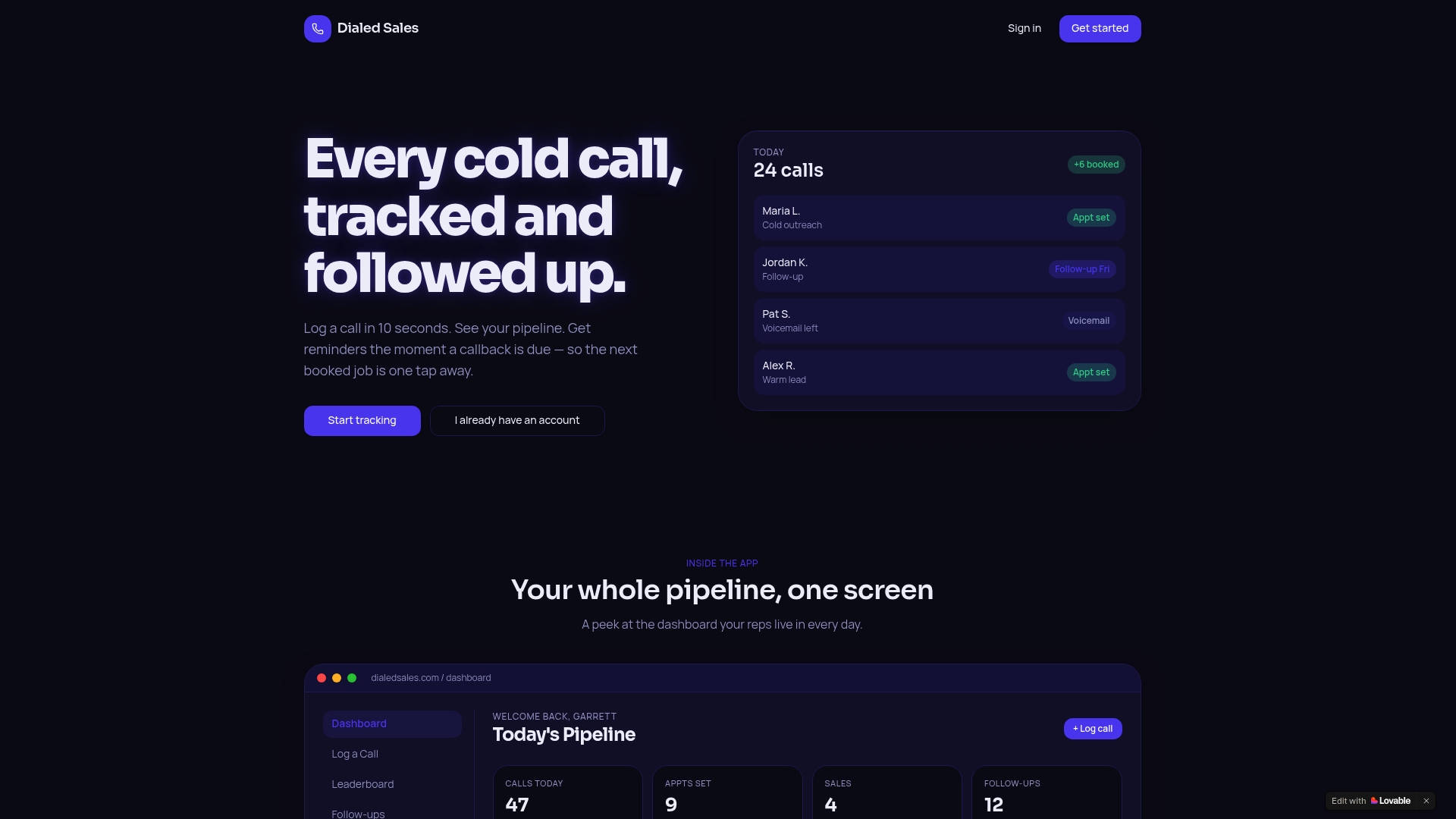
Log a call in 10 seconds with the customer name, outcome, and notes. Set a follow-up date and it surfaces automatically on your dashboard when it is due. The built-in AI assistant drafts activity summaries and helps you write follow-up messages without starting from a blank page. Per-rep stats and a live team leaderboard make follow-up compliance visible to managers without a separate reporting process. It runs on iPhone, Android, and desktop, so field reps and inside reps work from the same system.
If you are evaluating a call-logging tool, the checklist that matters: logging speed (under 15 seconds), automatic reminder accuracy, multithread support across multiple contacts per account, exportable dashboards, and mobile reliability. Dialedsales covers all five.
The two-week free trial requires a credit card to start. That is a deliberate friction point: it is built for teams who are serious about execution, not teams looking to kick the tires indefinitely. If the playbook in this guide is what you want to run, Dialedsales is where you run it.
Useful sources and further reading
- How to Build Trust in Workplace Relationships | HBS Online: The foundational reframe of trust as a capability built through predictable behaviors. Start here if you want the research behind the Sundown Rule and follow-through visibility.
- Negotiation Skills: 5 Proven Ways to Build Trust | PON: Harvard's Program on Negotiation covers rapport-building, transparency, and partner vetting. Directly applicable to first-contact strategy.
- Relationship Selling: The Ultimate Guide | EmailAnalytics: Practical breakdown of relationship selling methodology, including the five-plus-touch persistence data and lifetime value framing.
- Leadership Trust | DDI: DDI's case for the consultant mindset in high-trust selling. Covers empathy-based listening and explain-your-reasoning as core behaviors.
- Trust and Trust Building | Beyond Intractability: Academic grounding on how trust forms incrementally and what the research says about repairing it after a breach. Useful for the re-engagement and pitfalls sections.
- Building Sales Relationships | Prospeo: Practitioner-level guidance on signal-to-noise management and the Sundown Rule. The source for the "tie every touch to a promise or trigger" principle.