
A sales prospecting workflow is a repeatable, systematic sequence of steps that generates qualified leads and fills your pipeline with consistency. Without one, you rely on bursts of effort that produce feast-or-famine results. The sales prospecting workflow for beginners covered here walks through every stage: defining your Ideal Customer Profile (ICP), building targeted lists, crafting multi-touch outreach sequences, qualifying leads with proven frameworks, and iterating based on real data. Get these steps right and prospecting stops feeling random. It becomes a machine you can run every week.
What are the essential components of a beginner sales prospecting workflow?
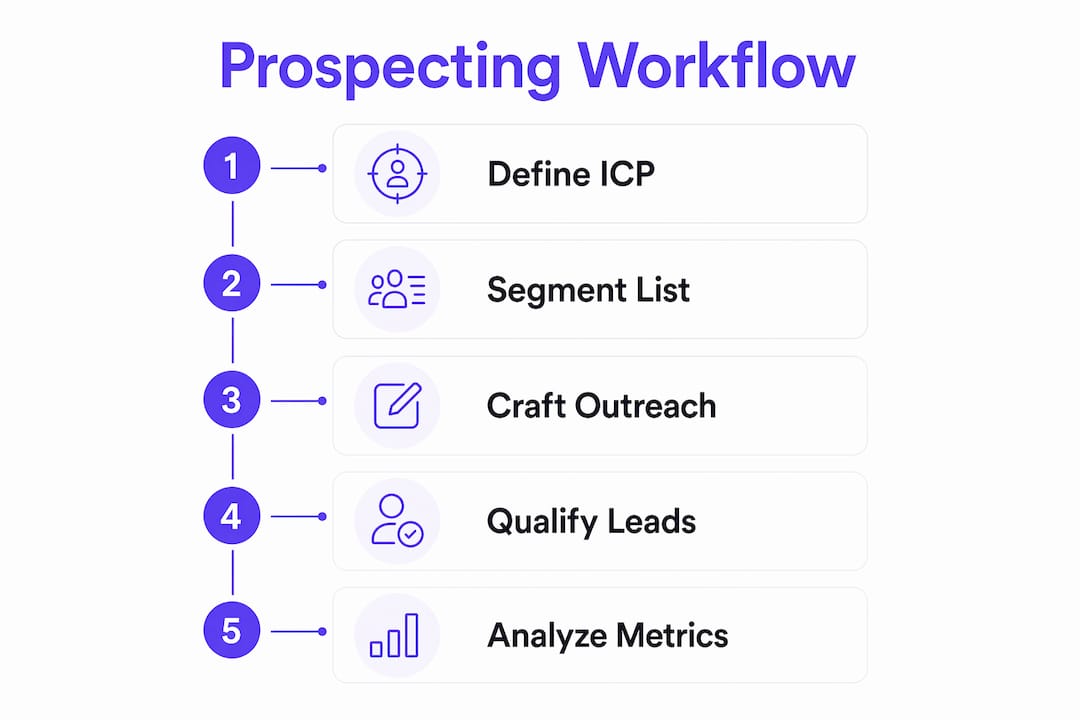
A complete prospecting workflow moves through five core stages, each feeding the next. Skipping a stage does not save time. It creates gaps that kill conversion later.
The five stages every beginner needs to build:
- Define your Ideal Customer Profile (ICP). Identify the exact type of company and contact most likely to buy. Criteria include industry, company size, job title, and specific pain points your product solves.
- Build a targeted prospect list. Research accounts that match your ICP using tools like LinkedIn Sales Navigator or public business databases. Quality beats quantity at every stage.
- Conduct stakeholder research. Before reaching out, learn what each prospect cares about. Check their LinkedIn activity, company news, and recent announcements.
- Execute multi-touch, multi-channel outreach sequences. Combine email, phone calls, and LinkedIn messages over several weeks. One touch rarely converts anyone.
- Qualify leads against defined criteria. Not every interested prospect is a good fit. Use a framework to decide who gets your full attention and who goes into a nurture sequence.
- Analyze results and iterate. Track response rates, meeting bookings, and conversion rates. Use that data to sharpen your ICP, messaging, and timing.
Building a systematic workflow rather than treating prospecting as isolated tasks transforms it from unpredictable effort into a predictable pipeline engine. That shift is the single biggest mindset change beginners need to make.
How do beginners define an effective ICP and build targeted prospect lists?

Your ICP is the foundation of every other step. A well-defined ICP increases conversion rates because it enables hyper-relevant messaging tailored to specific pain points. Beginners often fear that narrowing their focus shrinks their opportunity pool. The opposite is true. Focused targeting produces better results than broad outreach every time.
Define your ICP using these criteria:
- Industry. Which sectors have the problem your product solves? Be specific. "B2B technology" is too broad. "SaaS companies with 10–200 employees selling to mid-market" is workable.
- Company size. Revenue range and headcount determine budget capacity and buying complexity.
- Decision-maker role. Identify the job title that owns the problem and the budget. A VP of Sales and a Sales Operations Manager have different priorities.
- Pain points. What specific challenge does your ICP face that you solve? Name it in one sentence.
- Buying signals. Look for triggers like recent funding rounds, new hires in relevant roles, or product launches that indicate a prospect is ready to buy.
Once your ICP is clear, segment your prospect list into clusters. Group accounts by shared characteristics, such as industry vertical or company size band. This segmentation lets you write one strong message for each cluster rather than a generic message for everyone.
Pro Tip: Segment your list into three to five ICP clusters before writing a single outreach message. Each cluster gets its own angle, which lifts reply rates without requiring you to write a unique message for every contact.
What are best practices for crafting multi-touch outreach sequences?
Outreach sequences are where most beginners either give up too early or annoy prospects with repetitive messages. Effective sequences involve 8 to 12 touches over 3 to 4 weeks, using multiple channels and varying the angle with each touch. That range sounds like a lot. It reflects how many interactions it actually takes to earn a response from a busy professional.
A practical sequence structure for beginners:
- Day 1: Personalized email. Reference a specific pain point relevant to their industry. Keep it under 100 words. End with one clear question, not a pitch.
- Day 3: LinkedIn connection request. Add a short note referencing your email. Do not pitch in the connection request.
- Day 5: Follow-up email. Add new value. Share a relevant case study, a short insight, or a piece of content they would find useful.
- Day 8: Phone call. Leave a voicemail if they do not answer. Keep it under 30 seconds. Reference your previous emails.
- Day 11: LinkedIn message. Engage with something they posted or share a relevant observation about their industry.
- Day 14: Email with a pattern interrupt. A personalized video, a short screen recording, or an unusual subject line breaks the monotony and improves prospect engagement.
- Day 18: Final email. Be direct. Tell them you will stop reaching out after this message. This "breakup" email often gets the highest reply rate in the entire sequence.
Use a messaging framework to structure each touch: state the problem, describe the impact of that problem, offer proof that you solve it, then make a clear ask. This problem-impact-proof-ask structure keeps messages focused and easy to respond to.
Tiered personalization solves the scalability problem. Write segment-level messaging that references shared industry pain points, then add one line of contact-level personalization for each prospect. Writing a completely unique message for every prospect is not scalable for beginners managing a list of 50 or more contacts.
Pro Tip: Space your touches wider as the sequence progresses. Early touches can be two to three days apart. Later touches should be five to seven days apart. This mirrors natural follow-up behavior and feels less aggressive to the prospect.
How can beginners qualify and prioritize leads effectively?
Qualification separates prospects worth pursuing from those who will waste your time. The GPCTBA/C&I framework covers Goals, Plans, Challenges, Timeline, Budget, Authority, Negative Consequences, and Positive Implications. It gives beginners a structured way to assess every lead before investing significant effort.
Apply qualification by asking discovery questions that uncover each element:
- Goals. What is the prospect trying to achieve in the next 90 days?
- Challenges. What is blocking them from reaching that goal?
- Timeline. When do they need a solution in place?
- Budget. Do they have funds allocated for this type of solution?
- Authority. Are you speaking with the person who makes the final decision?
After gathering this information, score each prospect on fit and engagement. A prospect who matches your ICP, has a clear problem, and has responded to two or more of your outreach touches is a high-priority lead. A prospect who matches your ICP but has not engaged belongs in a longer nurture sequence, not your immediate pipeline.
Responding to positive replies promptly maximizes booking rates. When a prospect shows interest, follow up within the hour. Waiting a day to respond to a warm lead is one of the most common and costly beginner mistakes.
Move qualified leads to the next stage of your sales process. Move unqualified leads to a nurture sequence where you stay in touch with lower-frequency, lower-effort touches over a longer period.
How do you analyze and improve your prospecting workflow over time?
Tracking performance is what separates a workflow that improves from one that stays flat. Analyzing key metrics like response rates, conversion rates, and meeting bookings tells you exactly where your workflow is working and where it breaks down.
| Metric | What it tells you | How to act on it |
|---|---|---|
| Email open rate | Whether your subject lines are working | Test two subject line variations per sequence |
| Reply rate | Whether your message resonates | Rewrite the opening line if reply rate is below 5% |
| Meeting booking rate | Whether your ask is clear and compelling | Simplify your call to action if bookings are low |
| Sequence completion rate | Whether prospects are dropping off early | Identify the touch where drop-off spikes and revise it |
Documenting your workflow makes it repeatable and scalable. Without documentation, your results depend entirely on individual memory and effort. Write down each step, the tools you use, the message templates, and the timing. Review and update the document monthly based on what the data shows.
Refine your ICP when your meeting booking rate is low despite high reply rates. That pattern usually means you are reaching the right people but targeting the wrong accounts. Adjust your ICP criteria and rebuild your list before changing your messaging.
Key Takeaways
A documented, systematic prospecting workflow is the single most reliable way for beginners to build a consistent pipeline and avoid relying on last-minute effort.
| Point | Details |
|---|---|
| Define your ICP first | Narrow targeting improves conversion more than broad outreach ever will. |
| Build segmented prospect lists | Group accounts into ICP clusters to scale personalization without burning out. |
| Use 8–12 touch sequences | Spread touches across email, phone, and LinkedIn over 3–4 weeks for best results. |
| Qualify with GPCTBA/C&I | Score leads on goals, timeline, budget, and authority before investing full effort. |
| Track and document everything | Monthly metric reviews and written workflow documentation make results repeatable. |
What I have learned from watching beginners build their first prospecting workflow
The most common mistake I see is treating prospecting as a series of one-off tasks. A rep sends five emails, gets no replies, and concludes that cold outreach does not work. The problem is never the channel. The problem is the absence of a system.
The beginners who build real pipeline fast share one habit: they block time for prospecting every single day, even when it is just 30 minutes. Batch processing works well here. Research 10 accounts on monday, write outreach for those 10 accounts on tuesday, send and follow up on wednesday. That rhythm prevents the mental switching cost of jumping between research and writing and calling all at once.
The other thing I would tell every beginner is this: your first ICP will be wrong. That is fine. The goal is to define it clearly enough to test it, then refine it based on what the data shows. Beginners who refuse to narrow their ICP because they fear missing out end up with generic messages that convert no one.
Patience matters more than most people admit. A well-built prospecting workflow takes four to six weeks to show reliable results. Stick with it long enough to collect real data before changing anything.
— Garrett
How Dialedsales fits into your prospecting workflow
Building a prospecting workflow is straightforward once you have the right system for tracking what happens after each call and outreach touch.
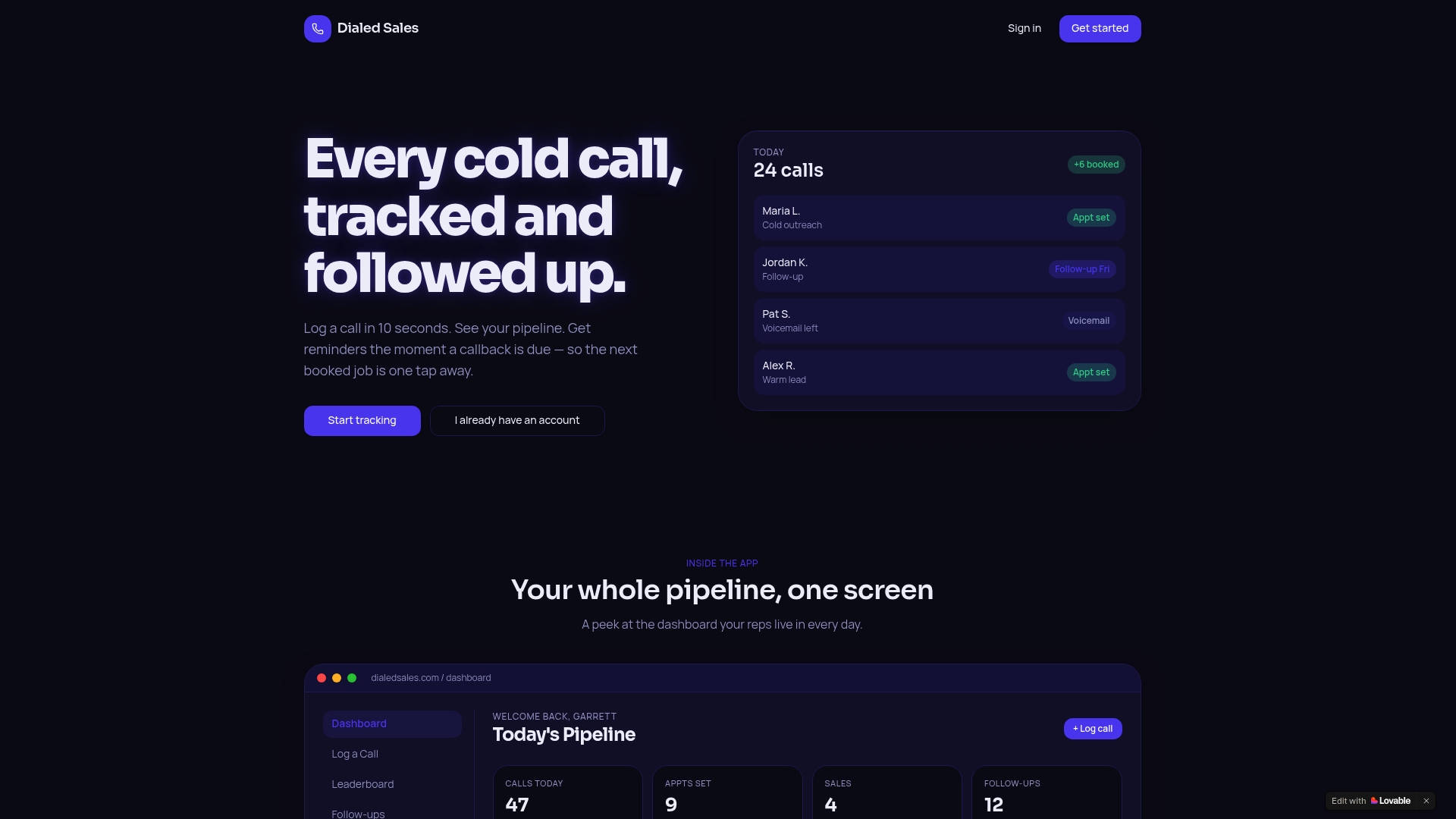
Dialedsales is a lightweight cold call tracking app built for sales reps and field teams across every sales-based industry. Log a call in 10 seconds with the customer name, outcome, and notes. Set a follow-up date and it auto-surfaces on your dashboard the moment it is due. Every outcome gets tracked so you can watch your close rate climb over time. For beginners building their first workflow, Dialedsales removes the friction of manual tracking and keeps your pipeline visible at a glance. No complicated setup. No features you will never use.
FAQ
What is a sales prospecting workflow?
A sales prospecting workflow is a documented, repeatable sequence of steps used to identify, research, contact, and qualify potential customers. It replaces random outreach with a consistent system that generates predictable pipeline.
How many touches should a beginner use in an outreach sequence?
Effective outreach sequences involve 8 to 12 touches spread across 3 to 4 weeks, combining email, phone calls, and LinkedIn messages. Starting with fewer touches and building up as you get comfortable is a practical approach.
What is an Ideal Customer Profile and why does it matter?
An Ideal Customer Profile (ICP) defines the exact type of company and contact most likely to buy from you. A well-defined ICP improves conversion rates by enabling messages that speak directly to specific pain points rather than generic audiences.
How do I qualify a lead as a beginner?
Use the GPCTBA/C&I framework to assess goals, challenges, timeline, budget, and authority before investing significant effort in any prospect. Leads that match your ICP and have responded to outreach are your highest priority.
How do I know if my prospecting workflow is working?
Track reply rates, meeting booking rates, and sequence completion rates weekly. If reply rates are below 5%, rewrite your opening message. If bookings are low despite replies, simplify your call to action.