
A sales team leaderboard makes rank and progress visible in real time, and that visibility alone changes how reps behave before you say a word to them. The immediate move: pick one KPI, decide how often it resets, and get a live board up before your next stand-up. Dialed Sales can generate that board automatically from calls your reps already log, but even a whiteboard works if you start today.
TL;DR:
- Choosing a single, clear KPI like revenue or meetings and updating it regularly is more effective than tracking multiple metrics or blended scores.
- Visible, easily accessible leaderboards that update on a consistent schedule motivate improvement through social comparison and gamification.
- Normalizing scores by quotas or territory difficulty prevents unfair advantage and ensures fair competition across different roles and regions.
- Starting with a simple, manual display like a whiteboard or spreadsheet allows teams to test the habit before investing in automated CRM dashboards.
- Regularly monitoring activity, conversion, pipeline health, and quota attainment, and adjusting the leaderboard rules accordingly, sustains motivation and prevents gaming or burnout.
Table of Contents
- What Is a Sales Team Leaderboard and Why Does It Motivate Reps?
- Which Sales Leaderboard Metrics Should You Actually Track?
- How Do You Set Fair, Sustainable Leaderboard Rules?
- What's the Best Way to Set Up a Sales Leaderboard?
- What Are Some Ready-to-Run Sales Leaderboard Contest Ideas?
- How Do You Know If a Sales Leaderboard Is Actually Working?
- Manager Checklist and Notes on Building Your First Leaderboard
- What Most Managers Get Wrong About Sales Leaderboards
- Run Your Leaderboard Without the Manual Grind
- Sources
What Is a Sales Team Leaderboard and Why Does It Motivate Reps?
A sales leaderboard is a ranked, regularly updated display of performance on a chosen metric. It could be calls made, meetings booked, or revenue closed. What matters is that it turns a private number into a shared one, and shared numbers change behavior in ways private numbers never do.
Here's the mechanism. The board takes one KPI, ranks every rep or team against it, and updates on a schedule the whole team can see. That's it. No complicated formulas, no hidden weighting most of the time. Geckoboard's explanation of sales leaderboards frames this correctly: the entire value comes from making progress and rank visible, not from the sophistication of the scoring.
The psychology behind it is well documented. Harvard Business School research on performance and visibility supports social comparison as a real driver of productivity, not just in sales but across performance-based work generally. When people can see where they stand relative to peers, most adjust their effort without being told to. Salesforce's take on sales leaderboards adds the gamification layer: rankings paired with immediate feedback create a loop that keeps reps checking back, the same loop that makes a fitness app or a video game hard to put down.
None of that works if the board sits buried in a spreadsheet nobody opens. Visibility has to be physical or at least habitual: a TV on the wall, a link pinned in Slack, something reps see without hunting for it.
A minimal viable leaderboard needs four things:
- One metric everyone understands without explanation.
- A visible display, whether that's a TV screen, a shared link, or a channel embed.
- An update cadence stated up front, so reps know exactly when the board refreshes.
- A clear owner responsible for keeping the numbers accurate.
Pro Tip: Launch with the ugliest, fastest version you can build. A whiteboard updated by hand at 4 PM beats a beautiful dashboard that takes three weeks to configure. You can always upgrade the tooling once the habit sticks.
Which Sales Leaderboard Metrics Should You Actually Track?
Pick one KPI per contest, not five. A board that ranks reps on five blended metrics confuses everyone and motivates no one, because nobody can tell which behavior actually moved their rank.
Five metrics cover almost every situation:
- Revenue closed — the cleanest measure for AEs and field reps who own the full sale.
- Deals won — useful when deal sizes are roughly similar and you want volume over size.
- Meetings set — the standard SDR metric, since meetings are the output SDRs actually control.
- Calls made — an activity metric for early-funnel teams or new hires still building pipeline.
- Pipeline added — good for tracking contribution to future revenue, not just closed deals.
Role mapping matters more than most managers realize. SDRs should be ranked on activity and meetings set, since revenue is mostly out of their hands. AEs belong on deals won or revenue closed, the outcomes they directly influence. Field reps often do best on closed revenue or share of team pipeline, depending on whether their job is closing or prospecting.
The single biggest mistake managers make is picking a vanity metric that feels impressive but doesn't predict revenue. Call volume looks great on a board until you realize your top dialer is making thirty-second calls to hit a number. Indeed's guidance on sales incentives points out that incentive design works best when it's tied to behaviors that actually compound into outcomes, not just activity for its own sake.
If your team spans different territories or quota sizes, raw numbers will always favor whoever has the easiest patch. Normalize by tracking percentage-to-quota instead of absolute totals, or show progress bars alongside rank so a rep in a tough territory can see they're winning relative to their own target even while sitting mid-pack overall.
How Do You Set Fair, Sustainable Leaderboard Rules?
Fairness isn't a nice-to-have add-on you bolt on later. It's the difference between a board that motivates and one that quietly wrecks morale within a month.
Start with what counts. Decide explicitly whether a "deal" means a signed contract, a paid invoice, or something in between, and write it down somewhere everyone can check. Ambiguity here breeds resentment fast, especially once someone feels like a rival got credit for a deal that should have counted differently.
Follow these five rules when you design your scoring:
- Default to a single number. Weighted or blended scores feel sophisticated but obscure what's actually driving rank, and reps stop trusting a board they can't reverse-engineer.
- Match reset cadence to the metric. Daily resets suit activity sprints like call volume; weekly suits meetings booked; monthly suits revenue, since sales cycles rarely close in a week.
- Normalize across roles and territories. Use percent-to-quota or share-of-team-pipeline instead of raw totals whenever reps don't start from equal footing.
- Set a clear tie-breaker in advance. Whether it's earliest submission time or a secondary metric, decide before the contest starts, not after someone complains.
- Build in an opt-out for reps who find public ranking demotivating. Not everyone thrives under visible comparison, and forcing it can push a strong performer toward disengagement instead of effort.
Watch for warning signs that a board is doing more harm than good: chronic bottom-three finishers who stop trying entirely, side conversations about the board feeling "rigged," or a spike in end-of-period deal dumping right before a reset. Any of those means it's time to adjust the metric, the cadence, or the visibility settings, not just push through and hope it fixes itself.
Pro Tip: If your team has both senior reps with fat pipelines and new hires still ramping, run two boards instead of one, split by tenure. Comparing a six-month rep against someone in week three isn't fair to either of them.
What's the Best Way to Set Up a Sales Leaderboard?
Three setup paths cover nearly every team size and budget, and the right one depends less on your headcount than on how much manual upkeep you're willing to tolerate.
A spreadsheet or whiteboard is the true minimum viable product. Setup cost is basically zero, it works for teams of three to eight, and the only real requirement is someone disciplined enough to update it daily. This is the right starting point if you've never run a leaderboard before and want to test whether the habit sticks before investing in tools.
Lightweight web leaderboards sit a step up. Products in this category, like the ones MakeTheBoard describes, let teams stand up a live, shareable display in minutes, often with a TV-friendly URL and a link reps can use to log their own scores. You trade some automation for speed, since most of these still require manual or semi-manual entry, but for a small team that wants something better than a spreadsheet by Friday, this is often the sweet spot.

CRM-integrated dashboards are the third tier, built for mid-size and larger teams where manual entry becomes a bottleneck. A real-time sales dashboard pulls data automatically from wherever reps already log activity, which eliminates the "somebody forgot to update the board" problem entirely. The tradeoff is setup time and, usually, cost. If your team already runs on a CRM and you're evaluating the role CRM plays in performance tracking, this is the natural next step once the whiteboard phase proves the concept works.
Whichever path you pick, week one looks the same: assign an owner, define the metric, choose the display, and run it manually for at least five business days before automating anything. You want to catch definitional disputes early, while the stakes are still low.
What Are Some Ready-to-Run Sales Leaderboard Contest Ideas?
Three templates cover most of what managers actually need, and you can launch any of them this week without building anything custom.

Template A: The Daily Activity Sprint. Track calls made or meetings booked over a single day. Reset the board every morning at 9 AM. Prize the single-day winner with something small and immediate, like a $15 lunch credit or first pick of leads the next morning. This format works best for SDR teams building early-funnel volume.
Template B: The Weekly Pipeline Push. Track pipeline dollars added or meetings converted to pipeline over a five-day week. Reset every Monday. A $50 gift card or an afternoon off on Friday works well as a prize here, since the payoff matches the slightly longer effort window.
Template C: The Monthly Revenue Race. Track closed revenue, normalized by individual quota so reps on different territories compete fairly. Reset monthly. Prizes should scale up here, think a bonus, a public shoutout, or a bigger perk like a parking spot for the month.
A few design notes that keep any of these from backfiring:
- Run team-versus-team instead of individual-versus-individual occasionally to build collaboration alongside competition.
- Rotate prize types between cash, time off, and recognition. Indeed's incentive research and broader guidance on rep incentive design both point to mixing monetary and non-monetary rewards as the more sustainable approach long-term.
- Watch for cherry-picking, where reps hold deals back to time them for a fresh contest window instead of closing when the customer is ready.
- PPAI's guidance on building successful sales contests recommends stating judgeable rules before launch so nobody can argue with results after the fact.
How Do You Know If a Sales Leaderboard Is Actually Working?
Track four things: activity volume, conversion rate, pipeline health, and quota attainment. If a leaderboard is working, you'll see movement in the middle of the pack, not just at the top. Your best rep was probably going to perform well regardless. The real signal is whether your fifth- and sixth-ranked reps start closing the gap.
A simple evaluation plan works better than an elaborate one. Measure a two-week baseline before launch, run the contest, then check results at 30 and 90 days. Harvard Business School's research on visibility and performance suggests early gains often come fast, sometimes within the first week, but sustaining them past 90 days depends heavily on rotating the metric or the format before novelty wears off.
Watch for these four pitfalls:
- Data inaccuracies that erode trust in the board faster than any design flaw could.
- Perverse incentives, like reps cherry-picking easy deals or delaying closes to time them favorably.
- Burnout, especially with daily contests that never let up.
- Public shaming, where consistently ranking last becomes a source of embarrassment rather than motivation.
If any of these show up, the fix is rarely to scrap the whole idea. Normalize the scoring, swap the metric, add a team-based incentive to soften individual pressure, or pause the board for a reset period. Coaching built around call outcomes can help you diagnose whether a slump is a leaderboard problem or a skills problem before you tear the whole system down.
Manager Checklist and Notes on Building Your First Leaderboard
Print this and fill in the blanks before your next team meeting:
- Metric: one KPI, stated plainly (calls, meetings, revenue, pipeline).
- Cadence: daily, weekly, or monthly reset.
- Display method: TV, shared link, or Slack embed.
- Update owner: the person responsible for accuracy.
- Prize: cash, time off, or recognition, rotated over time.
- Measurement window: baseline period plus 30 and 90 day check-ins.
Garrett writes about outbound sales workflows for Dialed Sales, focusing on what actually gets a small team's numbers up without adding busywork. For more on the accountability side of this, Dialed Sales' guide to rep accountability covers how tracking and transparency work together, and why cold callers specifically need dashboards breaks down the case for activity-driven boards in outbound-heavy teams.
What Most Managers Get Wrong About Sales Leaderboards
Most advice on this topic treats the leaderboard itself as the strategy. It isn't. The board is a mirror, not an engine. What actually drives results is the metric you point it at and the discipline to change that metric before your team gets bored of gaming it.
The conventional wisdom oversells automation and undersells cadence. Managers spend weeks picking the perfect software when the real leverage sits in deciding whether a contest resets daily or monthly, and in normalizing scores so a rep with a tough territory isn't demoralized by week two. A whiteboard updated honestly beats a slick dashboard tracking the wrong number.
If you want one place to start, it's not the tool. It's the metric. Pick the one behavior that actually predicts revenue for each role on your team, separate SDR activity from AE outcomes, and resist the urge to blend five KPIs into a single score just because it looks more comprehensive. Fairness rules and opt-outs matter more than most managers assume going in. A board that quietly demoralizes your middle performers is worse than no board at all.
— Garrett
Run Your Leaderboard Without the Manual Grind
If you're already running calls through a spreadsheet and building the board by hand, Dialed Sales removes the busywork between logging a call and seeing where your team stands. Log a call in about ten seconds with customer name, outcome, and notes, and the app builds live per-rep activity stats and a real-time leaderboard automatically. No end-of-day data entry, no separate tool to keep in sync.
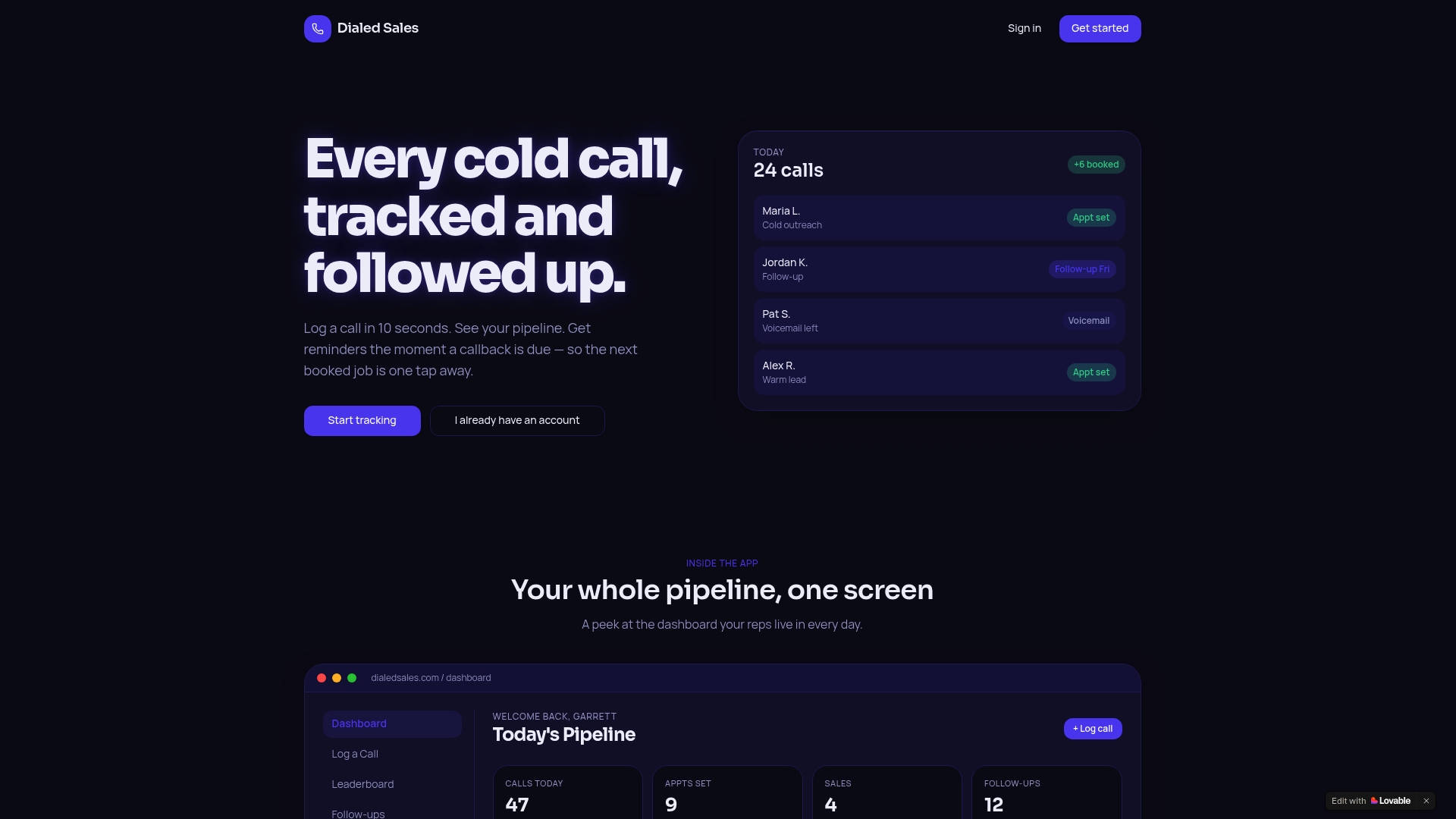
The practical path most teams take: start with a manual board to prove the habit sticks, then move to Dialed Sales once you're ready to stop updating spreadsheets by hand. Automated follow-up reminders mean a rep's callback surfaces the moment it's due, so your leaderboard reflects real activity instead of whatever got remembered to be logged. If you're weighing setup paths, Dialed Sales' comparison of sales tracking tools is worth a look before you commit to one approach. Start a trial and get your first live board running before your next team stand-up.
Sources
- Harvard Business School research on performance and visibility
- What is a sales leaderboard and how do I create one? — Geckoboard
- Why a Sales Leaderboard Is the Key to Team Motivation — Salesforce
- Sales incentive ideas and tips — Indeed (2026)
- What Is A Sales Leaderboard (And How To Make Yours Successful) — PPAI