
What does sales rep productivity actually mean?
Sales rep productivity measures how efficiently your reps convert time, effort, and resources into closed deals and revenue. It is not the same as activity volume. A rep who sends 100 generic emails and books one meeting is busy. A rep who sends 50 targeted emails to qualified buyers and books five meetings is productive.
That distinction shapes everything downstream, from how you coach, what you measure, and where you invest in technology.
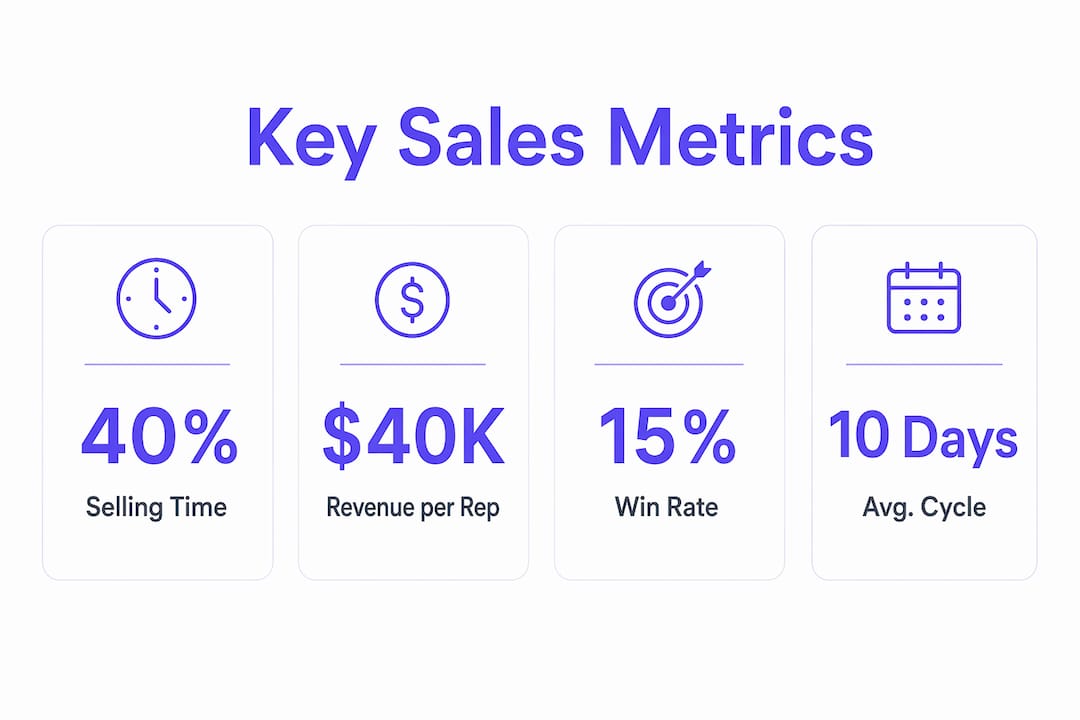
The core challenge is time allocation. Reps spend only a minority of their time on actual selling, with a large portion consumed by administrative tasks, CRM updates, internal meetings, and manual research. Getting that ratio right is the central problem of sales productivity.
Key facets of sales rep productivity:
- Selling time ratio: What percentage of the workweek goes to buyer-facing activities
- Output per effort: Revenue generated relative to hours, headcount, and tools invested
- Activity quality: Whether calls, emails, and meetings actually advance deals
- Process adherence: Whether reps follow a defined path through the funnel
- Resource utilization: How well the team uses available tools and support
Table of Contents
- Which metrics actually tell you how productive your reps are?
- What is actually killing your reps' selling time?
- Practical strategies that actually move the needle
- What your team actually gains when productivity improves
- How to measure and track productivity over time
- How Dialedsales approaches productivity tracking in practice
- How training and skill development affect rep output
- How to set realistic productivity goals and benchmarks
- How motivation and incentives shape rep productivity
- Time management and prioritization practices that actually work
- How Dialedsales helps you put this into practice
- Key Takeaways
Which metrics actually tell you how productive your reps are?
Measuring sales team performance means tracking both activity inputs and revenue outputs together. Neither alone gives you the full picture.
The metrics that matter most:
- Selling time percentage: How much of each rep's week goes to direct buyer interaction. Most teams spend less than one-third of their time on selling activities, below the higher targets that high-performing organizations aim for.
- Quota attainment: The share of reps hitting or exceeding their number. When this drops across the team, it usually signals a structural productivity problem, not individual effort.
- Win rate: Deals won divided by deals pursued. A low win rate often means reps are chasing unqualified prospects.
- Pipeline coverage: The ratio of pipeline value to quota. Thin coverage with a healthy win rate points to a top-of-funnel gap, not a rep efficiency problem.
- Average deal cycle length: How long deals take from first contact to close. Lengthening cycles signal friction, unclear next steps, or stakeholder confusion.
- Revenue per rep: Total revenue divided by headcount. This is the headline metric finance and leadership care about most, and the one that cuts through all the noise.
Read these metrics as a system, not in isolation. Low selling time paired with long cycles points to workflow friction. Thin pipeline with strong win rates means you have a lead generation problem, not a rep performance problem. The metrics tell you which lever to pull.
Pro Tip: Track revenue per selling hour, not just revenue per rep. A rep closing $40,000 a month working 160 hours outperforms one closing $50,000 working 220 hours. That ratio is your real productivity benchmark.

What is actually killing your reps' selling time?

Most productivity problems are structural, not behavioral. The friction is built into the sales process itself, and pushing reps to work harder inside a broken system produces diminishing returns fast.
The biggest culprits:
- Administrative drag: Data entry, CRM updates, meeting notes, and report generation consume hours every week. Every hour spent updating records is an hour not spent with buyers.
- Tool sprawl: Reps toggle between 10 or more tools daily. Each context switch costs focus, and by the time they find what they need, the moment to act has passed.
- Manual account research: For enterprise reps managing complex accounts, research alone can consume a third of the workweek. This produces zero revenue on its own.
- Unqualified leads: Pursuing prospects who were never going to buy drains time and energy while lowering win rates.
- Undefined sales process: Without a clear path through the funnel, reps operate on instinct, duplicating effort and missing critical steps.
The numbers are stark. Sales reps spend about 70% of their time on non-selling activities like admin, meetings, and research, leaving only 30% for actual selling.
The "middle mile" tasks, including data wrangling, CRM hygiene, sequence orchestration, and lead enrichment, are where most productivity disappears. These are not coaching problems. They are automation opportunities. Asking reps to work harder inside that setup is like asking a factory to produce more while the conveyor belt keeps stopping.
Practical strategies that actually move the needle
The highest-leverage moves for improving sales rep efficiency target the 70% of non-selling time, not the 30% already spent with buyers.
- Run a workflow audit first. You cannot fix what you have not mapped. Ask reps to log their activities for one week in plain-language categories. Identify tasks that do not advance a deal stage and eliminate or delegate them. If a rep spends 30 minutes a day copying data from email to CRM, that is over 100 hours a year on a task a workflow can handle.
- Automate the middle mile. Automating repetitive tasks can save reps up to two hours of work daily. CRM sync, follow-up reminders, lead enrichment, and reply classification are all candidates. Start with the one task your team complains about most.
- Consolidate your tech stack. Teams using integrated tech stacks that replace multiple standalone tools achieve noticeably higher sales productivity. Every additional tool adds context-switching overhead that erodes the gains it promises.
- Automate account research. For reps spending substantial time weekly on manual research, account research automation can save significant hours, the equivalent of adding a full selling day without adding headcount.
- Implement AI-powered coaching. Conversation intelligence tools analyze call transcripts at scale, surfacing talk-to-listen ratios, objection handling patterns, and competitor mentions. Managers can coach on specific moments rather than guessing where deals stalled.
- Align sales and marketing on content. Reps waste hours hunting for collateral or building their own off-brand slides. A centralized, searchable content library tagged by buyer journey stage removes that friction entirely.
- Use lead qualification frameworks. Frameworks like MEDDIC focus rep effort on prospects who match your ideal customer profile and show real buying intent. Time spent on bad-fit prospects is time taken from winnable deals.
Pro Tip: Audit before you automate. Automating a broken process just produces broken results faster. Map the workflow, cut the waste, then apply automation to what remains.
What your team actually gains when productivity improves
The benefits of higher sales rep output extend well beyond the revenue line. When reps spend more time with qualified buyers, the entire organization feels it.
- Higher revenue: More selling time against better-qualified prospects directly increases closed deals and average deal size.
- Lower operational costs: Automation reduces the manual labor cost embedded in every deal, improving margin without adding headcount.
- Faster deal closure: Removing friction from the sales process shortens cycle length, which accelerates cash flow and improves forecast accuracy.
- Better customer experience: Reps who are not buried in admin have more bandwidth for discovery, follow-through, and relationship building. Buyers notice.
- Improved quota attainment: When reps spend time on activities that actually advance deals, hitting their number becomes a process outcome rather than a luck outcome.
- Higher team morale: Reps who consistently hit quota and feel their time is well spent stay longer. Turnover in sales is expensive, and productivity is one of the clearest drivers of retention.
The connection between productivity and morale is often underestimated. A rep who spends half their day on admin and still misses quota does not just underperform. They burn out.
How to measure and track productivity over time
Tracking sales effectiveness requires more than pulling a CRM report once a quarter. You need a system that combines quantitative data with qualitative signals.
- Run a time and motion audit. Ask every rep to log their week in five plain-language buckets: selling, research, admin, internal meetings, and content creation. One week of clean data reveals more than months of CRM reports.
- Set a headline ratio. Revenue per rep or revenue per selling hour gives you a single number that resists gaming. Track it monthly.
- Combine CRM data with customer feedback. Quantitative metrics tell you what happened. Customer surveys and call recordings tell you why. Both are necessary for accurate diagnosis.
- Use automation to collect activity data. Manual time-tracking degrades quickly. CRM integrations, call logging tools, and calendar analytics capture behavior without adding rep burden.
- Establish clear KPIs tied to revenue. Every metric you track should connect to a revenue outcome. If you cannot draw a line from a metric to closed deals, cut it from your dashboard.
- Review metrics as a system. A single weak metric rarely tells the full story. Low win rate plus thin pipeline plus long cycles together point to a qualification problem at the top of the funnel, not a closing problem at the bottom.
For a structured approach to pipeline visibility, regular pipeline reviews using these metrics give managers the context to coach on the right problems at the right time.
How Dialedsales approaches productivity tracking in practice
The most useful productivity metric for any sales team is revenue per rep hour. Everything else is a diagnostic. Dialedsales is built around that principle: give reps a way to log calls in 10 seconds, surface follow-ups automatically, and track every outcome so close rate trends become visible without manual reporting.
Practical tips from the Dialedsales approach:
- Measure revenue per rep hour as your core ratio, not calls made or emails sent.
- Eliminate non-value-adding activities before adding new tools. Consolidating onto a single platform reduces context switching and the integration glue that slows teams down.
- Coach process adherence, not activity volume. A rep who follows a defined qualification and follow-up process consistently outperforms one who makes more calls with no structure.
- Use call outcome data for coaching. Patterns in outcomes, such as which objections kill deals most often, tell managers exactly where to focus skill development. Dialedsales surfaces those patterns directly from logged call outcomes.
- Auto-surface follow-ups. The single most common productivity leak in field sales is a missed callback. When follow-up dates appear automatically on the dashboard the moment they are due, reps stop losing deals to timing.
Pro Tip: Consolidate your tools onto one platform before adding another. AI automation tools work best when they run on a single substrate, not across eight disconnected apps.
For teams using call outcome data to drive coaching decisions, the feedback loop between logged outcomes and rep skill development is one of the fastest ways to move the productivity needle.
How training and skill development affect rep output
Training is not a one-time event. The teams with the highest sustained productivity treat skill development as an ongoing process embedded in the daily workflow, not a quarterly offsite.
The most effective training approaches share a few characteristics. They are specific to real call situations rather than generic sales theory. They use actual conversation data, such as recorded calls and logged outcomes, to identify where individual reps lose deals. And they deliver feedback close to the moment it is relevant, not weeks later in a performance review.
AI-powered conversation intelligence has changed what is possible here. Managers can now analyze call behaviors at scale, identifying patterns in talk-to-listen ratios, objection handling, and deal progression across the entire team. That kind of visibility used to require sitting in on dozens of calls. Now it surfaces automatically.
Peer-to-peer learning compounds the effect. A library of recorded best-practice calls gives newer reps a concrete model to work from, reducing the time it takes to reach full productivity after onboarding. For accelerating rep development, the combination of conversation intelligence and structured peer learning consistently outperforms traditional manager-led training alone.
How to set realistic productivity goals and benchmarks
Goals that stretch the team without breaking it require grounding in historical performance, not aspirational guesses. A quota set at twice last year's attainment does not motivate. It demoralizes.
Start with your current baseline. What is your team's average selling time percentage, win rate, and revenue per rep right now? Those numbers define the floor. From there, set targets that represent a realistic improvement given the changes you are actually making, whether that is automation, a new qualification framework, or a consolidated tech stack.
A common benchmark is reps spending 35–45% of their week on buyer-facing selling, with most teams currently sitting closer to 28–30%. Closing that gap by even five percentage points, through automation and workflow cleanup, translates directly to more selling hours without adding headcount.
Connect every goal to a specific lever. If you want to improve win rate, the lever is lead qualification. If you want to shorten cycle length, the lever is removing approval friction and clarifying next steps. Goals without a connected lever are just wishes. For a deeper look at how data drives sales decisions, tying each goal to a measurable input makes progress trackable and coaching conversations concrete.
How motivation and incentives shape rep productivity
Motivation is downstream of structure, but it is not irrelevant. A rep working inside a well-designed process who also feels recognized and fairly compensated will consistently outperform one who does not, even with identical tools and training.
Incentive design matters more than most managers realize. Commission structures that reward only closed revenue can push reps toward short-term behavior, chasing easy deals and neglecting pipeline development. Adding recognition for pipeline quality, quota consistency, and skill improvement creates a more balanced set of behaviors.
Public recognition of small wins, meetings booked, demos delivered, deals advanced, sustains momentum between closed deals. Sales cycles can be long, and reps who only get recognized at the finish line spend most of their time feeling unrewarded. Celebrating progress at each stage keeps energy up across the full cycle.
Autonomy also drives output. Reps who have input into their territory, their tools, and their process feel more ownership over results. That ownership translates into accountability, which is one of the clearest predictors of rep performance over time.
Time management and prioritization practices that actually work
The reps who consistently hit quota are not working longer hours. They are protecting their selling time more aggressively than everyone else.
A few practices that separate high-output reps from average ones:
- Time-block selling activities. Reserve specific windows for calls and outreach and treat them as non-negotiable. Admin fills whatever time you leave open.
- Prioritize by deal stage and close probability. Not every opportunity deserves the same attention today. Focus the first two hours of the day on deals most likely to close this week.
- Batch administrative tasks. CRM updates, email responses, and internal messages handled in one block at the end of the day cost far less focus than scattered throughout selling hours.
- Use qualification frameworks to cut fast. MEDDIC and similar frameworks help reps decide quickly whether a prospect is worth pursuing. A fast no is more productive than a slow maybe.
- Limit meeting time. Internal meetings are one of the largest non-selling time sinks. A standing rule of no internal meetings before noon protects the highest-energy selling hours.
For teams building out a prospecting workflow, the same prioritization logic applies: work the highest-intent, best-fit prospects first, every single day, before touching anything else.
How Dialedsales helps you put this into practice
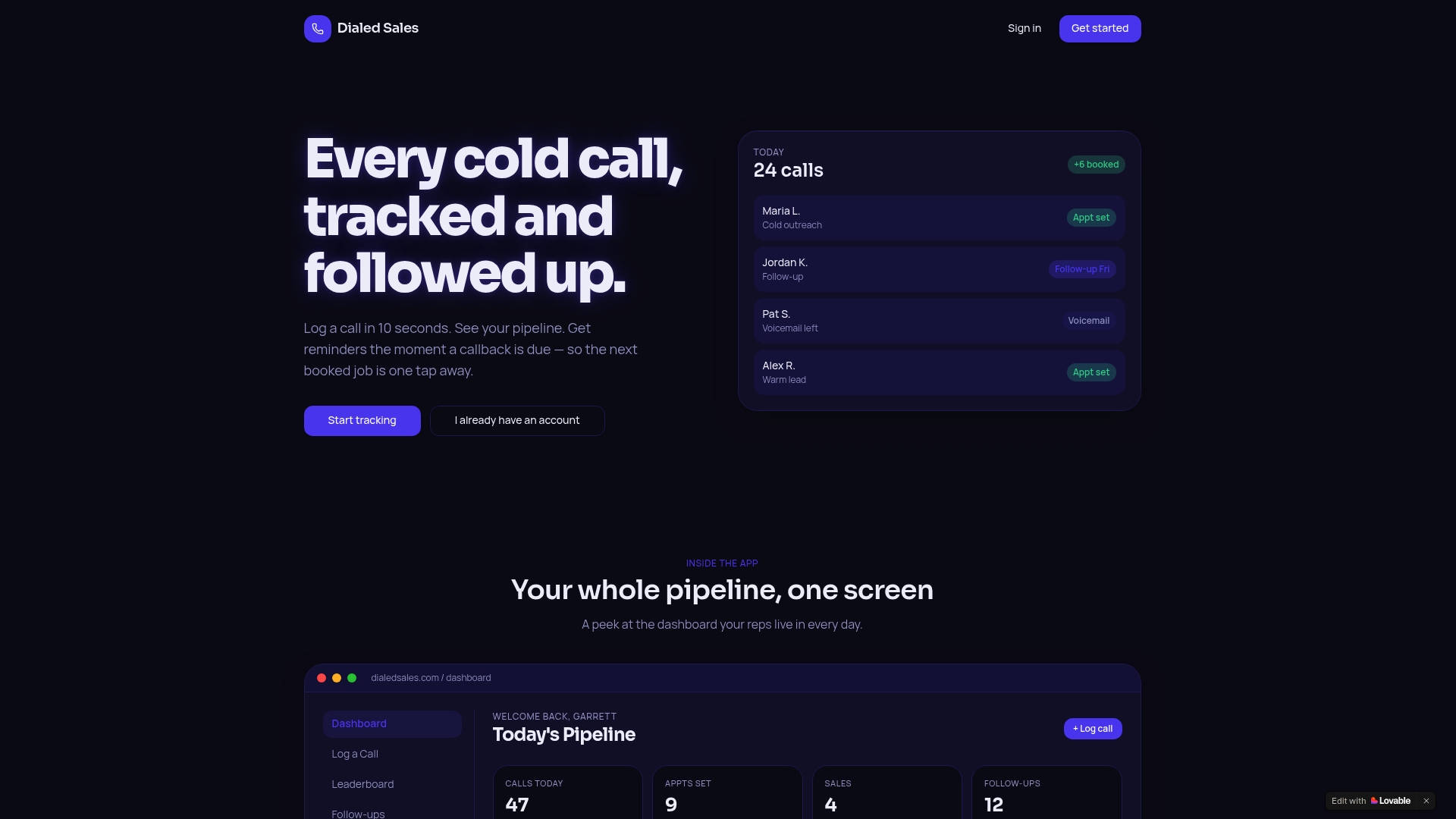
Dialedsales is built for exactly the problem this article describes: too much time on admin, not enough time selling. Log a call in 10 seconds, set a follow-up that surfaces automatically when it is due, and watch your close rate trend in real time without building a single report.
Whether you manage a field team or an inside sales crew, Dialedsales gives you the pipeline visibility and call tracking your team needs to stay focused on what actually closes deals. See which industries it is built for, or go straight to the follow-up tool that stops opportunities from slipping through the cracks.
Key Takeaways
Sales rep productivity is determined by how much revenue your team generates per hour of selling time, not by how many calls they make.
| Point | Details |
|---|---|
| Selling time is the core problem | Reps spend only about 30% of their week selling, with the majority of time going to non-selling activities like admin, meetings, and research. Closing that gap drives more revenue without adding headcount. |
| Measure as a system | Track selling time percentage, win rate, pipeline coverage, and deal cycle length together, not in isolation. |
| Automate the middle mile | Automating repetitive tasks can save reps up to two hours daily, freeing capacity for buyer-facing work. |
| Consolidate tools | Integrated tech stacks produce noticeably higher sales productivity versus fragmented, multi-tool setups. |
| Coach process, not volume | Reps who follow a defined qualification and follow-up process consistently outperform those who simply make more calls. |