
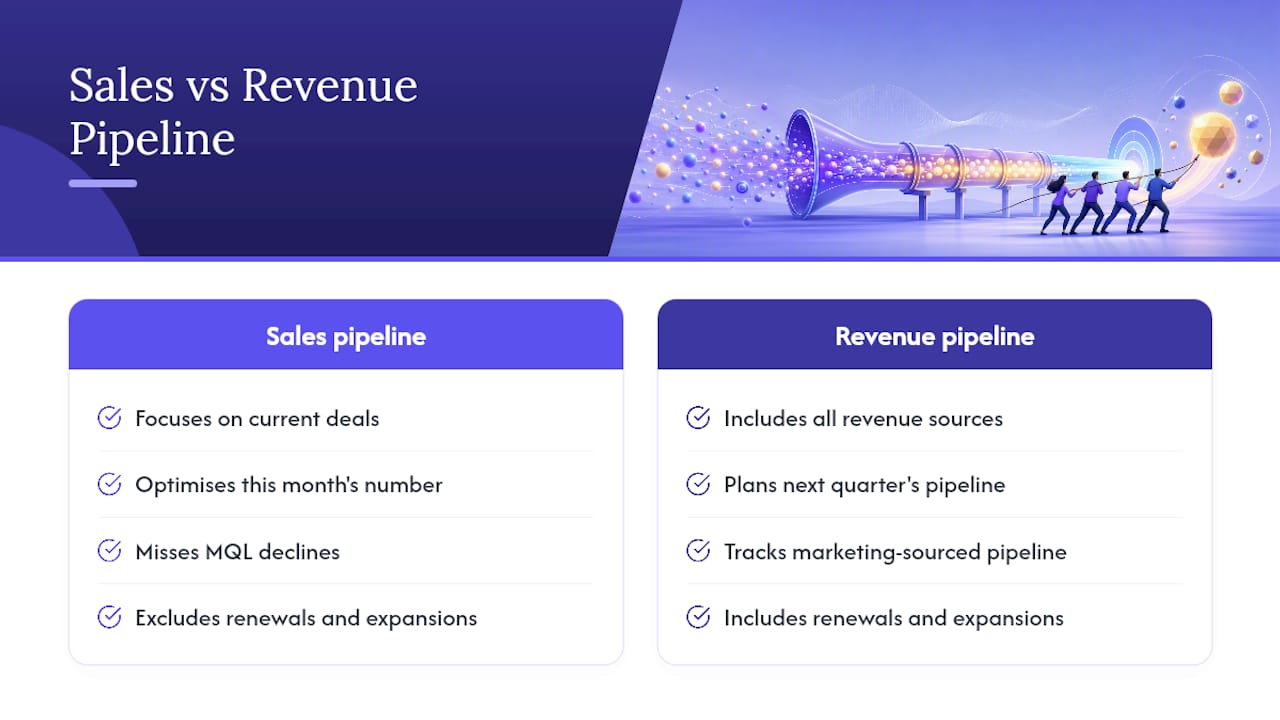
A revenue pipeline is the complete, end-to-end view of every activity that generates revenue for your business, from the first marketing touch through renewal and expansion. A sales pipeline, by contrast, is a narrower, sales-owned snapshot of live deals currently moving toward a close. The revenue pipeline contains the sales pipeline inside it, not the other way around.
What the revenue pipeline typically includes:
- Demand generation (ads, content, events, outbound calls that create awareness)
- Lead capture and qualification (MQLs, SQLs, and the handoff between marketing and sales)
- Active sales opportunities (the deals your reps are working right now)
- Post-sale activities (onboarding, renewals, upsells, and expansion revenue)
Sales and revenue teams use this broader view for quarterly planning, forecasting, and spotting gaps before they become missed targets.
Table of Contents
- Revenue pipeline vs. sales pipeline: what actually differs?
- How do you calculate pipeline revenue?
- A simple template you can copy right now
- Key Takeaways
- The revenue pipeline view most teams skip
- Dialedsales tracks your call-driven pipeline without the complexity
- Useful sources and further reading
Revenue pipeline vs. sales pipeline: what actually differs?
The sales pipeline is a subset of the revenue pipeline. That one sentence settles most of the confusion. Here is how they differ across the five dimensions that matter most for planning:
Scope
- Revenue pipeline: end-to-end activities from demand generation through renewal and expansion
- Sales pipeline: live opportunities from qualification to close
Ownership
- Revenue pipeline: cross-functional (marketing, sales, customer success, finance)
- Sales pipeline: sales-owned, managed at the rep and manager level
Time horizon
- Revenue pipeline: covers the full customer lifecycle, often 12–24 months
- Sales pipeline: short-term, aligned to the current quarter or sales cycle length
Metrics and KPIs tracked
- Revenue pipeline: MQL volume, SQL conversion rate, win rate, renewal rate, net revenue retention, expansion ARR
- Sales pipeline: deal count, average deal size, stage conversion rates, days in stage, quota coverage
Strategic impact
- Revenue pipeline: informs headcount planning, budget allocation, and long-term revenue growth targets
- Sales pipeline: drives quota attainment, rep coaching, and weekly forecast calls
Pro Tip: Use the sales pipeline view in your Monday morning forecast call. Switch to the revenue pipeline view when you are planning next quarter's budget or diagnosing why pipeline volume is thin three months out. They answer different management questions.
How do you calculate pipeline revenue?
Pipeline revenue refers to the expected revenue from deals currently in progress, used to project future cash flows and guide resource decisions. The most practical calculation is the weighted pipeline, which adjusts raw deal value by the probability of closing at each stage.
The formula:
Weighted Pipeline = Sum of (Deal Value × Stage Probability)
Worked example:
| Deal | Stage | Deal Value | Stage Probability | Expected Value |
|---|---|---|---|---|
| Acme Corp | Proposal | $55,250 | a team's historical win rate | — |
| Beta LLC | Negotiation | — | — | — |
| Gamma Inc | Discovery | — | 25% | — |
| Delta Co | Qualify | — | 10% | — |
Weighted Pipeline Total: $55,250
If your quota for the quarter is $100,000, that weighted total tells you immediately that you are short. You need either more deals in the pipeline or deals at higher stages.
The pipeline coverage ratio is the second metric to track. It is calculated as total pipeline value divided by quota. Coverage ratio guidance depends heavily on your historical win rate. Pipeline coverage needs depend heavily on a team's historical win rate; teams with higher win rates require less coverage, while those with lower win rates need more to meet targets. There is no universal "right" number, which is why calibrating to your own historical data matters more than copying a benchmark from a blog post.
The weighted pipeline formula is straightforward to run in any CRM, but its accuracy lives or dies on whether your stage probabilities reflect real historical win rates rather than optimistic guesses. Improving your close rate directly improves the reliability of every weighted forecast you run.
A simple template you can copy right now
You do not need expensive software to start mapping your revenue pipeline. Two generic stage lists, one for B2B SaaS and one for outbound service sales, give you a starting point.
B2B SaaS pipeline stages:
- Marketing Qualified Lead (MQL)
- Sales Qualified Lead (SQL)
- Discovery / Demo Scheduled
- Proposal Sent
- Contract Negotiation
- Closed Won / Closed Lost
- Onboarding Active
- Renewal Pending
- Expansion Opportunity
Outbound service sales pipeline stages (field and cold-call teams):
- Prospect Identified
- First Contact Made
- Appointment Set
- Needs Assessment Complete
- Quote Delivered
- Follow-Up / Negotiation
- Closed Won / Closed Lost
- Job Scheduled / In Progress
- Upsell / Referral Opportunity
For a deeper look at how outbound teams structure their stages, the cold call pipeline stages playbook covers the activity-level detail that generic lists skip.
Sample data row:
| Deal Name | Stage | Deal Value | Probability | Expected Value | Close Timeframe |
|---|---|---|---|---|---|
| Westfield Services | Proposal Sent | — | a team's historical win rate | — | 30 days |
Common mapping pitfalls to avoid:
- Double-counting renewals. A renewal is a distinct revenue event. Do not count it in the same pipeline as the original deal, or your total pipeline value will be overstated.
- Misattributing MQLs. An MQL that came from a paid ad is not the same as one from a referral. Tag the source at creation, not after the fact.
- Lumping upsells with new business. Expansion revenue has a different sales cycle and a different owner. Track it in a separate pipeline view or at minimum a separate stage.
Key Takeaways
A revenue pipeline is the most complete picture of how your business creates, protects, and grows revenue across every stage of the customer lifecycle, from first touch to renewal.
| Point | Details |
|---|---|
| Revenue pipeline vs. sales pipeline | The revenue pipeline spans the full customer lifecycle; the sales pipeline covers only active deals heading to close. |
| Weighted pipeline formula | Multiply each deal's value by its close probability, then sum all opportunities to get your forecast number. |
| Coverage ratio depends on win rate | A team with a 25% win rate needs roughly 4x pipeline coverage; teams with higher win rates require less coverage, while those with lower win rates need more to meet targets. |
| Post-sale stages belong in the model | Onboarding, renewals, and expansion materially affect lifetime revenue and should be tracked in your pipeline. |
| Dialedsales for outbound teams | Dialedsales logs calls in seconds, surfaces follow-up reminders automatically, and shows your live call pipeline on one dashboard. |
The revenue pipeline view most teams skip
Most sales teams I have seen run their business entirely off the sales pipeline. They track deals, stage them, and forecast the quarter. That is fine for hitting this month's number. It is a poor way to run a business.
The revenue pipeline view forces a harder question: where is next quarter's pipeline coming from? If marketing is generating half the MQLs it was six months ago, that gap will not show up in your sales pipeline until it is too late to fix. By the time the deal count drops, you have already missed the window to course-correct.
The other thing teams underestimate is how much revenue lives after the close. Renewals and expansions are not a customer success problem. They are a revenue problem, and they belong in the same model as new business. A company with a strong expansion motion can grow revenue even when new logo acquisition slows. You cannot see that dynamic if you only look at the sales pipeline.
The practical shift is not complicated. Add post-sale stages to your pipeline model. Assign an owner to each one. Review them in the same meeting where you review new business. That single change gives leadership a complete picture instead of a partial one.
Dialedsales tracks your call-driven pipeline without the complexity
For outbound teams, home services, solar, insurance, HVAC, real estate, and financial services reps who build their pipeline one call at a time, the gap between a logged call and a tracked opportunity is where deals fall through.
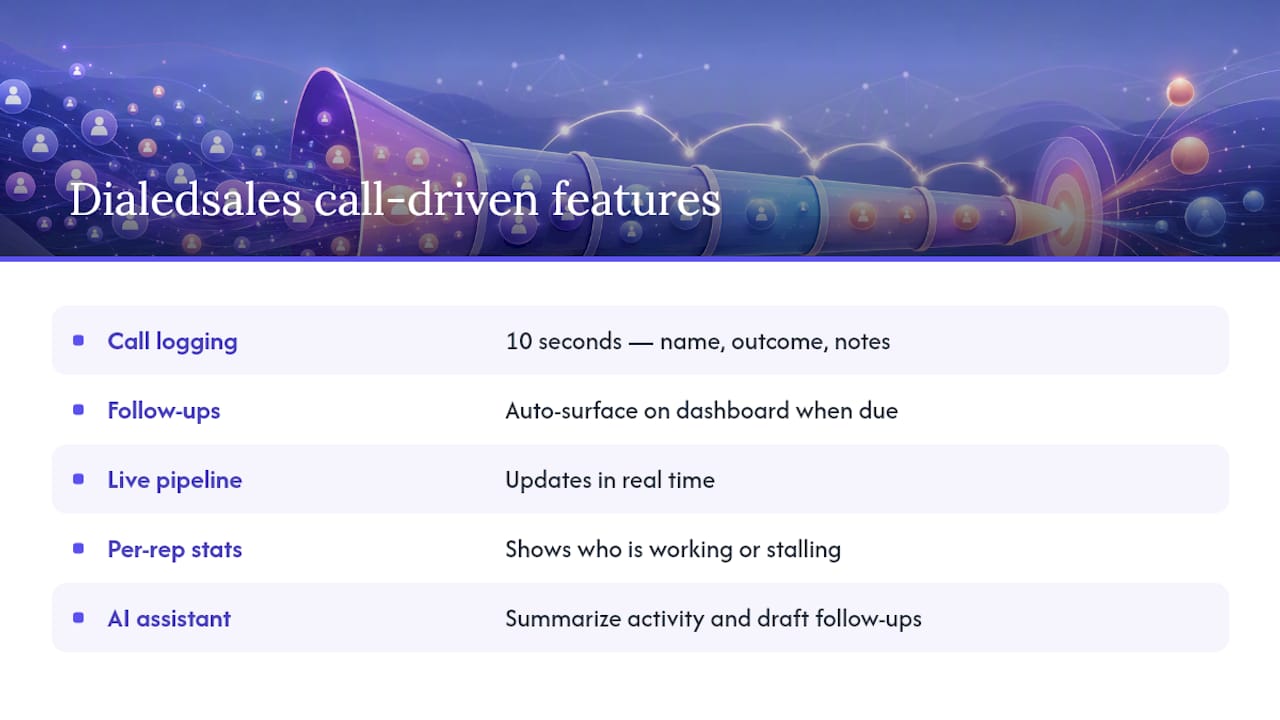
Dialedsales closes that gap. Log a call in 10 seconds with the customer name, outcome, and notes. Set a follow-up date and it surfaces automatically on your dashboard the moment it is due. Your live call pipeline updates in real time, per-rep activity stats show who is working and who is stalling, and the built-in AI assistant helps you summarize activity and draft follow-up messages without switching apps.

It runs on iPhone, Android, and desktop, so field reps and office teams work from the same data. If your pipeline lives in your reps' heads and your follow-ups live in a spreadsheet, that is the problem Dialedsales solves. See how it fits your industry at dialedsales.com and start a free trial today.
Useful sources and further reading
- Revenue Pipeline vs Sales Pipeline: Key Differences
- What is Pipeline Revenue
- What is a sales pipeline? | Definition from TechTarget
- What is Sales Pipeline? | DealHub AI
- What Is a Sales Pipeline? Definition & Math
- What is sales pipeline coverage? Formula, examples, and ideal ratios
- Customer onboarding stats | HubSpot blog