
A sales conversion funnel is a visual, measurable model that maps the path a prospect travels from first contact to closed deal. The term "conversion funnel" is the standard industry phrase; "sales funnel" is the everyday shorthand most teams use interchangeably. Understanding the sales conversion funnel explained in full means knowing not just the stages, but the buyer mindset at each one, the metrics that reveal where deals die, and the fixes that move more prospects through. This article covers all three, with enough depth to change how you manage your pipeline starting today.
What are the key stages of a sales conversion funnel?
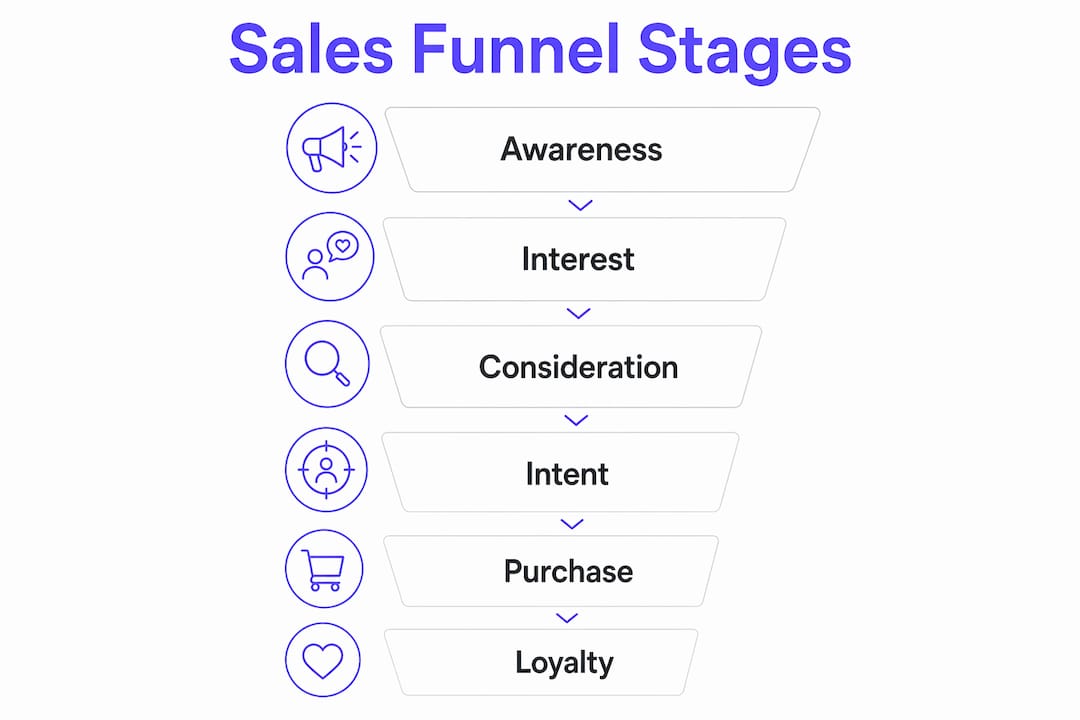
A sales funnel maps six distinct buyer mindsets: Awareness, Interest, Consideration, Intent, Purchase, and Loyalty. Each stage represents a shift in how the prospect thinks, not just where they sit in your CRM. Treating them as mental states rather than administrative labels is what separates high-performing teams from average ones.
The funnel shape itself is intentional. You start with a large pool of prospects at the top and end with a smaller group of buyers at the bottom. Minimizing that "spillage" requires delivering the right content at the right moment for each mindset.

| Stage | Buyer mindset | Marketer/sales goal |
|---|---|---|
| Awareness | "I have a problem" | Generate reach, educate broadly |
| Interest | "I want to learn more" | Capture attention, build credibility |
| Consideration | "Which solution fits me?" | Differentiate, provide proof |
| Intent | "I'm ready to evaluate" | Demo, proposal, handle objections |
| Purchase | "I'm buying" | Close, reduce friction |
| Loyalty | "I'll buy again and refer" | Retain, upsell, generate referrals |
Many teams simplify this into three zones: top of funnel (Awareness and Interest), middle of funnel (Consideration and Intent), and bottom of funnel (Purchase and Loyalty). The simplified model works for reporting. The detailed six-stage model works for diagnosing exactly where you are losing people.
Pro Tip: Map your current CRM stages directly to one of the six buyer mindsets above. If a CRM stage does not match any mindset, it is an administrative label, not a funnel stage. Remove it or rename it.
Which metrics reveal where your funnel is leaking?
Teams track conversion ratios between every stage to find specific bottlenecks. The three ratios that matter most are visitor-to-lead, MQL-to-SQL, and opportunity-to-win. Each one tells a different story about where your funnel is healthy and where it is not.
A high visitor-to-lead rate but low SQL-to-opportunity rate signals wrong traffic targeting, not a sales team problem. That distinction matters because the fix is completely different. Blaming sales when marketing is sending unqualified leads wastes months of effort.
Essential funnel metrics to track:
- Visitor-to-lead rate: What percentage of website visitors submit a form or make contact?
- MQL-to-SQL rate: What percentage of marketing-qualified leads meet sales qualification criteria?
- SQL-to-opportunity rate: What percentage of qualified leads become active pipeline opportunities?
- Opportunity-to-win rate: What percentage of opportunities close as customers?
- Average deal cycle length: How many days does a prospect spend in each stage?
- Stage-to-stage drop-off rate: Where do the most prospects exit without advancing?
Segmented funnel metrics provide sharper diagnostics than aggregate numbers. A strong overall conversion rate can hide a collapsed middle funnel if top-of-funnel volume is unusually high. Always break metrics down by traffic source, product line, and rep to get a clear picture.
Clear entrance and exit triggers at each stage, combined with real-time tracking across your CRM and analytics tools, let you forecast revenue and speed up funnel velocity. Without defined triggers, stages blur together and handoffs between marketing and sales become guesswork.
Pro Tip: Never report a single aggregate conversion rate to leadership. Always segment by source and product. A blended number hides the real problem and delays the fix.
How do you reduce lead leakage and improve conversion rates?
Lead leakage is the silent killer of pipeline health. Prospects enter the funnel but disappear between stages because no one owns the handoff. The fix is systematic, not inspirational.
Follow these steps to tighten your funnel:
-
Define exit and entry triggers for every stage. A demo request is the exit trigger from Consideration. A scheduled discovery call is the entry trigger into Intent. Aligning these triggers prevents leads from falling into the gap between marketing and sales.
-
Audit your MQL-to-SQL handoff first. The transition between MQL and SQL is the most common failure point in B2B funnels. Precise qualification criteria and a defined response time window reduce lost leads at this stage more than any other single fix.
-
Match content to buyer mindset, not CRM stage. A prospect in Consideration needs case studies and comparisons. A prospect in Intent needs a proposal and objection handling. Sending the wrong content at the wrong moment pushes people backward in the funnel.
-
Fix one bottleneck at a time. Funnels improve incrementally. Test a change for at least a week, confirm the metric moves in the right direction, then move to the next stage. Full funnel overhauls create noise that makes it impossible to know what actually worked.
-
Personalize follow-up cadence based on funnel position. A prospect who attended a demo but has not responded needs a different follow-up sequence than one who just downloaded a whitepaper. Funnel position tells you the urgency and the message.
Pro Tip: Log every call outcome against the prospect's funnel stage. Over time, you will see which stage produces the most stalled deals and exactly what the last touchpoint was before they went cold. Dialedsales makes this visible in seconds.
A sales funnel turns unstructured marketing into a measurable system where you can see exactly where visitors enter, where they drop off, and which step needs attention. Without that structure, you are reacting to symptoms instead of fixing causes.
What advanced challenges do experienced teams face with funnel management?
The biggest mistake experienced teams make is treating the funnel as a straight line. Prospects do not move cleanly from stage to stage. They re-evaluate after demos, revisit earlier concerns when a competitor enters the picture, and sometimes go cold at the bottom of the funnel for reasons that have nothing to do with your product.
Common pitfalls that experienced sales professionals still fall into:
- Static stage thinking. Assuming a prospect in Intent will stay in Intent. Buyer priorities shift. A new stakeholder entering the deal can reset the evaluation entirely.
- Ignoring behavioral signals. A prospect who opens your proposal email four times in one day is signaling urgency. A prospect who has not opened anything in two weeks is signaling risk. Funnel stage alone does not capture this.
- Over-reliance on volume metrics. High lead volume feels good. It is not good if the leads are unqualified. Top-of-funnel volume without proportional middle and bottom funnel conversion means your marketing spend is generating noise, not pipeline.
- Misaligned funnel models across teams. Marketing defines MQL one way; sales defines SQL another way. When the definitions do not match, the handoff breaks and both teams blame each other.
Specific funnel stages also vary by business model. Product-led growth companies add stages like trial activation and product-qualified lead that traditional B2B models do not include. If you copy a funnel model from a different business type, you will measure the wrong things and optimize for the wrong outcomes.
The fix for all of these challenges is the same: design your funnel around the buyer's actual decision process, not your internal sales process. Your CRM stages should reflect how buyers think, not how your team reports.
Key takeaways
A well-built sales conversion funnel turns every stage of the buyer's journey into a measurable, fixable system rather than a series of hopeful handoffs.
| Point | Details |
|---|---|
| Six-stage funnel model | Map Awareness through Loyalty to buyer mindsets, not just CRM labels. |
| Three critical metrics | Track visitor-to-lead, MQL-to-SQL, and opportunity-to-win rates to find bottlenecks fast. |
| Exit and entry triggers | Define clear handoff criteria between stages to stop leads from disappearing between teams. |
| Incremental optimization | Fix one funnel stage at a time and test for at least a week before moving on. |
| Buyer-centric design | Build your funnel around how buyers actually decide, not how your sales process is structured. |
Where most teams get the funnel wrong
I have watched sales teams spend months debating funnel stage names in their CRM while their MQL-to-SQL conversion rate quietly collapsed. The naming exercise felt productive. The pipeline did not agree.
The most underrated funnel problem is not a missing stage. It is a missing conversation between marketing and sales about what "qualified" actually means. I have seen companies where marketing celebrates a record month of MQLs while sales is working the same 20 leads they had the month before. The funnel looked full. The pipeline was empty.
The other thing most articles will not tell you: the funnel is not a sales tool. It is a diagnostic tool. Its value is not in the model itself but in the gaps it reveals. When you see a 60% drop between SQL and opportunity, that number is telling you something specific. It is telling you that your qualification criteria are too loose, your discovery calls are not landing, or your timing is off. The funnel does not fix anything. It shows you where to look.
My honest recommendation is to start with the MQL-to-SQL handoff. Fix the definition, fix the response time, and fix the follow-up sequence. That single stage improvement will do more for your close rate than any funnel redesign. Track every call outcome against stage position, and the pattern will become obvious within 30 days.
— Garrett
How Dialedsales fits into your funnel
Knowing your funnel stages is one thing. Tracking what actually happens inside them is another.
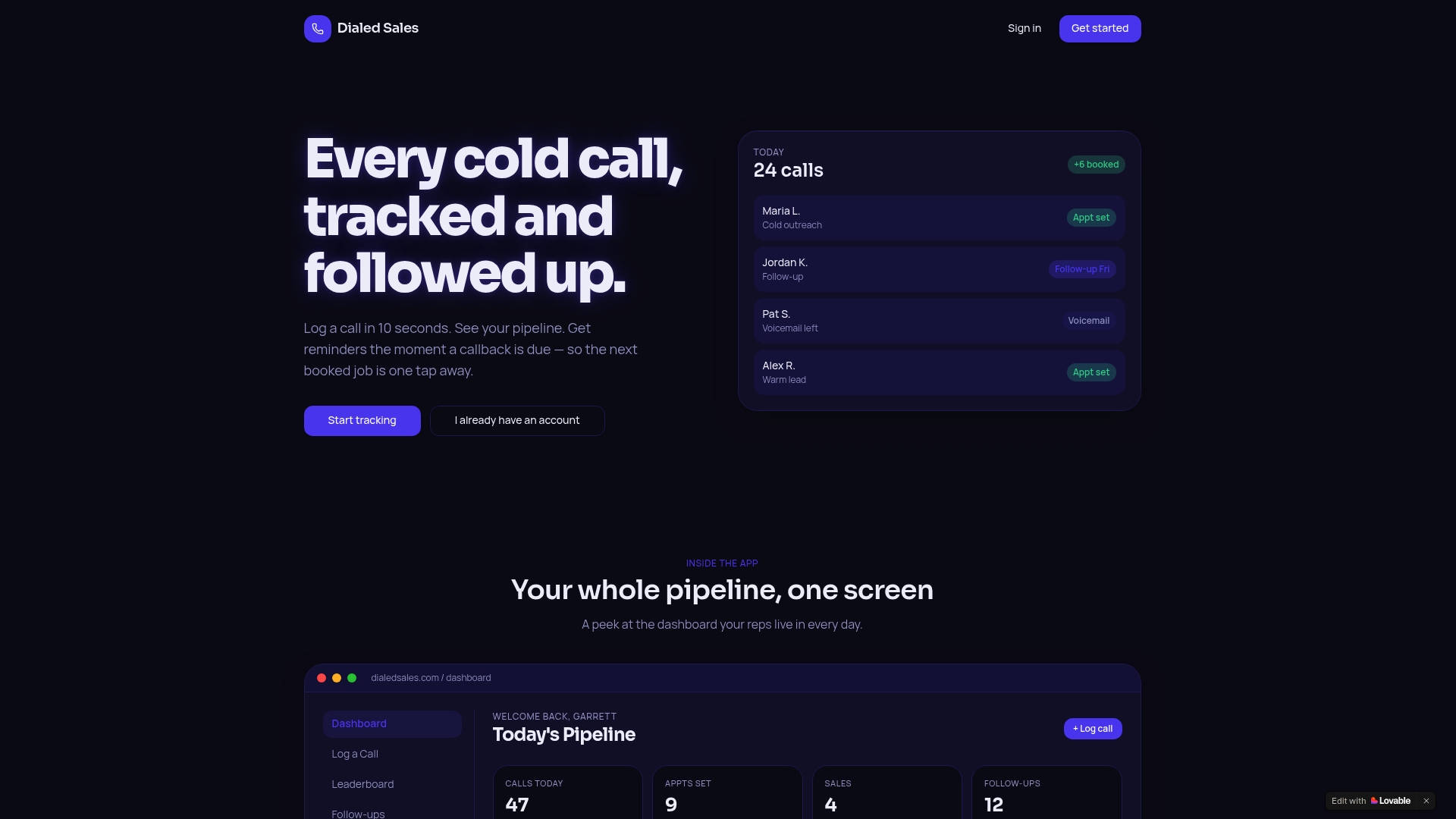
Dialedsales is built for sales reps and field teams who need to log calls fast and see their pipeline clearly. You log a call in 10 seconds, record the outcome and notes, and set a follow-up date that surfaces automatically when it is due. Every outcome ties back to your pipeline so you can watch your close rate move in real time. For teams working to reduce lead leakage and tighten their funnel handoffs, Dialedsales cold call tracking gives you the visibility to act on funnel data instead of guessing. The workflow is simple enough that reps actually use it, which means the data is actually there when you need it.
FAQ
What is a sales conversion funnel?
A sales conversion funnel is a model that maps the stages a prospect moves through from first awareness of a product to becoming a paying customer. It is called a funnel because more prospects enter at the top than exit as buyers at the bottom.
What are the standard sales funnel stages?
The standard model includes six stages: Awareness, Interest, Consideration, Intent, Purchase, and Loyalty. Each stage represents a distinct buyer mindset and requires different content and sales actions to move the prospect forward.
What is the most important funnel metric to track?
The MQL-to-SQL conversion rate is the most critical metric for most B2B teams because it reveals whether marketing is generating leads that sales can actually close. A low rate signals a qualification problem, not a sales performance problem.
How do you fix a leaking sales funnel?
Define clear exit and entry triggers between every stage, audit the MQL-to-SQL handoff first, and fix one bottleneck at a time rather than overhauling the entire funnel at once.
How does a product-led growth funnel differ from a traditional B2B funnel?
Product-led growth funnels include additional stages like trial activation and product-qualified lead that traditional B2B models do not use. The right funnel design depends on your specific buying motion and business model.