
Which sales activity metrics actually move the needle?
The sales activity metrics that matter for cold calling are the ones you control every single day: call attempts, connect rate, conversations started, meetings booked, and follow-up completion. These are leading indicators — they tell you what's happening in your pipeline before revenue numbers do.
Here's the short list every rep should track:
- Call attempts (dials): Total outbound dials in a given period; your volume baseline
- Connect rate: Percentage of dials that reach a live person; typical cold outbound benchmark is a low to moderate connect rate
- Conversations started: Live calls where you actually spoke with a prospect
- Meetings booked: Scheduled next steps resulting from those conversations
- Meetings held: How many booked meetings actually happened (filters out no-shows)
- Follow-up task completion: Whether you executed every promised callback on time
- Time-to-follow-up: How fast you re-engaged after a missed or incomplete call
None of these require a complex CRM. They require discipline and a system that captures them without slowing you down.
Table of Contents
- Why activity metrics beat outcome metrics for daily improvement
- The most important cold call metrics, defined
- Your metrics are a behavioral mirror — read them that way
- How Dialedsales supports cold call tracking in practice
- Best practices for using activity metrics effectively
- Why consistent tracking compounds over time
- How activity metrics reveal sales process health
- Common pitfalls when measuring sales activity metrics
- Dialedsales makes the metrics work for you
- Key Takeaways
Why activity metrics beat outcome metrics for daily improvement
Activity metrics measure what reps directly control — calls, emails, tasks completed. Outcome metrics like revenue and closed deals are lagging indicators: they reflect decisions made weeks or months ago.
If your close rate drops this month, the outcome metric can't tell you why. But if your connect rate dropped three weeks ago, that's the real story. Activity data lets you intervene early, adjust your approach, and fix problems before they show up in your quota numbers.

Focusing only on revenue is like driving by looking in the rearview mirror. The reps who improve fastest are the ones watching the road ahead.
The most important cold call metrics, defined
| Metric | Formula | Why It Matters |
|---|---|---|
| Connect rate | (Live connects / Dials) × 100 | Shows if your list and timing are working |
| Conversation rate | (Conversations / Connects) × 100 | Measures pitch effectiveness on live calls |
| Meeting book rate | (Meetings booked / Conversations) × 100 | Reveals how well you create next steps |
| Meeting show rate | (Meetings held / Meetings booked) × 100 | Filters real interest from polite yeses |
| Follow-up completion | (Tasks completed on time / Tasks set) × 100 | Tracks discipline and CRM hygiene |
Call attempts set the floor. Without enough dials, every downstream metric becomes statistically unreliable. An outbound-focused SDR typically targets a moderate to high number of dials per day, though the right number depends on your market and sales motion.
Connect rate is your first quality signal. The typical cold outbound connect rate benchmark is 6–12%, according to Call Time. If your rate is below 6%, it points to a bad list, wrong call times, or a number that's gone cold. If your rate is above 12%, it suggests strong targeting.
Tasks completed on time is a discipline metric. It shows whether reps are managing follow-ups effectively or letting warm prospects go cold between touches.
Your metrics are a behavioral mirror — read them that way
A rep dialing 80 times a day but booking zero meetings doesn't have an effort problem. They have a messaging or targeting problem. High activity with poor conversion usually signals systemic issues — a bad list, a misaligned pitch, or calls going to the wrong personas.
Here's how to read the patterns:
- High dials, low connects: Check your list quality and call timing
- High connects, low conversations: Your opener isn't earning the next 30 seconds
- High conversations, low meetings booked: Work on your ask and objection handling
- High bookings, low show rate: Expectation-setting during the call needs tightening
- Low follow-up completion: A process or tool problem, not a motivation problem
Managers who use these patterns for data-driven coaching stop saying "make more calls" and start saying "your connect rate dropped Tuesday afternoon — let's look at your call times." That specificity is what actually changes behavior.
How Dialedsales supports cold call tracking in practice
Dialedsales is built for exactly this kind of disciplined tracking. It's a lightweight cold call tracking app designed for reps and field teams across every sales-based industry.
The workflow is fast by design:
- Log a call in 10 seconds with customer name, outcome, and notes
- Set a follow-up date that auto-surfaces on your dashboard the moment it's due
- See your pipeline at a glance without digging through a bloated CRM
- Track every outcome so your close rate trends become visible over time
What makes Dialedsales practical for field reps is the speed. Most tracking tools add friction; this one removes it. When logging a call takes less time than the call itself, reps actually do it. That consistency is what makes the metrics meaningful.
Pro Tip: Use Dialedsales's outcome tracking to spot your personal connect rate trend week over week. A two-week decline is a signal worth acting on before it hits your pipeline.
Best practices for using activity metrics effectively
Set benchmarks from your own historical data, not arbitrary industry averages. A benchmark that doesn't reflect your territory, product, or sales cycle will mislead more than it guides.
- Link activity to outcomes. Track both together. High call volume that never produces meetings isn't effort; it's noise. Pair dials with meeting book rate to see if volume is actually converting.
- Coach on quality, not just quantity. When a rep's conversation rate drops, review call recordings before adding dials to their target.
- Run focused blitz cycles. Effective sales teams use activity metrics to plan short, high-intensity blitz periods rather than grinding at the same pace all quarter. A two-hour call blitz with a clear goal beats a vague "call more" directive.
- Maintain CRM hygiene. Inaccurate logs corrupt every metric downstream. If your data isn't clean, your connect rate calculation is fiction.
Pro Tip: Monitor your Selling Time Ratio — the share of your day spent on actual prospect-facing work versus admin. Excessive admin quietly kills capacity. Even a 10% shift toward selling time can meaningfully increase your weekly dial count.
Why consistent tracking compounds over time
Tracking activity metrics once is interesting. Tracking them every week for three months is where the real value appears. Patterns emerge: which days produce the best connect rates, which call times generate the most conversations, which follow-up cadences keep prospects engaged.
Reps who track consistently also build sales accountability that doesn't depend on a manager watching over their shoulder. The data becomes a self-coaching tool. You see your own trends before anyone else does.
How activity metrics reveal sales process health
Activity metrics don't just measure individual performance. They diagnose the health of your entire sales process. A team-wide drop in meeting show rate points to a qualification problem, not a rep problem. A spike in dials with no corresponding increase in conversations suggests a list or timing issue affecting everyone.
For cold call activity tracking, the connection between activity and pipeline is direct. When activity patterns slip, pipeline health weakens next. When activity is strong but conversions lag, the process needs attention, not the people.
Common pitfalls when measuring sales activity metrics
The biggest mistake is tracking activity metrics in isolation. Dials without connect rate, or meetings booked without show rate, creates a false picture of productivity.
A few others worth avoiding:
- Vanity counting: Logging every dial regardless of whether anyone answered inflates volume without meaning
- Ignoring follow-up metrics: Most deals require multiple touches; a rep who sets no follow-ups is leaving pipeline on the table
- Setting universal benchmarks: An enterprise AE and an SDR have completely different activity profiles; one standard misleads both
- Skipping the "why": When a metric drops, investigate before reacting. A lower connect rate this week might reflect a holiday, not a broken process
Dialedsales makes the metrics work for you
Tracking the right numbers is only half the job. You need a tool that captures them without adding overhead to your day.
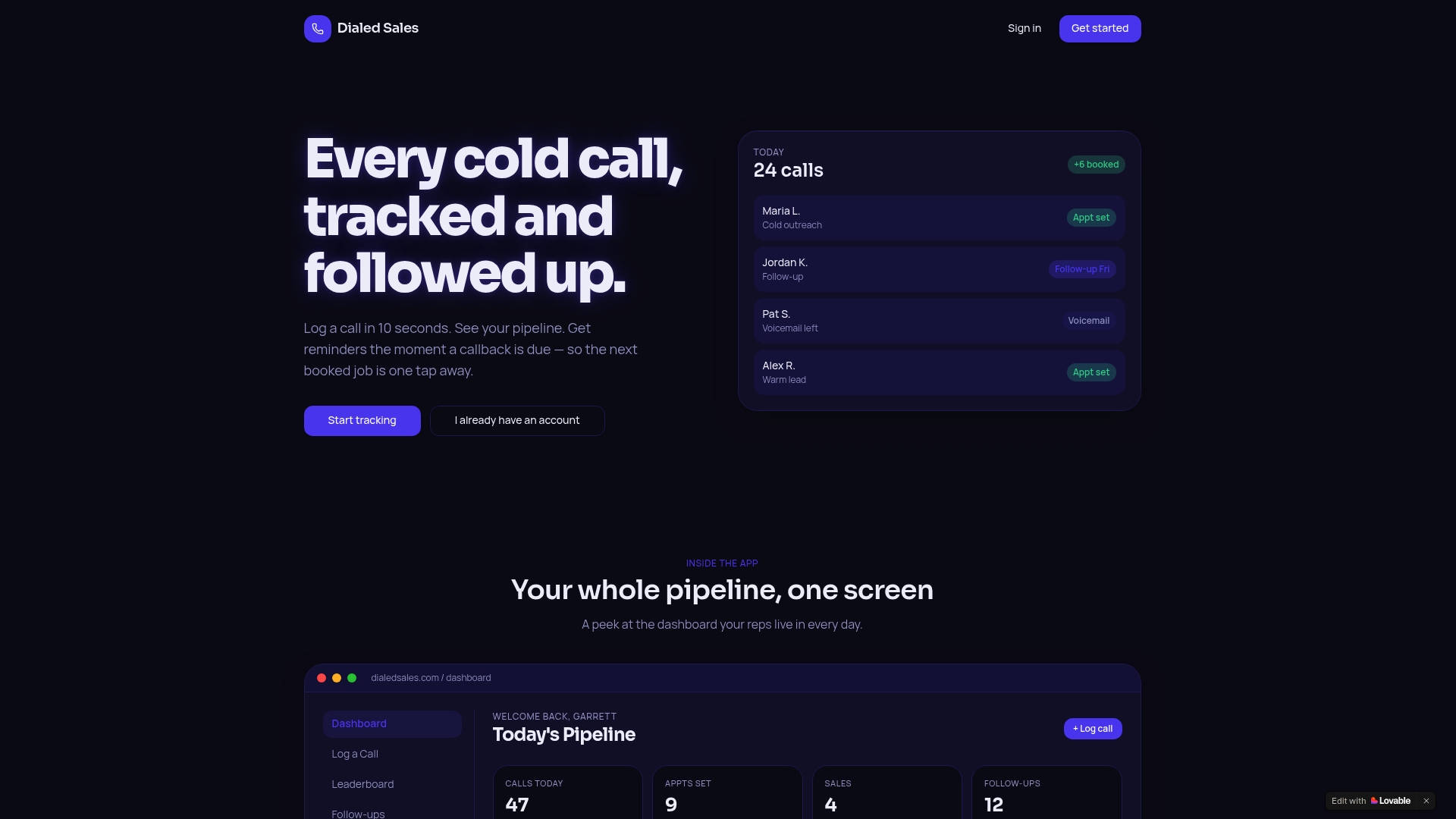
Dialedsales gives field reps and cold call teams a frictionless way to log every call, set every follow-up, and watch their close rate climb over time. No bloated interface, no manual spreadsheets. Just a clean dashboard that shows you exactly where your pipeline stands and what needs attention today. If your current tracking method takes longer than 10 seconds per call, you're losing selling time.
Start tracking your cold calls with Dialedsales and see your activity patterns clearly for the first time.
Key Takeaways
The most effective cold call reps track activity metrics daily and use them to diagnose process gaps before those gaps show up in revenue numbers.
| Point | Details |
|---|---|
| Lead with activity metrics | Connect rate, conversations started, and meetings booked predict pipeline before revenue numbers do. |
| Connect rate benchmark | The typical cold outbound connect rate benchmark is 6–12%, according to Call Time. If your rate is below 6%, it signals a list or timing problem. |
| Behavioral mirror principle | High dials with low meetings booked points to a messaging issue, not an effort problem. |
| Blitz cycles over sustained grind | Short, focused high-activity periods outperform constant low-intensity effort across a full quarter. |
| Dialedsales for field reps | Log calls in 10 seconds, auto-surface follow-ups, and track outcomes to watch your close rate trend upward. |