
The best field sales routine looks like this: rank your accounts before you plan a route, spend 10 to 15 minutes on focused research before every call, walk in with a written agenda of 3 to 5 objectives, and log the outcome within 10 seconds of walking out. That's the whole system. Everything else in this guide is detail on how to run each piece without burning your morning on logistics instead of selling.
Here's the fast version if you're heading out the door right now:
- Before you leave: Tier your accounts (A/B/C), then build today's route around the highest-priority stops, not the closest ones.
- Before each call: Spend 10 to 15 minutes checking company background, stakeholders, and CRM history. Write down 3 to 5 objectives.
- After each call: Log outcome, next step, and follow-up date in under 10 seconds, before you start the car.
Reps who spend 15 minutes or more preparing before a call win roughly 50% more deals than reps who skip prep and improvise. That's not a small edge. It's the difference between a coin flip and a call you were built to win before you knocked on the door.
Key Takeaways
Field sales calls run more efficiently when reps combine priority-based routing, a 10 to 15 minute pre-call research routine, and 10-second post-call logging into one repeatable daily system.
| Point | Details |
|---|---|
| Tier accounts before routing | Rank accounts A/B/C by value or churn risk, then build the day's route around priority, not proximity. |
| Cap pre-call prep at 15 minutes | Cover company background, stakeholders, triggers, and CRM history in a fixed time box. |
| Share a written agenda | Open every call with 3 to 5 objectives stated out loud in the first two minutes. |
| Log outcomes in 10 seconds | Capture outcome, next step, and follow-up date immediately, before starting the next task. |
| Run one small experiment weekly | Test agenda format or prep time against a matched set of calls and track next-step conversion. |
| Use Dialed Sales for fast field logging | Its 10-second logging pattern and automatic follow-up reminders keep the routine from collapsing on a busy week. |
Table of Contents
- Why Field Sales Calls Need a Different System Than Inside Sales
- How to Plan Your Day Before You Start Driving
- The Pre-Call Research Checklist You Can Finish in 15 Minutes
- Structuring the Call: Agenda, Segments, and Time Allocation
- How to Prepare Differently for Each Type of Call
- Cutting Admin Time Without Losing Data Quality
- Which Tools Actually Support This Workflow?
- Measuring What Matters and Adjusting the Routine
- A Field-Tested 15-Minute Pre-Call Routine You Can Copy Today
- Five Preparation Mistakes That Quietly Kill Deals
- Working With Inside Sales and Support to Extend Field Reach
- Staying Safe on Field Sales Visits
- Why Discipline Beats Talent in Field Sales
- Try the Lightweight Way to Keep This Routine Alive
- Frequently Asked Questions
- Sources
Why Field Sales Calls Need a Different System Than Inside Sales
An inside sales rep who blows a call can dial the next lead in 90 seconds. A field rep who blows a call just lost an hour of drive time, a parking spot, and often the rest of the afternoon's schedule. That asymmetry is the entire reason field sales needs its own organizational rules instead of borrowed inside-sales habits.
Three things compound against you in the field that don't exist at a desk:
- Travel time turns a 30-minute meeting into a 90-minute commitment once you count the drive there and back.
- Cancellations hit harder because you can't fill the gap with another dial. A no-show mid-route can strand you with 45 dead minutes and no backup plan.
- Admin drain eats into windshield time or evening hours if you're not logging calls on the spot, and that backlog compounds daily until Friday becomes a two-hour data-entry session.
The American Psychological Association's research on multitasking found that switching between tasks, like trying to review notes while driving to the next stop, measurably slows performance and increases errors compared to single-tasking. That's a direct argument against "I'll review my notes at the next light." Prep happens before you drive, not during.
The knock-on effect shows up in how you sequence a day. If cancellations and drive time are guaranteed costs, your visit order and account priority have to absorb that risk instead of your calendar. A field sales strategy that ignores this reality is really just an inside sales script with a car attached.
How to Plan Your Day Before You Start Driving
Route planning that starts with a map is backwards. Route planning that starts with account value works. FieldPie's research on field sales routing found that prioritizing account value before geography reduces windshield time and increases the number of genuinely productive visits per day, compared to routes built purely on proximity.
Start with tiering, not a map:
- Tier A accounts get visited weekly or biweekly. These are your highest revenue accounts or the ones most at risk of churn.
- Tier B accounts get monthly visits. Steady, but not urgent.
- Tier C accounts get quarterly check-ins or a phone touch instead of a drive.
Once you know which accounts matter most this week, build the route around them, then cluster the remaining stops by geography to avoid crisscrossing your territory. A structured daily workflow helps here, because time-blocking only works if you protect the blocks instead of letting the first cancellation eat your whole afternoon.
A typical 8 to 10 call day might look like this:
| Time Block | Activity |
|---|---|
| 7:30 to 8:00 AM | Review route, confirm appointments, check CRM history |
| 8:00 AM to 12:00 PM | Morning calls (3–4 visits, priority accounts first) |
| 12:00 to 12:30 PM | Lunch, batch quick admin (log morning outcomes) |
| 12:30–4:30 PM | Afternoon calls (4–5 visits) |
| 4:30 to 5:00 PM | End-of-day CRM cleanup and next-day prep |
Pro Tip: Keep a backup list of 5 to 8 secondary contacts in each territory zone. A pharma field team scheduling model shows that reps who keep a ready backup list recover a canceled slot in minutes instead of losing the whole window to an empty calendar gap.
Routing tools like Spotio and Map My Customers exist specifically to solve the clustering problem: they take your tiered account list and suggest a driving order that minimizes backtracking. Even a basic version of this, done manually on a paper map, beats winging it by feel.
The Pre-Call Research Checklist You Can Finish in 15 Minutes
Fifteen minutes of focused research before a call beats an hour of scattered browsing the night before. The reps HubSpot studied for its pre-call planning guide consistently outperformed peers who skipped structured prep, and the difference wasn't more research. It was better-targeted research.
Four areas cover almost everything you need:
- Company background: recent news, funding, leadership changes, or expansion signals.
- Stakeholder mapping: who you're meeting and who else influences the decision.
- Trigger events: a new hire, a competitor loss, an expiring contract, anything that explains "why now."
- CRM history: past notes, prior objections, and any commitments made on the last call.
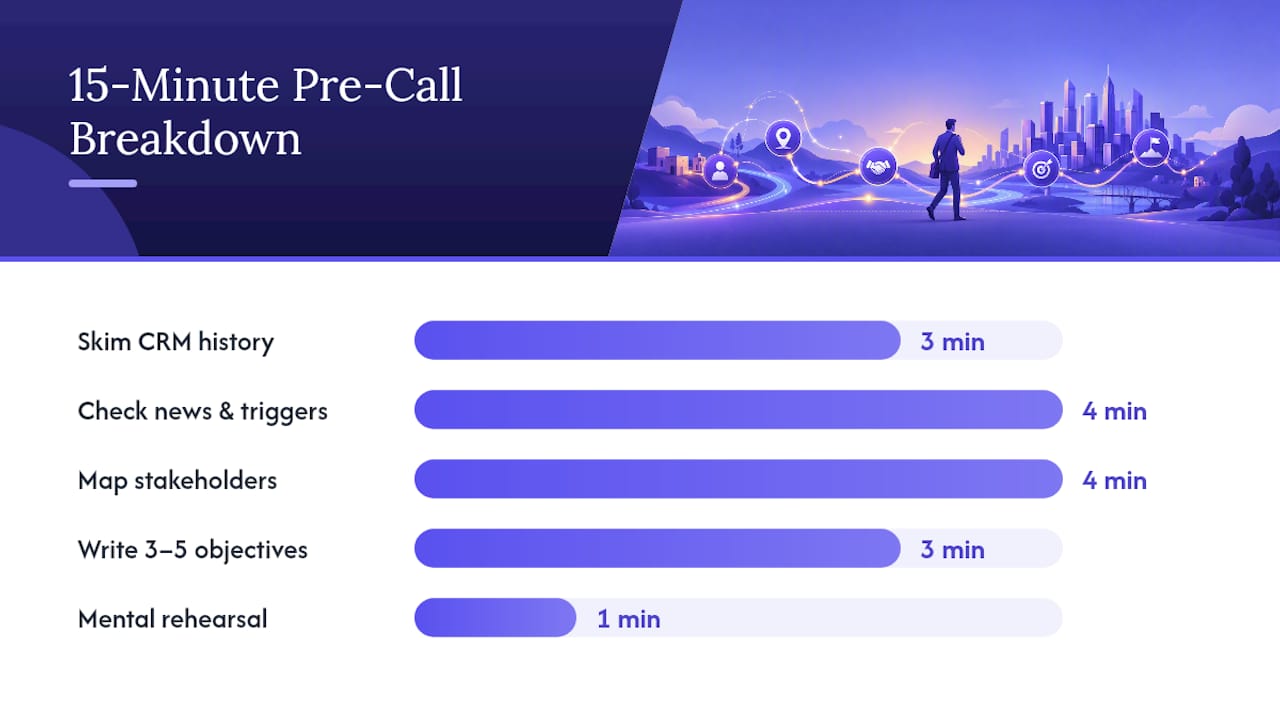
Here's how that time actually breaks down:
| Minutes | Task |
|---|---|
| 0–3 | Skim CRM history and last call notes |
| 3–7 | Check company news, LinkedIn updates, recent triggers |
| 7–11 | Map stakeholders: who's attending, who else matters |
| 11–14 | Write 3–5 call objectives based on what you found |
| 14–15 | Quick mental rehearsal of your opener |
For stakeholder mapping specifically, look for four roles: the economic buyer who signs off on budget, the champion who wants your solution to win internally, the technical evaluator who checks the fine print, and the blocker who has a reason to say no. You won't always meet all four in one visit, but knowing who's missing tells you what your next call needs to accomplish.
Pro Tip: Top-performing reps tend to research more data points per prospect than average reps, but the gap isn't about volume for its own sake. It's about picking the three or four facts that actually change how you open the conversation.
Over-researching is a real trap. If you're 20 minutes into prep and still reading, you've crossed from useful to procrastination. A good rule: if a fact doesn't change what you'll say or ask in the first five minutes, skip it.
Structuring the Call: Agenda, Segments, and Time Allocation
A call without a written agenda is a conversation. A call with one is a meeting that produces a decision. RAIN Group's research on sales call planning found that reps who share a written agenda with 3 to 5 objectives at the start of a call convert to an explicit next step significantly more often than reps who wing the structure.
Share the agenda in the first two minutes, out loud or on a shared screen: "Here's what I'd like to cover today: your current process, where it's breaking down, how our approach handles that, and what a next step would look like if this makes sense." That single move sets expectations and gives you permission to redirect if the conversation wanders.
For a standard 30-minute discovery call, allocate time like this:
| Segment | Minutes | Purpose |
|---|---|---|
| Opening and agenda | 2–3 | Set expectations, confirm time available |
| Discovery questions | 10–12 | Understand pain, priorities, and process |
| Tailored pitch or demo | 8–10 | Connect your solution to what you just heard |
| Objections and questions | 4–5 | Address concerns directly |
| Next steps | 2–3 | Lock in a specific date and action |
Shorter or longer meetings compress proportionally. A 15-minute call might spend just 60 seconds on the agenda, 6 to 8 minutes on discovery, and the rest on a tight next-step close. A 60-minute meeting, often a demo or a deeper technical session, can afford 20 minutes of discovery and 20 minutes of tailored demo without losing focus.
Pro Tip: End every call with a specific date, not "I'll follow up soon." "Let's plan for Thursday at 2 PM" produces a real next step. "I'll check back with you" produces nothing on either calendar.
If a call runs long on one segment, that's a signal to steer back, not push through. Watching the clock against your agenda is how you catch a stalled conversation before it eats your next appointment.
How to Prepare Differently for Each Type of Call
Not every call deserves the same 15 minutes of prep. A cold outreach visit and a signed-customer follow-up require completely different homework.
Cold outreach calls need speed, not depth. Identify one or two trigger events (a new location opening, a leadership change, a competitor complaint you heard about), prepare two or three opening hooks tied to those triggers, and do a quick verification check to confirm the business is still operating and the contact still works there. Nothing kills a cold visit faster than walking in on outdated information.
Discovery calls run on questions, not statements. Pull from MEDDIC or BANT frameworks to prioritize a handful of must-ask questions, then keep 8 to 12 reserve questions organized by priority in case the conversation opens doors you didn't expect. A workable question bank:
- "What's driving you to look at this now?"
- "Who else is involved in this decision?"
- "What have you tried before, and why didn't it stick?"
- "What does success look like six months from now?"
- "What's your timeline for making a change?"
- "What budget range have you set aside for this?"
- "What would stop this from moving forward?"
- "Who's most affected by the current process?"
Demo calls fail when reps show every feature instead of the three that matter. Pick three use cases tied directly to what discovery revealed, and skip the rest. A feature dump signals you weren't listening earlier.
Follow-up calls should open by reviewing outstanding items from the last conversation, propose an exact next step (not a vague check-in), and surface one piece of new value, a case study, a relevant update, something that justifies the meeting happening now rather than next month.
Cutting Admin Time Without Losing Data Quality
The fastest way to kill a field sales routine is to make logging a call feel like homework. If it takes five minutes to update a record, reps skip it, and the CRM turns into a graveyard of half-finished notes nobody trusts.

The fix is a logging pattern that fits in three fields: outcome, next step, and follow-up date. That's it. "Interested, wants pricing by Friday, follow-up 3/14" takes 10 seconds to type on a phone in a parking lot. Compare that to a rep who waits until evening to write a paragraph of notes from memory, half of which are already wrong.
A few field-tested habits make this stick:
- Use voice-to-text for the outcome field while walking back to your car.
- Set a personal rule: no next call starts until the last one is logged.
- Batch anything beyond the three core fields, like detailed conversation notes, into an end-of-day 15-minute window instead of doing it call by call.
Not every CRM field deserves equal attention in the moment. Outcome, next step, and follow-up date are what managers actually use for coaching and forecasting. Deeper notes on objections or competitive mentions matter, too, but they can wait until your evening batch without losing value. Setting follow-up dates correctly is often the single highest-leverage field in the whole system, since a missed follow-up date is a missed deal regardless of how good your notes were.
A manager reviewing a week of three-field logs can spot patterns fast: which reps are converting discovery calls to demos, which are stalling at "interested" without ever locking a next step, and where the pipeline is quietly dying. That visibility is worth more than a paragraph of prose nobody rereads.
Pro Tip: If your logging takes longer than your drive to the next stop, the system is too complicated. Simplify until it fits in the time it takes to buckle your seatbelt.
Which Tools Actually Support This Workflow?
Four categories of tools cover almost everything a field rep needs, and picking the wrong one in any category adds friction instead of removing it.
CRM platforms like HubSpot handle the system of record: contact history, deal stages, and reporting. They're built for depth, which is exactly why they're often clunky for quick field updates typed on a phone between visits.
Routing and territory tools in the Spotio and Map My Customers category solve the clustering problem from earlier: turning a tiered account list into an efficient driving order instead of a random string of addresses.
AI prep tools, similar to what MyKO.ai offers, can generate account summaries or suggested talking points from CRM and public data before a call. Practitioner reports suggest AI-assisted prep tools reduce the time reps spend gathering context, which matters directly if your goal is a 15-minute prep window instead of 30.
Lightweight call trackers fill the gap the other three leave open: fast, mobile-first logging that doesn't require a laptop or a five-minute form. This is where a tool built specifically for quick outcome capture, follow-up reminders, and simple activity visibility earns its place in a rep's daily kit, without duplicating everything a full CRM already does.
When picking tools in any of these categories, four criteria matter more than feature lists:
- Offline access, since cell coverage in some territories is unreliable.
- Integration with whatever CRM your team already runs.
- Simplicity, because a tool reps avoid using is worse than no tool at all.
- Logging speed, measured in seconds, not minutes.
Templates make all of this repeatable instead of reinvented daily: a pre-call worksheet covering the four research areas, a 30-minute agenda template with the time allocations above, and a discovery question bank organized by priority. Reps who keep a repeatable prospecting workflow on hand spend less time deciding what to do next and more time doing it.
Measuring What Matters and Adjusting the Routine
Field sales activity is easy to track and easy to track badly. The trap is measuring effort (calls made, miles driven) instead of outcomes (deals moved forward, follow-ups completed on time).
Six metrics cover the essentials, mixing leading and lagging indicators:
- Visits per day (leading): are you hitting your planned volume?
- Contact rate (leading): what percentage of planned visits actually happen?
- Meeting-to-next-step conversion (leading): how often does a call end with a concrete next action?
- Talk-to-listen ratio (leading): are you dominating discovery calls instead of asking questions?
- Follow-up completion rate (lagging): are promised follow-ups actually happening on schedule?
- Close rate (lagging): the ultimate scoreboard, but too slow-moving to adjust daily behavior.
Prospeo's field sales benchmarks treat visits per day and talk/listen ratio as core leading indicators precisely because they're fast to measure and predictive of downstream results, unlike close rate, which lags weeks behind the behavior that caused it.
Small experiments beat sweeping process overhauls. Try a two-week test: half your calls use a written agenda shared out loud, half don't, and you compare next-step conversion between the two groups. Or test 15 minutes of prep against zero prep on a matched set of similar accounts. You don't need a large sample to see a real signal here.
Review the numbers weekly, not monthly. A pipeline review checklist gives managers a structure for that weekly look, and a rep doing solo review can use the same six metrics on a smaller scale.
A Field-Tested 15-Minute Pre-Call Routine You Can Copy Today
Here's the exact sequence, broken into minutes, that turns "prep" from a vague good intention into something you actually do before every call.
- Minutes 0–3: Pull up CRM history. Read the last three notes on this account, if they exist. Flag any open commitments from the last visit.
- Minutes 3–7: Check for trigger events. Quick search on company news, a scan of LinkedIn for leadership changes, anything that answers "why does this matter now?"
- Minutes 7–11: Map the room. Who's attending? What role do they play? Is the economic buyer in this meeting or somewhere upstream?
- Minutes 11–14: Write your agenda. Three to five objectives, in order of priority, ready to say out loud in the first two minutes.
- Minutes 14–15: Rehearse your opener once, out loud if you're alone in the car. It sounds strange. It works.
The logging habit that pairs with this routine is just as simple:
- Outcome: one phrase ("interested, needs pricing," "not ready, revisit Q3," "champion identified, needs technical sign-off").
- Next step: the specific action ("send proposal," "schedule demo," "check in after budget cycle").
- Follow-up date: an exact date, never "soon."
Rolling this out across a team works better as a habit experiment than a mandate. Ask reps to try the 15-minute routine for one week and compare their own next-step conversion before and after. People adopt what they can see working in their own numbers faster than what a manager tells them to do.
Pro Tip: Track adoption, not just outcomes, for the first two weeks. If half your team isn't doing the routine, the results won't show up in the aggregate data, and you'll wrongly conclude the system doesn't work.
Five Preparation Mistakes That Quietly Kill Deals
Most lost field sales opportunities trace back to one of five preventable errors, and HubSpot's research on pre-call planning flags all five as common across sales teams regardless of industry.
| Mistake | Fix |
|---|---|
| Over-researching before a call | Cap prep at 15 minutes; if a fact won't change your opener, skip it |
| Skipping stakeholder mapping | Ask "who else is involved?" on the previous call, every time |
| No written agenda | Share 3–5 objectives out loud in the first two minutes |
| Feature-dumping in demos | Pick three use cases tied to discovery, ignore the rest |
| Weak follow-up cadence | Propose an exact date before you leave, never "I'll check in" |
Over-researching feels productive because you're doing something, but it burns the exact time budget that should go toward rehearsing your opener or reviewing objections. Skipping stakeholder mapping means you often don't find out the real decision-maker wasn't in the room until three calls in. And feature-dumping is the fastest way to lose a prospect's attention. Showing everything signals you weren't paying attention during discovery.
Working With Inside Sales and Support to Extend Field Reach
Field reps can't be everywhere, and trying to personally visit every account on a list is how territories get neglected. Coordinating with inside sales solves the coverage gap: inside teams handle lower-tier accounts by phone, qualify new leads before they're worth a drive, and pick up warm follow-ups between in-person visits.
A practical split looks like this: inside sales owns Tier C accounts and initial qualification calls, while field reps focus their drive time on Tier A and B accounts where an in-person visit actually moves the deal. When a field rep uncovers a strong lead during a visit that isn't worth an immediate follow-up trip, handing it to inside sales for phone-based nurturing keeps the opportunity alive without burning windshield time on a low-priority stop.
Support teams matter here too, especially post-sale. A field rep who closes a deal but never loops in support on implementation details ends up fielding technical questions they're not equipped to answer, which slows onboarding and creates friction that shows up later as churn risk. A quick handoff note, using the same three-field logging habit from earlier, gives support enough context to take over without a redundant discovery call of their own.
The coordination point that gets missed most often: shared visibility. If field, inside, and support teams are logging activity in different systems with no shared view, nobody notices when the same account gets contacted three times in a week by three different people. A shared activity log, even a simple one, prevents that kind of overlap.
Staying Safe on Field Sales Visits
Field sales work carries physical realities that inside sales never has to think about: unfamiliar locations, driving in unpredictable conditions, and meetings with people you've never met in person before.
A few baseline protocols reduce real risk without slowing you down:
- Share your daily route and expected visit times with a manager or teammate before you leave.
- Trust your instincts about a location or situation that feels off, and have a standard reason ready to leave early if needed.
- Keep your phone charged and easily reachable, not buried in a bag, in case you need to make a quick call.
- Avoid scheduling first-time meetings at isolated locations when a public or well-trafficked alternative is available.
- Build in buffer time between visits so a bad-weather drive doesn't push you into rushing the next appointment.
None of this needs to feel dramatic. Most field sales days are routine. But a route plan that includes basic check-in habits protects you on the rare day that isn't, and it costs almost nothing to build into the same morning planning routine covered earlier.
Why Discipline Beats Talent in Field Sales
The most talented rep on a mediocre routine loses to an average rep running a disciplined one, consistently, over a full quarter. It's a habit gap.
What gets underestimated most is how much the routing decision, not the pitch, determines a week's results. Reps obsess over what to say in the room and barely think about which room they walk into first. But priority-first routing means your best pitch, delivered on your sharpest morning, lands on your highest-value account instead of whichever stop happened to be closest to your house.
The other underestimated piece is logging discipline. Teams treat CRM hygiene as an administrative chore imposed from above, when it's actually the raw material for every coaching conversation and every route adjustment that follows. A manager can't fix a broken pipeline they can't see clearly, and a three-field log entered consistently beats a detailed paragraph entered sporadically, every time.
Field teams that build their process around a tool like Dialed Sales tend to stick with the routine longer, not because the app does the selling for them, but because logging friction drops low enough that the habit survives a busy week instead of collapsing the first time someone's running late.
Try the Lightweight Way to Keep This Routine Alive
Dialed Sales is built for exactly the moment this whole guide keeps circling back to: the ten seconds after you walk out of a call, when you either log it or you don't. Heavier CRMs ask for a form. Dialed Sales asks for three things: customer name, outcome, and notes, entered fast enough to do from the driver's seat before you pull out of the lot.
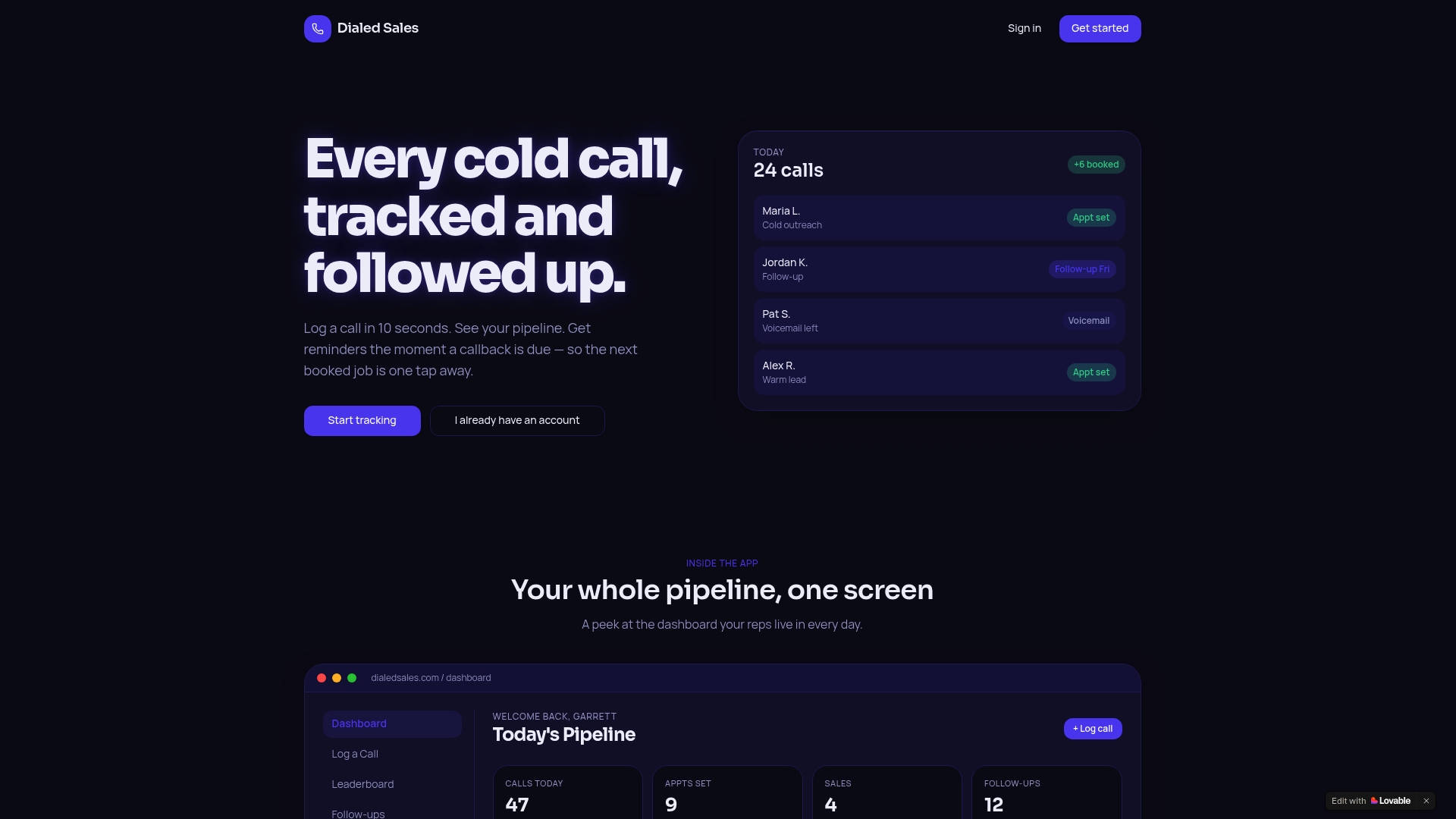
The follow-up reminder feature solves the other failure point covered earlier: the vague "I'll check back soon" that never turns into an actual date on anyone's calendar. Set the date once, and it surfaces automatically on your dashboard the moment it's due, so nothing slips because you forgot to check a spreadsheet. Add the live pipeline dashboard and per-rep activity stats, and a manager gets the same visibility into a field team's week that used to require chasing five people for status updates.
For teams weighing a full CRM rollout against something lighter, the honest answer is that both have a place. A heavyweight platform still owns long-term account history and reporting. But for the daily grind of logging outcomes between visits, a tool built specifically for cold-call and field tracking removes friction a general-purpose CRM was never designed to solve.
Dialed Sales works across iPhone, Android, and desktop, with a free trial to test the workflow against your own territory. Start the trial at Dialed Sales and see whether your close rate moves in the first two weeks.
Frequently Asked Questions
How long should pre-call prep take for a field sales visit? Ten to fifteen minutes is the sweet spot. Reps who prepare in that window tend to significantly outperform reps who skip prep entirely, while pushing past 20 to 30 minutes usually means you're researching facts that won't change how the call actually goes.
What's the fastest way to organize a field sales territory? Tier your accounts by value or churn risk first, then build routes around geography within each tier. Prioritizing account value before proximity cuts unnecessary drive time and puts your best calls on your sharpest hours.
How many objectives should a sales call agenda include? Three to five objectives, shared out loud or on screen in the first two minutes of the call. Fewer than three usually means the call lacks direction; more than five tends to overwhelm the conversation and dilute focus.
What should a rep log after every field sales call? Three fields cover what matters most: the outcome, the next step, and a specific follow-up date. Deeper conversation notes can wait for an end-of-day batch session without losing coaching value.
How do field reps handle a canceled or no-show appointment? Keep a backup list of five to eight secondary contacts in each territory zone so a canceled slot can be filled within minutes instead of leaving a dead gap in the schedule.
Sources
A handful of sources back the routines in this guide, and most include templates you can adapt directly:
- Pre-call planning: A comprehensive guide to effective sales calls (HubSpot)
- Sales Call Preparation: B2B Pre-Call Playbook | Sendspark
- Field Sales Route Planning: Cut Drive Time & Boost Visits (FieldPie)
- Field Sales in 2026: Benchmarks, Strategy & Playbook (Prospeo)
- Sales Call Planning Guide (RAIN Group via RainSalesTraining blog)