
What does a sales rep's daily workflow actually look like?
The sales rep daily workflow explained simply: it's a structured sequence of prospecting, outreach, follow-ups, meetings, and admin tasks built to protect selling time and keep the pipeline moving. Top-performing reps don't wing it. They run a repeatable daily routine where every hour has a job.
Here's what a typical mid-market SDR day covers:
- Pre-shift prep (7:30–9:00 AM): Inbox triage, overnight reply review, target account refresh, and building a prioritized dial list of 50–60 contacts
- Morning call block (9:00–11:30 AM): The highest-converting window of the day. Mid-market SDRs target a full slate of calls, personalized emails, and LinkedIn touches daily
- Midday touches (11:30 AM–12:30 PM): Email replies, LinkedIn outreach, inbound lead booking, and sequence updates
- Lunch (12:30–1:15 PM): A real break away from the screen. Non-negotiable for afternoon energy
- Afternoon call block (1:15–3:00 PM): West Coast and Central time zone targets, plus callbacks from the morning
- Discovery calls and demos (3:00–4:30 PM): Active deal progression with booked prospects
- End-of-day pipeline review (4:30–5:15 PM): CRM logging, sequence updates, and building tomorrow's call list
The reps who consistently hit quota don't have more talent. They have a better daily structure and they protect it.
Breaking down the daily tasks for sales reps
The inside sales daily activity guide isn't just about call counts. Each task category has a specific purpose and a right time to happen.
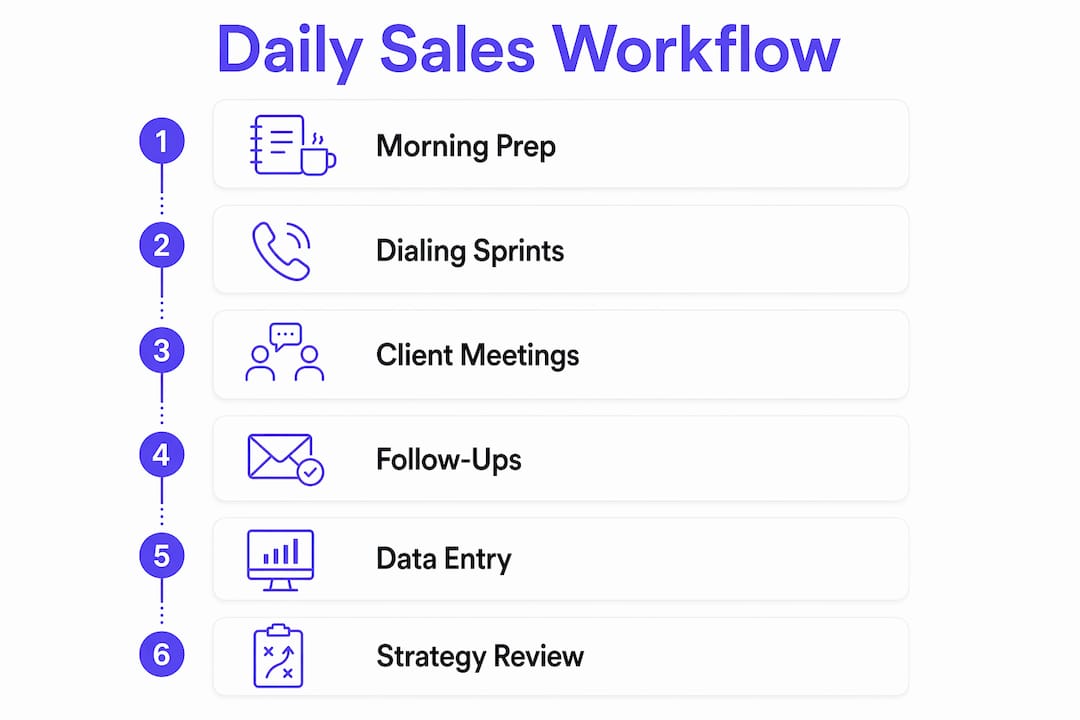
Pre-call research sets the tone for every conversation. Before dialing, reps scan LinkedIn activity, recent company news, job postings, and funding announcements for their top accounts. A 5-minute prep per named account is enough to find one specific opener that makes you sound like a peer instead of a cold caller.
Here's the full task breakdown:
- Account research: LinkedIn profile review, company news scan, trigger event identification (funding, hiring, leadership changes)
- Call blocks: Dialing sequence with voicemail strategy (12-second personalized voicemails, not canned drops), gatekeeper handling by name, and live connect approach with a specific reason for calling. Typical daily targets are 50–60 calls, 20–30 personalized emails, and 10–15 LinkedIn touches.
- Follow-up emails: Personalized responses referencing what the prospect actually said, not generic "thanks for your time" templates. Multi-channel outreach combining phone, email, and LinkedIn increases engagement by up to 4.7x versus single-channel approaches
- LinkedIn touches: 5–10 connection requests with a one-line note, 3–5 InMail messages, and 3–5 post engagements per day
- Inbound lead handling: Inbound leads under five minutes old break the call block. Speed-to-lead beats batching every time
- CRM hygiene: Every dial logged, every disposition set, every next step dated. Cold calling at 40–60 daily attempts yields roughly 2–4 live conversations and about 0.5–1 qualified meeting per day
- Discovery and demo calls: Active deal progression scheduled in the afternoon when prospects are past their morning meeting crunch
- Pipeline updates: Moving every deal forward by one stage before the day ends, not letting deals sit stale
The difference between a rep who hits 80% of quota and one who hits 120% often comes down to whether they treat these tasks as a checklist or as a craft.
How to organize your sales day with time blocking
Time blocking is the single most effective scheduling method for sales reps. The concept is simple: assign specific activities to fixed time slots and treat those slots as non-negotiable. Top-performing reps block 40%+ of their day for prospecting and batch admin work to prevent context-switching, which can reduce productivity by up to 40%.
Here's a proven step-by-step schedule for a mid-market SDR:
- 7:55–8:00 AM: Boot ritual. CRM open, sequence queue loaded, no Slack, no email
- 8:00–9:30 AM: Morning call sprint targeting East Coast decision-makers before their meetings stack up
- 9:30–9:45 AM: Reset. Water, short walk, no screen
- 9:45–11:00 AM: Personalized email block with LinkedIn touches woven in
- 11:00–11:30 AM: First allowed internal meeting window
- 11:30 AM–12:30 PM: Research block. Build tomorrow's call list, map org charts, identify trigger events
- 12:30–1:15 PM: Lunch, off screen
- 1:15–3:00 PM: Second call sprint targeting Central and Mountain time zones
- 3:00–4:15 PM: Third call sprint for West Coast prospects. Prime dialing windows are 8:00–10:30 AM and 3:30–5:00 PM local time for decision-makers
- 4:15–4:45 PM: Learning block. One call recording review, one short training segment
- 4:45–5:15 PM: End-of-day pipeline grooming ritual
Regional dialing matters more than most reps realize. Dialing West Coast accounts at 8:00 AM Eastern is wasted effort. Shift your list by time zone across the day: East Coast in the morning, Central mid-morning, Mountain at midday, Pacific in the early afternoon.
The most successful reps block multiple daily dial sprints and limit internal meetings before 11:00 AM to protect high-value selling windows. Make that a written team policy, not just a personal preference.

Pro Tip: Treat your calendar like a signed contract. Every "quick sync" before 11:00 AM costs roughly 33 minutes of recovered focus. When a colleague asks for 10 minutes during your dial block, respond with: "Locked in until 11. Free at 11:00 or after 4:45. Which works?"
Workflow optimization techniques and tools that actually move the needle
The biggest time drain in a typical sales day isn't outreach. It's research, manual data entry, and context-switching between tasks. Fixing those three things is where the real productivity gains live.

Pipeline grooming at day's end is the highest-leverage habit most reps skip. Building tomorrow's call list before you close the laptop means your morning starts at full speed instead of spending prime hours figuring out who to call. Pull 60 accounts into a named view, sort by last touch and intent signals, and write one-line openers for your top three accounts. Tomorrow's email block starts at velocity.
Key techniques and tools:
- Automated enrichment: Tools that pull verified emails and direct dials from multiple providers in sequence give you a call list where the majority of phone numbers are valid, versus the lower accuracy typical of single-source data
- Real-time call logging: Logging call dispositions immediately after each call preserves data accuracy for pipeline management and future outreach. Reconstructing notes from memory at 4:30 PM produces garbage data
- Local presence dialing: A local presence dialer improves connect rates by 30–40% on outbound calls. Prospects answer local area codes at a structurally higher rate
- Sequence management: Pause replied prospects immediately. Bump contacts who've gone quiet past six days. Move "interested but not now" contacts to a 60-day nurture sequence
- Minimize context-switching: Batch similar tasks together. Calls in one block, emails in another, LinkedIn in a third. Jumping between channels mid-block kills momentum
| Tool Category | Primary Function | Daily Impact |
|---|---|---|
| CRM | Pipeline visibility, follow-up sequencing, activity logging | Prevents pipeline leaks; every deal tracked |
| Dialer with local presence | Outbound calling with higher connect rates | 30–40% connect rate improvement |
| Email sequencer | Automated sequence sends plus personalized priority emails | Scales outreach without sacrificing quality |
| Enrichment tool | Verified contact data and intent signals | Reduces list-building time; improves dial accuracy |
| Activity tracker | Daily dials, connects, emails, meetings logged | Surfaces patterns by week 4 |
Dialedsales is built specifically for this kind of daily call tracking. Log a call in 10 seconds, set a follow-up date that surfaces automatically when it's due, and watch your close rate trend over time. For reps covering multiple industries, the workflow fits any sales environment without forcing you into an enterprise-grade setup you don't need.
You can also automate parts of your follow-up process through workflow automation tools that reduce manual handoffs between tasks and keep your pipeline moving between call blocks.
The reps who track their own sales close rate weekly, not just at quarter-end, catch conversion problems before they become quota problems.
Try Dialedsales for your daily call workflow
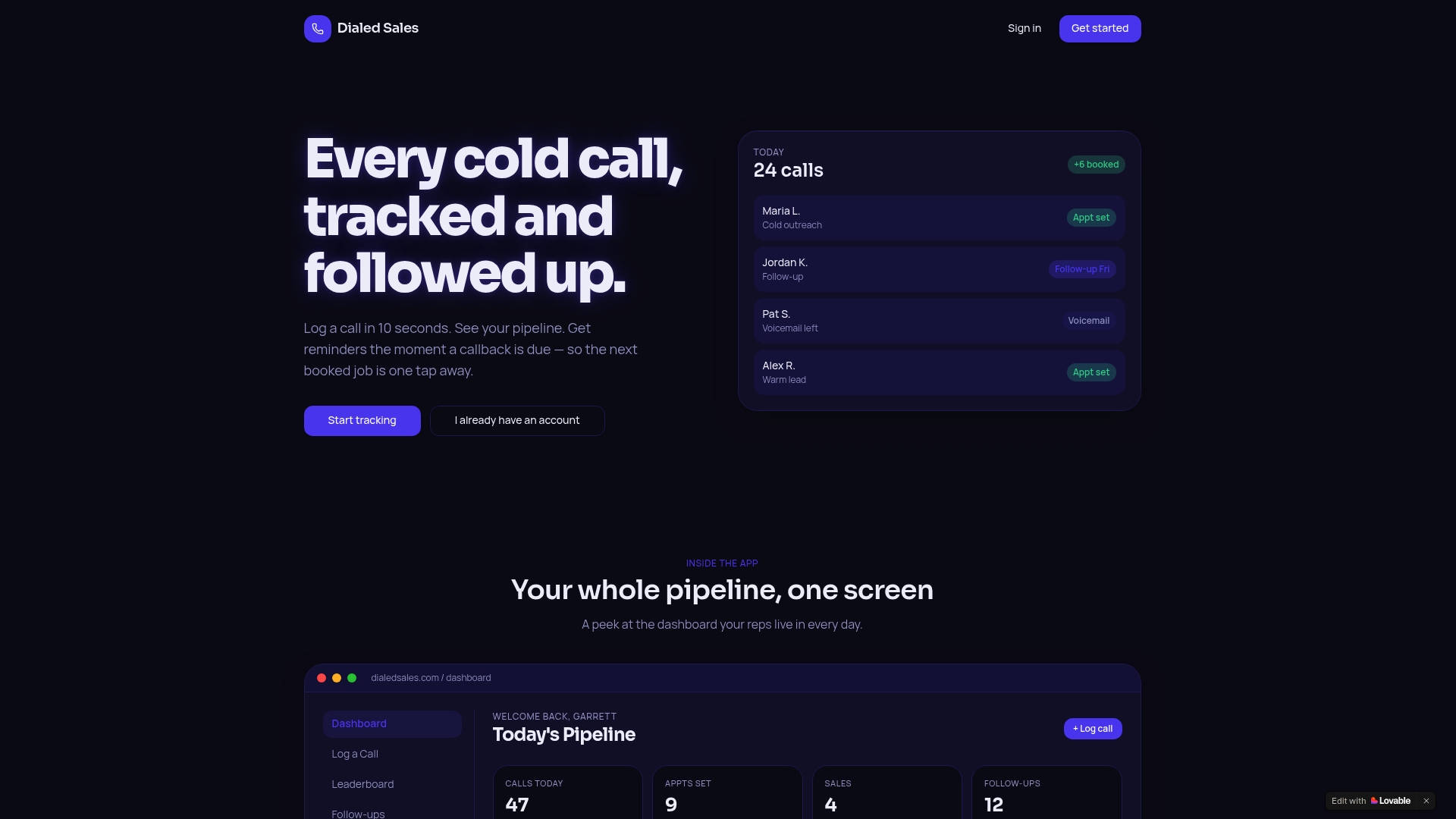
If your current process involves scrolling through a spreadsheet to find who to call next, you're losing time every single day. Dialedsales is a lightweight cold call tracker built for reps who want to log fast, follow up on time, and see their pipeline without digging through a bloated CRM.
Log a call in 10 seconds. Set a callback date. Get a reminder the moment it's due. The follow-up feature auto-surfaces every due callback on your dashboard so nothing falls through the cracks between dial blocks.
Key Takeaways
A structured daily workflow, not raw talent or call volume, is what separates reps who consistently hit quota from those who scramble at quarter-end.
| Point | Details |
|---|---|
| Activity benchmarks matter | Mid-market SDRs target 50–60 calls, 20–30 personalized emails, and 10–15 LinkedIn touches per day. |
| Time blocking protects revenue | Blocking a significant portion of the day for prospecting and limiting internal meetings before 11:00 AM preserves peak selling windows. |
| Multi-channel outreach multiplies results | Combining phone, email, and LinkedIn increases engagement by up to 4.7x versus single-channel approaches. |
| Real-time logging preserves pipeline accuracy | Logging call dispositions immediately after each call prevents data decay and supports accurate follow-up. |
| Local presence dialing lifts connect rates | Using a local presence dialer improves outbound connect rates substantially compared to standard dialing. |