
After call work (ACW) is the time an agent spends finishing bookkeeping once the customer hangs up: notes, disposition codes, CRM updates, and any follow-up scheduling. It directly adds to average handle time, which means it directly limits how many calls your team can take. The fastest way to shrink it is standardizing templates and automating field entry, not pressuring agents to type faster.
TL;DR:
- Standardizing templates and automating data entry can significantly reduce the time agents spend on post-call processing.
- Rushing ACW compromises data accuracy and impacts staffing forecasts, first-call resolution, and compliance adherence.
- Different industries have widely varying ACW benchmarks, from around 5 seconds in e-commerce to over 90 seconds in real estate, depending on call complexity.
- Implementing AI and automation, such as auto-summaries and metadata population, can cut manual wrap-up time by up to 30 percent without removing human judgment.
- Establishing a simple, fast logging process like Dialed Sales improves speed and follow-up consistency for outbound teams, with minimal training.
Table of Contents
- What Is After Call Work? Terms, Agent States, and Where It Sits in Handle Time
- Why After Call Work Matters to Your Bottom Line
- Common After Call Work Tasks and What Actually Eats the Clock
- How to Measure After Call Work: Formula and Realistic Benchmarks
- Best Practices to Cut After Call Work Without Wrecking Your Notes
- AI and Automation Approaches That Actually Reduce Wrap Time
- How Dialed Sales Cuts Post-Call Friction for Outbound Teams
- Speed Versus Completeness: What I'd Actually Tell a Manager
- Get Faster, Cleaner Post-Call Logs With Dialed Sales
- Sources
What Is After Call Work? Terms, Agent States, and Where It Sits in Handle Time
Contact centers also call it wrap-up, wrap time, or post-call processing, and the term shows up interchangeably across most workforce management platforms. Whatever your center calls it, it covers everything an agent does between calls that isn't talking to the next customer.
ACW usually shows up in your ACD or dialer as a distinct agent state, separate from "available" and "on call." That state code matters for reporting: if agents forget to log into it, your handle time numbers get skewed and your staffing forecasts follow suit.
ACW is one of three components of average handle time, alongside talk time and hold time. A center running long talk times but short wrap time often looks efficient on paper while quietly bleeding data quality.
Two flavors of ACW show up depending on the industry:
- Ticket-based wrap-up, common in support and IT service desks, where the agent closes or updates a case record tied to a resolution.
- Timed-call ACW, more typical in sales and outbound environments, where the clock keeps running until the agent manually switches states.
The distinction matters because ticket-based systems often auto-close on submission, while timed systems depend entirely on agent discipline to end cleanly.
Why After Call Work Matters to Your Bottom Line
Rushed ACW doesn't just cost seconds, it costs accuracy, and inaccurate data compounds every time someone downstream relies on it.
When ACW balloons, it inflates AHT, which throws off your Erlang staffing models and can leave you understaffed during peak hours you didn't see coming. When it's rushed instead, agents skip fields, mislabel dispositions, or leave notes so thin the next rep who touches that account has to start from scratch.
That second failure mode is sneakier than the first. A team obsessed with hitting a wrap-time target will hit it, and then wonder why first-call resolution drops and repeat contacts climb three weeks later. Compliance teams feel it too: incomplete notes on a regulated call (financial services, healthcare, insurance) create real audit exposure, not just an annoying gap in the CRM.
By the numbers: Contact centers average roughly 45 seconds of ACW per call, but that number swings wildly by vertical, from about 5 seconds in e-commerce support to over 90 seconds in real estate, where a single call can generate pages of notes.
CSAT tends to track this too. Customers who call back because an agent's notes didn't carry over rarely blame the software; they blame the company.
Common After Call Work Tasks and What Actually Eats the Clock
Not all wrap-up tasks cost the same amount of time, and knowing which ones dominate your team's ACW is the first step to fixing it.
The usual lineup looks like this:
- Writing a call summary or free-text notes
- Updating CRM fields (contact info, deal stage, account status)
- Selecting a disposition code
- Creating or updating a support ticket
- Scheduling a callback or follow-up task
- Sending a recap email or escalating to another team
Free-text note-taking is almost always the biggest time sink, because it has no structure and no ceiling. An agent typing a paragraph of context takes three times as long as one filling in five dropdowns. Multi-system entry compounds the problem: if an agent has to log the same outcome in a dialer, a CRM, and a ticketing tool separately, that duplication alone can eat 30 to 60 seconds per call before any actual thinking happens.
Task mix also shifts by function. Sales-focused post-call work leans heavy on scheduling and disposition (did they say yes, no, call back later), while support and billing calls lean heavier on ticket documentation and multi-field CRM accuracy, since a mislabeled billing dispute can trigger a compliance flag. Reviewing your sales outcome categories is a fast way to see which dispositions are actually driving your team's wrap time.

How to Measure After Call Work: Formula and Realistic Benchmarks
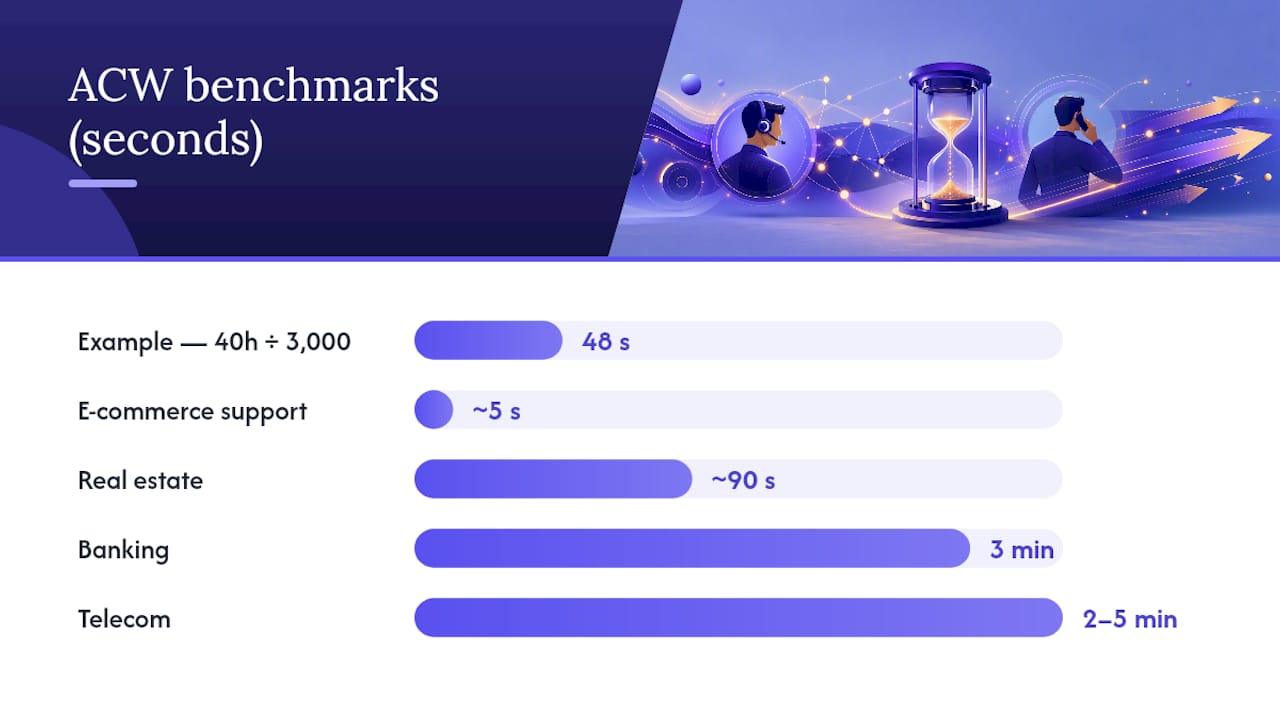
The formula is simple: Average ACW = total ACW time ÷ total number of calls, and it's the standard calculation used across the industry. If your team logs 40 hours of combined wrap-up time across 3,000 calls in a week, your average ACW is 48 seconds per call.
That number only means something once you segment it. Lumping a 20-second courtesy call in with a 40-minute account dispute and averaging them together tells you almost nothing actionable. Break ACW down by channel, call complexity, and skill group before you set a target, because a single center-wide cap almost always damages data quality somewhere.
Here's how benchmark ranges typically break down by industry, based on aggregate reporting:
| Industry | Typical ACW Range | Primary Driver |
|---|---|---|
| E-commerce support | ~5 seconds | Simple order-status lookups |
| Retail | 1–3 minutes | Return/exchange processing |
| Telecom | 2–5 minutes | Troubleshooting documentation |
| Banking | 3 minutes | Compliance and verification notes |
| Real estate | ~90 seconds | Lead qualification detail |
Use these as a directional gut check, not a mandate. A center handling complex financial disputes shouldn't chase e-commerce numbers, and forcing that comparison usually just teaches agents to under-document. Set your target from your own historical baseline first, segmented by call type, then improve from there.
Best Practices to Cut After Call Work Without Wrecking Your Notes
Speed and accuracy don't have to be a trade-off, but only if you fix the process before you fix the person.
Here's the sequence that actually moves the needle:
- Build templates with minimal mandatory fields. Every optional field is a decision point that slows an agent down. Cut dispositions to the ones you genuinely act on.
- Set a 5-minute capture window. Sales-practice guidance consistently points to capturing notes within five minutes of hanging up, before memory decay sets in and details get invented or lost.
- Run a three-stage post-call flow: organize, reflect, plan. Organize the raw facts first, reflect on what the outcome actually means for the account, then plan the next action. Agents who skip straight to "plan" tend to write thin, useless notes.
- Coach on note quality, not just wrap time. Pull a sample of ACW entries weekly and check whether the next agent could pick up the account cold from what's written there.
- Kill perverse incentives. If your scorecard rewards raw ACW speed with no counterbalance, agents will hit that number by leaving notes blank. Pair every time-based metric with a quality metric.
Pro Tip: Give agents a one-line "if in doubt" rule for notes, like "write it the way you'd want it written if you got this account back in six months." It cuts the debate over what belongs in a note down to almost nothing.
The three-stage organize-reflect-plan routine works especially well for field and outbound teams juggling multiple accounts a day, since it forces a decision on next steps instead of leaving a call to go stale in a queue.
AI and Automation Approaches That Actually Reduce Wrap Time
The technology layer matters more than most centers give it credit for, because the biggest ACW gains rarely come from typing faster, they come from typing less.
Standard automation patterns include:
- Template autofill that pulls known account data into the wrap-up screen automatically
- CTI-CRM integrations that pass call metadata (number, duration, prior interactions) into the record without manual entry
- Macros and keyboard shortcuts for repetitive disposition language
AI adds a second layer on top of that: automated call summaries generated from the transcript, disposition recommendations based on conversation content, sentiment tagging, and auto-created follow-up tasks pulled straight from what was said on the call. Vendor case data suggests enterprise AI that auto-summarizes calls and populates CRM fields can meaningfully cut manual wrap-up time, with some deployments reporting reductions in the range of 30%.
Automated field population also holds up better under volume spikes than manual entry does. Consistent automated classification keeps tags and notes uniform even when call volume triples, whereas manual entry is exactly where quality collapses first under pressure.
None of this means removing the human. Every AI summary needs a spot-check step, an audit trail for compliance review, and clear rules about what data the tool can touch, especially in regulated industries. The best ROI shows up when AI handles the pattern work, classification and field population, while agents keep judgment calls on disposition and anything customer-sensitive.
How Dialed Sales Cuts Post-Call Friction for Outbound Teams
Sales teams don't need a call center's full disposition taxonomy. They need speed and a follow-up that never gets lost.
Dialed Sales is built around a 10-second call log: customer name, outcome, and a short note, done before the rep dials the next number. Set a follow-up date in that same log and it auto-surfaces on the dashboard the moment it's due, so nothing sits forgotten in a spreadsheet.
That workflow maps cleanly onto the organize-reflect-plan routine. Logging the outcome is the organize step, the note is the reflect step, and the follow-up date is the plan step, compressed into one motion instead of three separate systems. Managers piloting this should run it with a small cohort for two weeks, then compare close rates and follow-up completion against the rest of the team before rolling it out further. Pairing the log with a defined follow-up cadence tends to produce the clearest lift.
Speed Versus Completeness: What I'd Actually Tell a Manager
The trade-off between fast wrap-up and complete data is real, but most teams pick the wrong side of it by default. They optimize for speed because it's easy to measure, then act surprised when notes go thin and repeat contacts rise.
If you're piloting any ACW change, run it small first, one team or one shift, and track first-call resolution and CSAT next to your wrap-time numbers, not instead of them. A change that shaves 15 seconds off ACW while FCR drops 5 points isn't a win, it's a cost shifted downstream where it's harder to trace back to the cause.
Agent buy-in matters more here than in almost any other metric. Set targets based on segmented, realistic baselines, not an industry benchmark pulled from a different vertical, and agents will trust the number enough to actually hit it honestly instead of gaming it.
— Garrett
Get Faster, Cleaner Post-Call Logs With Dialed Sales
Dialed Sales is the alternative to juggling a CRM, a spreadsheet, and a sticky note for follow-ups, built specifically for reps who spend their day on the phone instead of behind a desk.
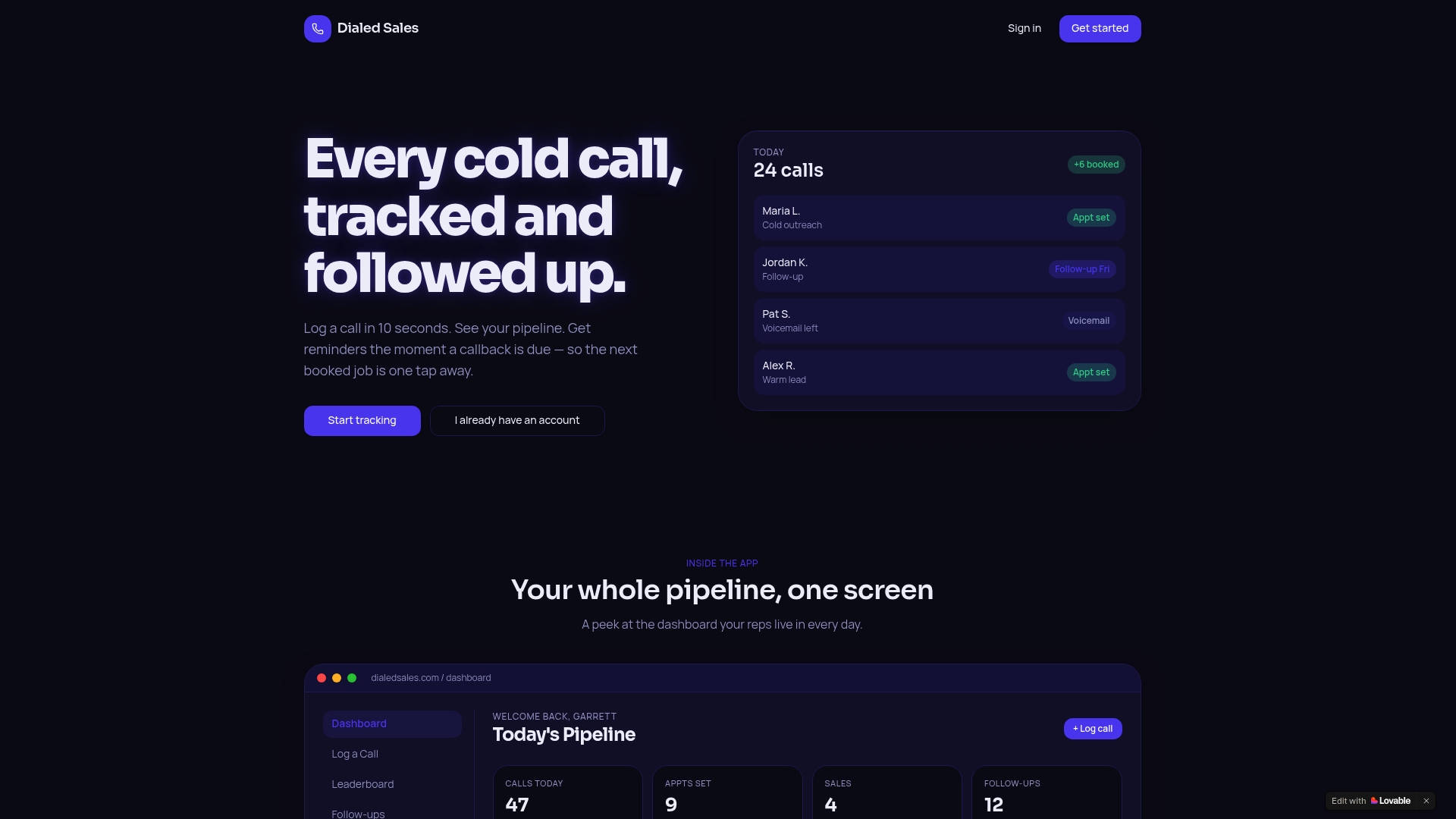
Every feature ties back to cutting the exact wrap-up friction this guide covers: the 10-second call log replaces free-text CRM entry, outcome codes replace ambiguous disposition menus, and auto-surfacing follow-up reminders replace the callback that never happens because it lived in someone's memory instead of a system. Add a live pipeline dashboard and a built-in AI assistant that can draft a summary or a follow-up message for you, and the post-call routine that used to take three minutes takes closer to ten seconds.
Generic contact-center software is built for ticket queues and compliance scripts. Dialed Sales is built for outbound reps who need to log an outcome, set a callback, and move to the next name on the list. If your team runs on cold calls, start a Dialed Sales trial and see how much of your wrap time actually disappears.
Sources
For deeper benchmarks and formulas, see Verint's ACW glossary and NiCE's guide to ACW optimization. For sales-specific follow-up timing, review effective outcome tracking methods.
- What is After Call Work (ACW)? | Verint
- What Is After Call Work (ACW)? | Uniphore
- After-Call Work (ACW): Definition | Aide