
Structured sales workflows matter because they turn inconsistent, rep-dependent selling into a repeatable system that closes more deals, faster, with fewer surprises in your forecast. Teams that document a formal process report significant gains across the board:
- Revenue lift: Companies with a formal sales process see a 28% revenue increase over those without one.
- Faster ramp: New reps working from a documented process ramp up faster than reps left to figure it out alone.
- Higher close rates: Teams enforcing documented qualification criteria at each stage report higher close rates.
Keep reading for the six-step rollout plan and the exact KPIs to track once your workflow is live.
Key Takeaways
Structured sales workflows outperform ad hoc selling because objective stage criteria and enforced follow-up timing turn inconsistent effort into measurable, repeatable revenue.
| Point | Details |
|---|---|
| Structure beats headcount | Documented processes drive revenue and cycle-time gains that adding reps alone doesn't match. |
| Objective exit criteria | Replace subjective stage labels like "budget discussed" with verifiable ones like "budget confirmed." |
| Speed on handoffs | Automate lead routing and follow-up reminders first, since response delay kills contact odds fastest. |
| Track five KPIs weekly | Win rate, stage conversion, cycle time, time-to-first-contact, and forecast accuracy reveal problems early. |
| Enforce logging with the right tool | Dialed Sales logs calls in ten seconds and auto-surfaces follow-ups so workflow data stays accurate. |
Table of Contents
- Why Structured Sales Workflows Matter: The Measurable Benefits
- What Should a Structured Sales Workflow Include?
- How Do You Implement a Structured Sales Workflow?
- Which KPIs Actually Prove a Workflow Is Working?
- What Tools Actually Enforce a Structured Workflow?
- What Is a Structured Sales Workflow, Exactly?
- What Do Real Results From Structured Workflows Look Like?
- How Do You Customize Workflows Across Roles and Product Lines?
- How Do You Get Reps to Actually Adopt a New Workflow?
- How Does a New Workflow Fit Into Existing Systems?
- Can Structured Workflows Support Remote or Hybrid Sales Teams?
- What Role Do CRMs, Call Trackers, and Automation Play?
- Sources
Why Structured Sales Workflows Matter: The Measurable Benefits
The case for structure isn't theoretical. It shows up in three places every sales leader already tracks: win rate, cycle time, and forecast accuracy.
Win rate climbs because documented qualification criteria strip out the deals that never had a real shot. When "budget discussed" becomes "budget verified in writing," reps stop chasing ghosts and managers stop forecasting revenue that was never coming. Cycle time drops for a similar reason. Organized teams with clear processes have shortened sales cycles by up to roughly 25%, largely by eliminating the back-and-forth that happens when nobody agreed on what "next step" actually means. Ramp time for new hires improves too, since a documented playbook replaces months of shadowing senior reps and guessing.
Structure, not headcount, drives long-term performance. Organized teams with clear processes close more deals, shorten cycle length, and scale with predictability that headcount growth alone can't match.
Run the math on a mid-size team. At an average deal size of $8,000, that's $160,000 in incremental revenue from a process change, not a headcount change. That's the argument for workflow investment over tactic-chasing: the lift compounds across every rep, every quarter, without needing anyone to work harder.
What Should a Structured Sales Workflow Include?
A workflow only works if every stage has a name, an owner, and an exit rule nobody can argue with. Vague stages ("in progress," "warm lead") are where forecasts go to die.
A basic structure typically runs through research, prospecting, qualification, outreach, demo, objection handling, proposal, closing, and nurturing. What matters more than the stage names is what moves a deal from one to the next. A workable stage template looks like this:
- Stage: Qualification. Exit criteria: Verified budget, confirmed decision maker, timeline within 90 days.
- Stage: Demo scheduled. Exit criteria: Meeting confirmed on calendar with all stakeholders listed.
- Stage: Proposal sent. Exit criteria: Pricing document opened or acknowledged by prospect within 5 business days.
Every stage transition needs a trigger and an owner. If a lead goes cold after three days of no response, who follows up, and by when? Build that SLA into the workflow itself, not into a rep's memory. Handoffs between sales and delivery need the same rigor, or you lose the deal at the exact moment it should be closing.
Pro Tip: Swap subjective stage labels for verifiable ones. "Budget discussed" is a conversation. "Budget verified" is a fact you can check. The second one is what makes your forecast trustworthy.
How Do You Implement a Structured Sales Workflow?
Rolling out a new workflow doesn't require a quarter-long initiative. A focused pilot inside 90 days is enough to prove the model and get buy-in for a full rollout.
- Audit your current motion. Sit with three reps and map what actually happens from first contact to close, not what the org chart says should happen.
- Map stages and exit criteria. Define five to eight stages with objective, checkable exit rules for each.
- Assign owners. Every stage transition and handoff needs one named owner, not "the team."
- Automate the friction points. Lead routing and follow-up reminders are the first things to automate, since manual delay at this step is the biggest source of lost deals.
- Train reps with playbooks. Attach a script or checklist to each stage so reps aren't improvising the qualification conversation.
- Iterate for 60 to 90 days. Review stage conversion weekly and adjust exit criteria that are too loose or too strict.
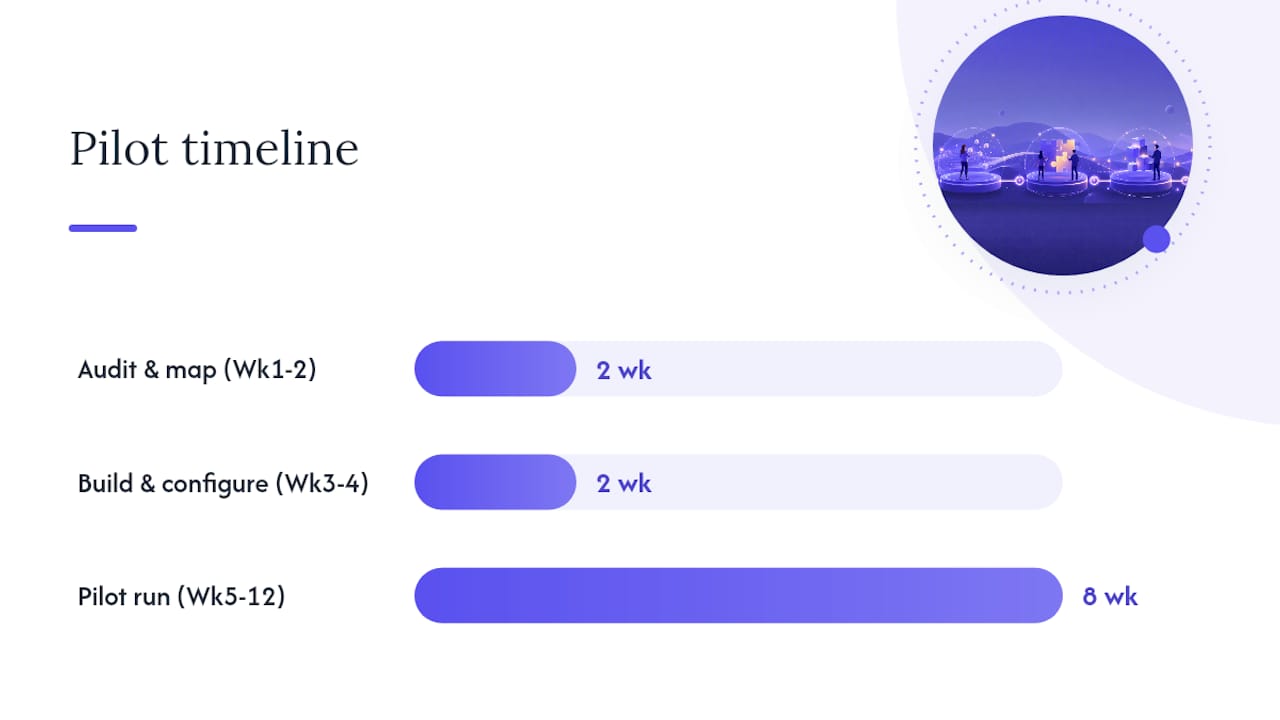
Pilot timeline: Weeks 1 to 2, audit and map. Weeks 3 to 4, build and configure. Weeks 5 to 12, run the pilot with one team and measure stage-by-stage conversion against the old process.
| Step | Primary Owner |
|---|---|
| Audit current motion | Sales manager |
| Map stages and exit criteria | Sales ops |
| Assign owners and SLAs | Sales manager + team leads |
| Automate handoffs | IT / sales ops |
| Train reps on playbooks | Enablement |
| Iterate and review | Sales manager + reps |
Skipping the audit step is the single most common reason pilots fail. Teams design an ideal-world process instead of fixing the one they actually run.
Which KPIs Actually Prove a Workflow Is Working?
Track these five numbers weekly, not quarterly, or you'll spot problems long after they've cost you deals.
- Win rate: Closed-won deals divided by total opportunities. A 3 to 5 point shift after a process change is meaningful; anything smaller is noise.
- Stage conversion rate: Percentage of deals that pass each stage's exit criteria. This is where you find your leaking stage.
- Cycle time (median): Days from first contact to close. Use median, not average, since a handful of six-month enterprise deals will distort your mean.
- Time-to-first-contact: Minutes or hours from lead creation to first outreach attempt.
- Forecast accuracy: Predicted quarter revenue versus actual, expressed as a percentage variance.
A simple dashboard built around these five numbers, segmented by rep and by stage, tells you within a week whether a stage is bottlenecking. If stage conversion at "demo scheduled" drops below your historical rate, that's your signal, not the quarterly close number.
What Tools Actually Enforce a Structured Workflow?
Documentation alone doesn't hold a workflow together. Tools do, by making the process the path of least resistance instead of something reps have to remember.
A CRM enforces stage progression and gives you the historical data to calculate conversion rates. Workflow automation platforms handle lead routing and follow-up sequencing. Call trackers log activity data that feeds your KPI dashboard without a rep filling out a spreadsheet. AI assistants can draft follow-up messages and summarize call notes, freeing selling time. The right starting point is automating lead routing, follow-up reminders, and CRM stage updates first, since these are the highest-friction, most repeatable tasks in the entire process. Keep a human in the loop for pricing and negotiation, where judgment still beats automation.
Pro Tip: Only automate steps with a deterministic, single correct outcome. A follow-up reminder has one right answer: send it. A discount approval doesn't.
A ten-second call log with an automatic follow-up reminder does more for workflow discipline than a 40-field CRM form nobody fills out completely.
What Is a Structured Sales Workflow, Exactly?
A structured sales workflow is a documented, stage-based sequence of actions a deal moves through from first contact to close, where each stage has a defined entry point, a required action, and an objective exit criterion. It's different from a general "sales process" description in one important way: a workflow specifies who does what, in what order, with what trigger, rather than just describing the philosophy of how selling should happen.
Think of the difference between a recipe and a cooking philosophy. "Cook with fresh ingredients" is a philosophy. "Preheat to 375°F, bake 22 minutes, check internal temp at 165°F" is a workflow. Sales teams that operate on philosophy ("build rapport, understand needs, present value") end up with as many selling styles as they have reps. Teams that operate on workflow end up with a process a new hire can execute correctly in their second week.
The standard version of this concept typically runs through nine recognizable stages: research, prospecting, qualification, outreach, demonstration, objection handling, proposal, closing, and nurturing. Not every business needs all nine, and a shorter sales cycle (inside sales, high-velocity transactional deals) might compress several into two or three. What doesn't change is the requirement for a defined trigger between each one. Without that trigger, you don't have a workflow. You have a to-do list with good intentions attached.
What Do Real Results From Structured Workflows Look Like?
The clearest proof of workflow value shows up in three specific outcomes: faster onboarding, tighter forecasting, and cycle time that shrinks without adding headcount.
Onboarding is the fastest place to see the impact. When a new rep inherits a documented playbook instead of shadowing a senior rep for six weeks, ramp time drops by as much as half. That matters more than it sounds, because ramp time is dead revenue. A rep who closes their first deal in month two instead of month four has contributed two extra months of pipeline the business would have otherwise waited on.
Forecasting accuracy improves for a related reason. Once stage exit criteria are objective instead of subjective, a manager can look at a pipeline report and trust that "proposal sent" means the prospect actually has pricing in hand, not that a rep marked it that way to look productive. ShareFile's research on workflow standardization ties this improved forecasting directly to better employee experience too. Reps aren't guessing what's expected of them at each stage, and managers aren't guessing what's really in the pipeline.
The cycle time story is the one that surprises leaders most. Teams don't need more reps to close more deals faster. They need fewer stalled handoffs. A deal that sits for four days waiting on an internal approval isn't a rep performance problem. It's a workflow design problem, and it's fixable without hiring anyone.
How Do You Customize Workflows Across Roles and Product Lines?
A single universal workflow rarely fits a team selling three different products to three different buyer types. The stages might stay similar in name, but the exit criteria and cadence should flex.
An outbound-heavy role (cold calling, high volume) needs a workflow weighted toward speed. Time-to-first-contact matters more here than anywhere else, since contact odds fall roughly 100x when response time stretches from 5 minutes to 30. A field sales role selling a complex enterprise product needs the opposite emphasis. Fewer touches, longer stages, more rigorous exit criteria around stakeholder mapping and budget verification.
Product line matters just as much as role. A $200 transactional product and a $50,000 enterprise contract shouldn't share a proposal stage definition. The transactional product might skip a formal proposal stage entirely and move straight from demo to close. The enterprise deal might need a legal review stage the transactional workflow never touches.
The practical move is to build one shared workflow skeleton, the same core stage names and reporting structure, then let each team customize exit criteria, cadence length, and playbook content underneath it. This keeps your KPI dashboard comparable across teams while letting the actual selling motion fit the product. Industries with different buying cycles, like home services versus insurance versus financial services, often need meaningfully different cadence rules even when the underlying stage names look identical on paper.
How Do You Get Reps to Actually Adopt a New Workflow?
Resistance to a new workflow almost always comes from one of two places: reps think it's extra paperwork, or reps who were succeeding under the old chaos feel threatened by a system that makes performance visible.
Address the paperwork objection by making the new process faster than what it replaces, not slower. If logging a call now takes ten seconds instead of the two minutes it took in a clunky CRM form, adoption follows because the tool is solving a rep's own problem, not just management's reporting problem. Involve your top performers in designing the exit criteria before rollout. Reps who help write the rules rarely fight the rules.
Run the rollout with one team first, not the whole sales floor at once. A successful pilot with visible results, faster response times, a tighter pipeline review, gives you social proof that beats any mandate from leadership. Publicly share early wins, particularly ones tied to individual reps hitting numbers faster than before.
Expect a dip before the lift. Any new process slows people down for the first two to three weeks while habits reset. Tell reps this upfront so a temporary slowdown doesn't get mistaken for the workflow failing. Coach to the data, not to compliance. If a rep skips a stage requirement, the conversation should be about the missing data point, not about rule-breaking.
How Does a New Workflow Fit Into Existing Systems?
Most sales teams already run a CRM, a calendar tool, and probably a call or activity tracker. The workflow you design has to sit on top of these, not force a rip-and-replace.
Start by mapping which system owns which data. Stage status usually lives in the CRM. Call outcomes and follow-up timing often live in a lighter tracking tool that reps actually update in real time because it's fast to use. The integration risk isn't technical complexity so much as data duplication, where reps end up logging the same call in two places and eventually stop logging it in one of them.
Prioritize integrations that reduce rep clicks, not ones that look impressive on an org chart. A follow-up reminder that auto-populates from a call log into the CRM pipeline saves more time than a fully connected fifteen-tool stack nobody configured correctly. Check with your existing CRM's role in enforcing stage rules before adding new automation layers on top of it, since redundant enforcement points are a common source of conflicting data.
Build in a data audit at 30 and 60 days post-launch. Confirm the numbers in your new dashboard match what reps report manually. Small discrepancies early on usually point to a stage that's ambiguous, not a system that's broken.
Can Structured Workflows Support Remote or Hybrid Sales Teams?
Structured workflows matter more, not less, once a team goes remote or hybrid, because the informal coaching and oversight that happens naturally in a shared office disappears.
In an office, a sales manager overhears a call going sideways and steps in. Remotely, that visibility only exists if the workflow captures it. This is why activity logging and stage tracking carry more weight for distributed teams: a documented workflow becomes the manager's primary window into what's actually happening in the pipeline, not a supplement to it.
Async handoffs need tighter SLA rules too. In person, a quick hallway conversation can resolve an ambiguous handoff in thirty seconds. Remotely, that same ambiguity can sit unresolved for a day if the workflow doesn't specify exactly who owns the next step and by when. Explicit ownership rules that might feel like overkill in a co-located team become essential once reps are spread across time zones.

The upside is that remote teams often adopt structured workflows faster than in-office teams, precisely because there's less informal process to unlearn. A rep working from home has no institutional memory of "how we've always done it" to fight against. Give a distributed team a clear stage-by-stage playbook and a fast way to log activity, and the lack of physical proximity stops being a disadvantage. It becomes an argument for better documentation everyone benefits from.
What Role Do CRMs, Call Trackers, and Automation Play?
Three categories of tools do the heavy lifting behind any structured workflow, and they each solve a different problem.
CRMs enforce stage logic and hold your historical pipeline data, which is essential for calculating win rate and conversion accuracy over time. Workflow automation platforms handle the repeatable, deterministic tasks: routing a new lead to the right rep, triggering a follow-up reminder, updating a stage status when a defined condition is met. Call trackers solve a narrower but critical problem: capturing activity data fast enough that reps actually use the tool instead of skipping it.
That third category matters more than it gets credit for. A CRM with fifteen required fields per call log will get abandoned within a month by a busy field rep. A tool built around logging a call in ten seconds with just the outcome and a follow-up date gets used consistently, and consistent data beats comprehensive data every time.
The vendor-agnostic recommendation is straightforward: pick a CRM for stage enforcement and historical reporting, an automation layer for routing and reminders, and a fast activity-logging tool that reps won't resent. Whether that's three separate tools or one platform that covers two of the three depends on team size and budget, but the functional requirement doesn't change. If any one of those three functions is missing, some part of your workflow reverts to memory, and memory is exactly what structure was supposed to replace.
Author perspective: workflows compound, tactics don't
Most sales advice chases the next tactic: a better subject line, a sharper objection response. Those help for a week. A workflow fix, like tightening one stage's exit criteria, keeps paying out every quarter after. A 3-point close rate gain across 200 deals a year isn't a tweak. It's six extra closed deals nobody had to work harder to get.
How Dialed Sales Enforces the Workflow You Just Built
A workflow only works if the activity behind it actually gets logged, and that's the piece most teams lose within a month of rollout. Dialedsales was built around that exact gap: log a call in ten seconds with customer name, outcome, and notes, set a follow-up date that auto-surfaces on your dashboard the moment it's due, and watch stage conversion and close rate move on a live pipeline view instead of a spreadsheet someone updates on Fridays.
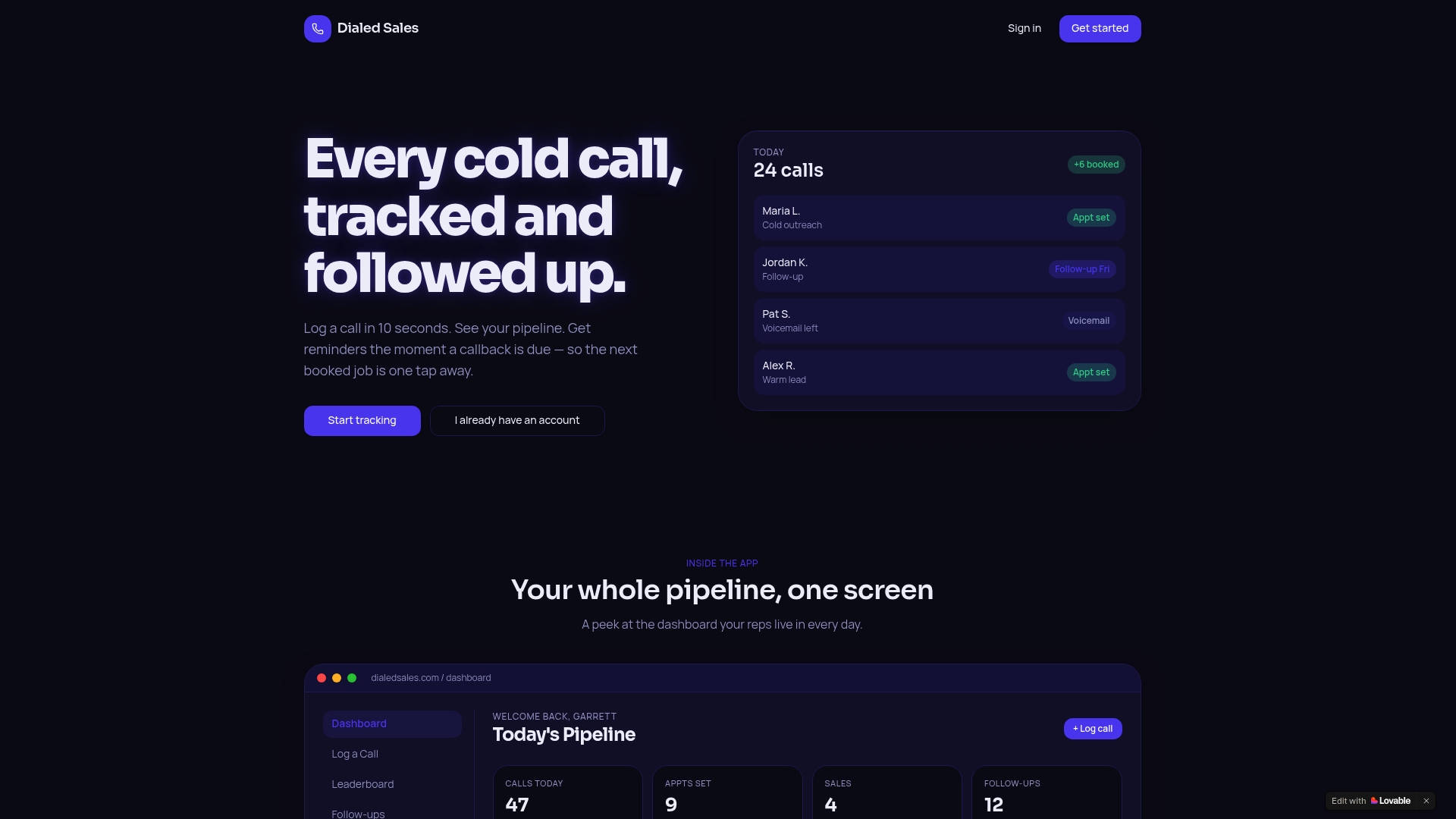
That maps directly onto the components covered above. Faster time-to-first-contact happens because a reminder actually fires instead of living in a rep's memory. Handoffs get enforced because every call outcome is tracked, not just the ones a rep remembers to write down. And your KPI dashboard, win rate, stage conversion, cycle time, gets built on real activity data instead of guesswork. Per-rep stats and team leaderboards give managers the stage-level visibility this whole article argues for, without adding a single extra field to a bloated CRM form. Start a free trial and see whether your current follow-up rate holds up once every callback actually surfaces on time.
Sources
- What Is a Sales Process? The Complete Guide
- How to Build Sales Workflows that 10x Revenue | Chief
- The ROI of Structure: Why Organized Sales Teams Outperform Bigger Ones
- Sales Workflow Automation 101: Complete Guide for 2026 | Lindy
- Sales workflow process (ShareFile blog)