
Start with a 7-touch, 21-day multi-channel cadence: email, LinkedIn, and phone calls, finishing with a break-up message on day 21. That single sequence beats most single-touch or "call once and hope" habits because 80% of sales require five or more follow-ups to close, and most reps stop long before that.
Your exact cadence should flex by lead type:
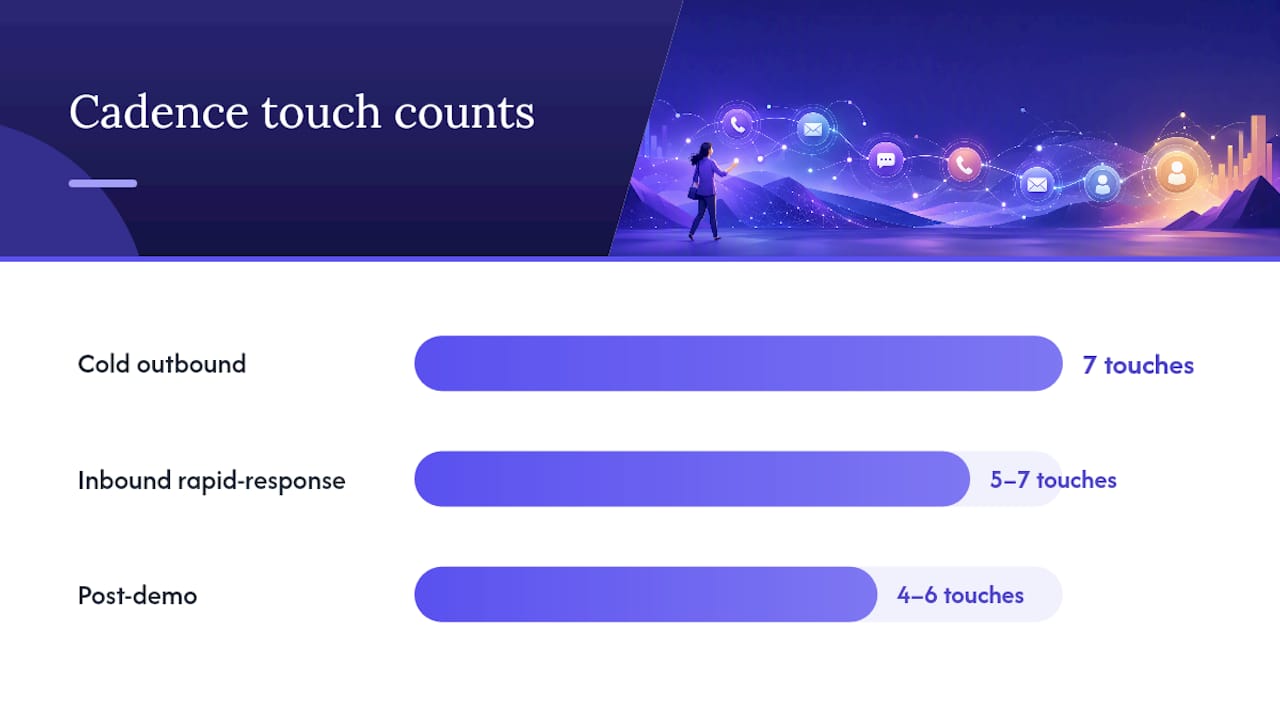
- Cold outbound: 7 to 12 touches over 21 to 28 days, mixing email, phone, and LinkedIn.
- Inbound leads: 5 to 7 touches over 7 to 10 days, weighted toward the first hour.
- Post-demo prospects: 4 to 6 touches over 7 to 14 days, anchored to their stated decision timeline.
Each of these outperforms a single follow-up attempt because persistence, spaced correctly, catches prospects at different points in their buying window. A tool like Dialed Sales can set the follow-up date the moment you log a call, so the reminder surfaces automatically instead of living in your head or a sticky note.
Key Takeaways
A structured, multi-channel sales follow-up schedule with 5 to 12 touches consistently outperforms single-touch or unstructured outreach.
| Point | Details |
|---|---|
| Baseline cadence | Use 7 touches over 21 days as your default starting cadence for most deal types. |
| Match cadence to lead type | Inbound needs 5 to 7 touches in 7 to 10 days; cold outbound needs 7 to 12 touches over 21 to 28 days. |
| Mix channels deliberately | Combine email, phone, LinkedIn, and occasional video so you reach prospects where they actually respond. |
| Know when to stop | End active follow-up after 8 touches with zero engagement and send a break-up message. |
| Automate the reminders | Dialed Sales lets you log a call, set the next follow-up date, and get automatic dashboard alerts when it's due. |
Table of Contents
- What Is a Sales Follow-Up Schedule, and Why Does Timing Matter?
- Three Copy-Ready Cadences: Cold, Inbound, and Post-Demo
- What Should Each Follow-Up Touch Actually Accomplish?
- Follow-Up Templates and Scripts You Can Adapt Today
- How Do You Measure and Improve Your Follow-Up Cadence?
- Running These Cadences Inside Dialed Sales
- Start Running Your Follow-Up Schedule With Dialed Sales
- Frequently Asked Questions
- Sources
What Is a Sales Follow-Up Schedule, and Why Does Timing Matter?
A sales follow-up schedule is a planned sequence of touches, spaced across specific days and channels, designed to move a prospect from silence to a decision without wearing out their patience. It is not a guess about when to "check in again." It is a structured cadence built on how buyers actually respond to repeated contact.
The numbers back this up hard. Forty-four percent of reps give up after a single follow-up, even though the same data shows most deals need five or more attempts before they close. That gap between what closes deals and what reps actually do is where most pipeline quietly dies. It is not a lead quality problem. It is a persistence and scheduling problem.
The data on quitting too early is stark:
80% of sales require 5+ follow-up contacts, yet 44% of reps stop after just one.
Channel mix matters as much as touch count. Multi-channel outreach creates a meaningfully higher connection probability than single-channel sequences, because prospects who ignore email might answer a call, and prospects who screen calls might engage on LinkedIn. Relying on one channel means betting your entire pipeline on one communication preference that may not match your prospect's habits.
Timing windows matter too. The strongest response rates tend to land Tuesday through Thursday, with morning send times between 8 and 11 AM and a secondary window around 3 to 4 PM in the prospect's own timezone. Monday mornings get buried under weekend inbox pileup, and Friday afternoons are where attention goes to die before the weekend.
Deal size and prospect type reshape the cadence's overall length, not its core logic:
- Larger deals with multiple stakeholders justify a slower, longer cadence with more spacing between touches.
- Transactional, lower-price offers move faster and compress into a tighter window.
- Warm inbound leads need speed over volume. Cold outbound leads need volume over speed.
Three Copy-Ready Cadences: Cold, Inbound, and Post-Demo
Here are three sequences you can paste directly into a CRM, spreadsheet, or cadence tool today. Each uses a Fibonacci-style spacing pattern, meaning the gaps between touches widen as the sequence progresses. That structure balances early momentum with later patience, so you're aggressive when interest is freshest and less naggy once it has cooled.
1. Cold outbound cadence (7 touches, 21 to 28 days)
| Day | Channel | Action |
|---|---|---|
| — | Initial outreach with a specific, relevant hook | |
| 2 | Phone | Cold call, leave a voicemail if no answer |
| 5 | Connection request with a short personalized note | |
| 9 | Value-add follow-up (case study or relevant insight) | |
| 14 | Phone | Second call attempt, different time of day |
| 21 | Direct ask for a meeting or a clear next step | |
| 28 | Break-up message |
This structure matches what works for multi-channel cold sequences generally: 7 to 12 touches spread across email, phone, and LinkedIn over roughly a month. If your prospect has a longer buying cycle or multiple decision-makers, stretch this toward 10 to 12 touches instead of compressing it.
2. Inbound rapid-response cadence (5 to 7 touches, 7 to 10 days)
| Day | Channel | Action |
|---|---|---|
| — (within 5 min) | Phone | Immediate call attempt |
| — | Follow-up email if no answer, referencing their inquiry | |
| 1 | Phone | Second call attempt |
| 3 | Share relevant resource tied to what they requested | |
| 5 | Light-touch connection or comment | |
| 8 | Phone | Final direct call |
| 10 | Break-up or re-engagement offer |
Speed is everything here. Responding within minutes rather than hours dramatically increases qualification odds because inbound interest fades fast once a prospect moves on to browse a competitor or gets pulled into another meeting.
3. Post-demo cadence (4 to 6 touches, 7 to 14 days)
| Day | Channel | Action |
|---|---|---|
| — (same day) | Recap with key points and agreed next steps | |
| 3 | Phone | Check-in call on questions or internal discussions |
| 6 | Value-add: address a specific objection raised in the demo | |
| 9 | Phone | Decision-timeline check-in |
| 14 | Final push or break-up, depending on engagement |
Three variants worth knowing:
- High-velocity: Compress any of the above into half the timeframe for high-urgency, low-price deals where speed drives conversion.
- Slow-burn: Stretch the cadence toward 45 to 60 days for enterprise deals with committee-based buying and long procurement cycles.
- Hybrid: Start high-velocity, then downgrade to slow-burn if the prospect shows engagement but needs internal approval time.
What Should Each Follow-Up Touch Actually Accomplish?
A follow-up schedule only works if each touch earns its place. Sending five identical "just checking in" emails is worse than sending none, because it signals you have nothing new to say.
Email should do the heaviest lifting for value delivery. Your first email states the reason you're reaching out in one sentence. Your third or fourth email should introduce a new angle: a case study, a relevant statistic, or a specific answer to something they mentioned. Your final email should make the ask unmistakably clear.
Phone and voicemail exist to create urgency and personality that text can't. A voicemail should be under 20 seconds, state your name, one specific reason for calling, and a clear next step. Never say "just calling to follow up." Say what you actually want.

LinkedIn works best as a soft touch that keeps you visible without asking for anything. Commenting on a post, sending a short connection note referencing something specific about their role, or sharing an article relevant to their industry all keep you in view without adding cadence fatigue.
Video touches, even a 30-second Loom-style clip, tend to stand out precisely because so few reps use them. Save video for a mid-cadence touch, roughly day 9 or 14, when a prospect has already seen a few emails and a personal face breaks the pattern.
Combining channels on the same day works only if each channel says something different. Sending an email and a LinkedIn message with identical wording on the same day reads as automated and lazy. Space the same-day touches by hours and vary the framing.
Pro Tip: Reference a specific trigger event, like a funding round, a new hire in their department, or a product launch, in at least one touch per cadence. Personalization tied to something that happened this week outperforms generic personalization every time.
Follow-Up Templates and Scripts You Can Adapt Today
Editable templates save time, but only if you customize the specifics for your ideal customer profile before sending. Here are six mapped to their place in the cadence.
Touch 1: Initial outreach email Subject: "Quick question about [specific pain point]" Keep it to three sentences: who you are, why you're reaching out (tied to something specific about them), and one clear, low-friction ask.
Touch 2: Bump email Subject: "Following up" This is the shortest email in your entire sequence. One line: "Wanted to make sure this didn't get buried. Worth a quick chat this week?"
Touch 4: Value-add email Subject: "Thought this might help" Share a relevant resource, case study, or insight with zero direct ask. This touch builds trust rather than pressure.
Touch 5: Voicemail script "Hi [Name], this is [Your Name] with [Company]. I sent over a quick idea for [specific benefit] and wanted to see if it landed. Give me a call back at [number], or I'll follow up by email."
Touch 6: Pattern-interrupt email Subject: "Wrong timing?" Ask directly whether this simply isn't a priority right now, or whether you should check back in a few months. This resets the tone and often gets a reply purely because it's different from everything before it.
Final touch: Break-up email Subject: "Permission to close your file?" Break-up emails often generate some of the highest reply rates in the entire cadence, because they remove pressure and create a sense of finality. State plainly that you'll stop reaching out unless you hear back, and leave the door open for a future re-engagement.
Customizing these for your ICP means swapping generic pain points for the specific language your buyers use. A solar sales rep's "specific pain point" looks nothing like an insurance agent's, even though the cadence skeleton is identical. Pull actual phrases from past won deals and drop them into these templates rather than writing from scratch every time. For a deeper library of editable options, sales rep email templates built specifically for reply rates are worth a look, and cold call follow-up tactics cover voicemail and call scripting in more depth.
How Do You Measure and Improve Your Follow-Up Cadence?
A cadence you never measure is a cadence you're guessing about. Track these metrics weekly, not monthly, so you catch problems before they compound across your whole pipeline:
- Reply rate per touch number, so you can see exactly where prospects tend to engage or go silent.
- Meeting rate per full sequence, which tells you whether replies are converting into actual pipeline.
- Time-to-first-response on inbound leads, since speed correlates directly with qualification odds.
- Unsubscribe and opt-out rates, which flag when your cadence feels too aggressive or poorly targeted.
- Deliverability signals, like bounce rates and spam flags, which quietly kill cadences that look fine on paper.
Roughly one in five deals in a healthy pipeline should still be active past touch 5, which tells you whether your cadence length matches your actual sales cycle.
For testing, don't overhaul everything at once. Test one variable at a time: spacing between touches, channel order, or subject-line phrasing. Run each test against a large enough sample, at minimum 30 to 50 prospects per variant, before drawing conclusions. A two-week test on five leads tells you nothing except that you got impatient.
Set a governance rhythm and stick to it: review raw activity numbers weekly, review conversion rates monthly, and revisit the overall cadence strategy quarterly. Stop active follow-up after 8 touches with zero engagement and move that prospect into a long-term nurture list instead of a daily cadence. Continuing past that point rarely produces a reply and mostly produces annoyance.
Running These Cadences Inside Dialed Sales
None of this works if the reminders live in your memory instead of a system. Dialed Sales was built around exactly this gap: log a call in about 10 seconds with the customer's name, the outcome, and a quick note, then set a follow-up date that automatically surfaces on your dashboard the moment it's due.
That workflow maps directly onto everything above:
- Log the call the moment it happens, so outcome data doesn't get lost or misremembered by end of day.
- Set the follow-up date using the cadence spacing from the schedules above, whether that's day 2 for cold outbound or same-day for a post-demo recap.
- Let the dashboard surface reminders, removing the mental load of tracking which prospect is due for which touch.
- Review your pipeline and close-rate stats to see which cadence variant is actually converting for your specific product and territory.
CRM automation and structured reminders materially improve follow-up consistency, which is the entire point. A perfect cadence written on paper does nothing if touch 4 gets missed because you were juggling six other accounts.
A cadence is only as good as your ability to execute it consistently, and consistency is a system problem, not a discipline problem.
To get started, set up your follow-up dates for active prospects today, then check the role of follow-up dates in keeping deals from slipping through the cracks.
Garrett's take: the mistakes that quietly wreck good cadences
The biggest mistake I see isn't a bad template. It's reps abandoning a sound cadence after touch 2 because silence feels like rejection. It's not. It's just silence. Fix: commit to the full sequence before judging whether it works.
Second mistake: generic personalization that name-drops the company but says nothing specific. "Noticed you're in solar" isn't personalization. Reference an actual detail from their world.
Third: inconsistent tracking, where half your follow-ups live in a notebook and half live nowhere. Fix that with a daily five-minute dashboard check and a weekly pipeline review with your team. Cadence discipline is a team ritual, not a solo habit.
Start Running Your Follow-Up Schedule With Dialed Sales
Building a great cadence on paper is the easy part. Executing it every single day, across dozens of prospects, without dropping a single follow-up date, is where most reps actually lose deals. Dialed Sales exists specifically to close that gap: log a call in seconds, set the next follow-up date right then, and let your dashboard tell you exactly who's due today instead of relying on memory or a spreadsheet you forgot to update.
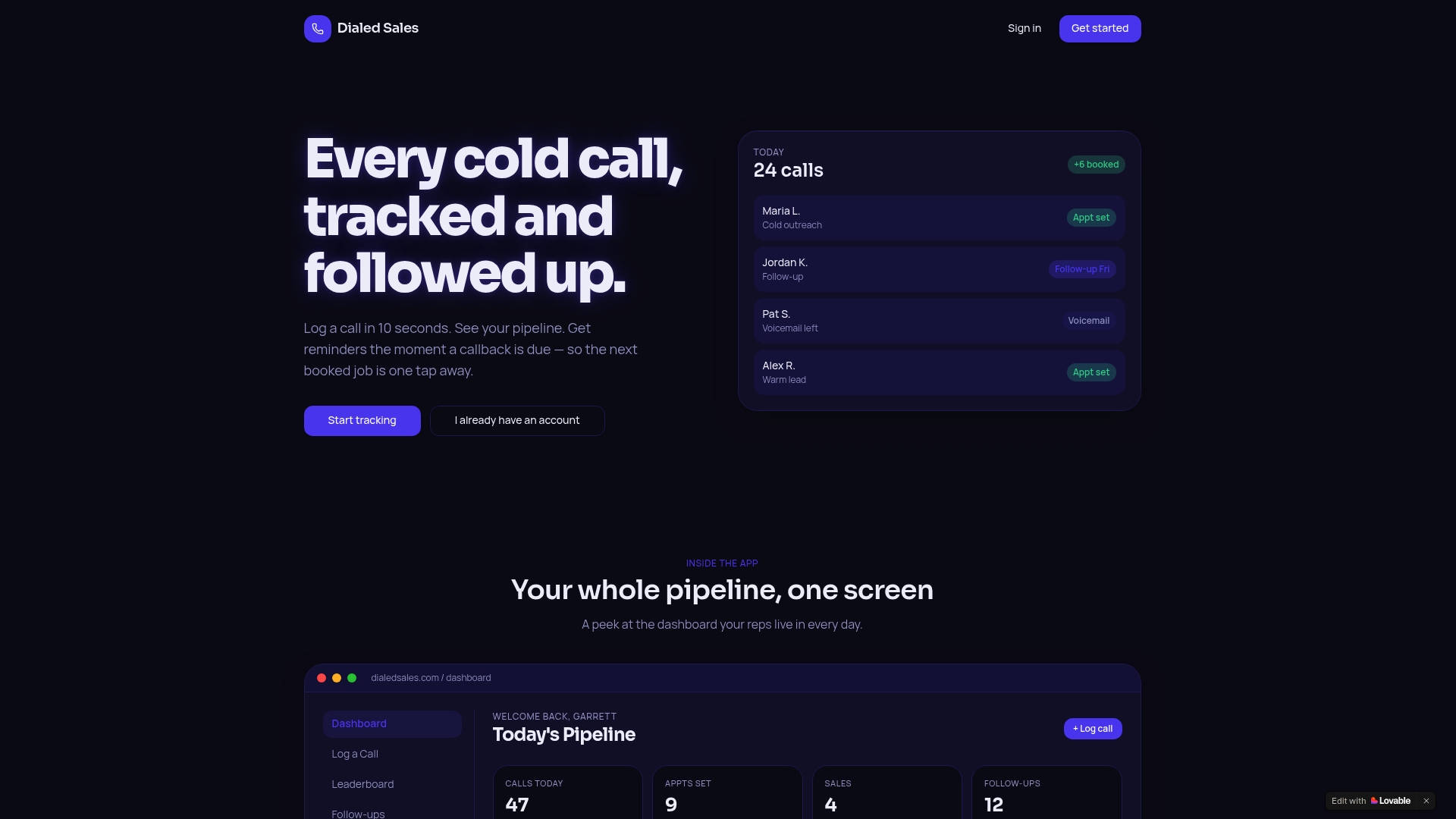
Every cadence in this guide, cold outbound, inbound, post-demo, works better when the reminder fires automatically the moment it's due rather than sitting buried in a notebook. Reps using a structured system like this report watching their close rate climb simply because fewer prospects fall through the cracks between touch 3 and touch 5, which is exactly where most pipelines leak. If you're managing a team, the per-rep activity stats and leaderboard also make it obvious who's actually working their cadence versus who's letting leads go stale.
Start your free trial of Dialed Sales today and set up your first follow-up cadence before your next batch of calls goes cold.
Frequently Asked Questions
How many follow-ups should a sales follow-up schedule include? Most effective schedules use 5 to 12 touches depending on lead source. Inbound leads need fewer, faster touches; cold outbound needs more touches spread across a longer window.
What is the best time to send sales follow-up emails? Tuesday through Thursday tends to perform best, with morning windows around 8 to 11 AM and a secondary window around 3 to 4 PM in the prospect's timezone.
When should you stop following up with a prospect? Stop active outreach after 8 touches with no response and send a break-up message before moving the prospect to a longer-term nurture list.
Do multi-channel follow-up sequences actually work better than email alone? Yes. Multi-channel outreach creates meaningfully higher connection probability than relying on a single channel, since prospects respond differently depending on where you reach them.
How do I track my follow-up schedule without losing prospects? A tool like Dialed Sales lets you log each call outcome in seconds, set the next follow-up date immediately, and get an automatic reminder on your dashboard the moment it's due.
Sources
The cadence data and timing recommendations in this guide draw on outreach research and practical B2B follow-up guides worth reading in full:
- Sales Follow-Up Strategy: How Many Times Should You Follow Up? (Data-Backed Guide 2026) | Auto Interview AI
- Follow Up Cadence: Timing, Templates & Examples | Sendspark
- Follow Up Email: Guide for B2B Sales Teams (2026) | Overloop