
A repeatable cold call talk track follows five components every time: a permission-based opener, a reason for calling tied to a trigger, a one-sentence value statement, one qualifying question, and a clear next-step ask.
Here is a copy-ready example you can test today:
"Hi [Name], this is [Your Name] at [Company]. I'm reaching out because [trigger event]. We help [persona] [specific outcome] without [common pain]. Quick question: is [problem] something your team is actively working on? If so, would 15 minutes Thursday make sense?"
That is the whole skeleton. Everything else in cold call talk track development is about sharpening each block, handling what comes after, and measuring what works.
Five core components every talk track needs:
- Opener: Permission-based, under 10 seconds, states who you are and why you called
- Reason/trigger: A specific event (funding round, new hire, expansion, seasonal pain) that makes the call timely
- Value statement: One sentence connecting your solution to a known outcome for that persona
- Qualifying question: One open question that surfaces whether the pain is real and active
- Clear CTA: A specific, low-friction next step (a date, a time, a yes/no)
Pick one persona right now. Write their version of that five-part track. Run it on 10 calls this week and note where the conversation stalls. That single experiment will teach you more than any template library.
Key Takeaways
A repeatable cold call talk track built on five modular components, tested on a minimum of 30 connects, and updated weekly from logged call data will consistently outperform ad-hoc outreach.
| Point | Details |
|---|---|
| Five components are non-negotiable | Every talk track needs an opener, trigger, value statement, qualifying question, and a specific CTA. |
| Brevity drives adoption | Keep the track to one page with 2–3 sentence blocks; longer playbooks rarely survive live calls. |
| Test one variable at a time | Run A/B tests with at least 30 connects per variant over two weeks before changing anything. |
| Log every call immediately | Capture outcome, pain signal, decision authority, and next step after every dial to fuel weekly iteration. |
| Iterate weekly, not monthly | Review 20 calls every Friday, extract winning language, and update one block before Monday's calls. |
Use Dialedsales to log calls in 10 seconds, automate follow-up reminders, and track your close rate as your talk track improves.
Table of Contents
- Why structured talk tracks matter for your results
- How to develop a cold call talk track step by step
- Ready-to-use talk-track templates for every scenario
- How to handle the 8 most common objections
- Voicemail best practices and a 6-step follow-up cadence
- How to test your talk track with metrics and A/B experiments
- The Dialedsales playbook for fast logging and weekly iteration
- Common mistakes that kill talk-track adoption and results
- Building a usable talk track in 30 minutes
- Sources
Why structured talk tracks matter for your results
Ad-hoc calls feel natural to the rep making them. They rarely feel natural to the person receiving them. Without a defined structure, reps skip the qualifying question, bury the value statement, or close with "just wanted to touch base" instead of asking for a meeting. A modular talk track framework fixes all three by giving reps a tested skeleton to internalize, not memorize.
For reps, the payoff is immediate. A defined opener kills call-freeze, the two-second panic before you say anything. A pre-built objection pivot means you stop improvising under pressure and start redirecting with confidence. New reps ramp faster because they are practicing a proven structure, not guessing.
For managers, the payoff is different but just as real. When every rep uses the same framework, you can coach to specific behaviors ("your qualifying question came too late") instead of vague impressions ("that call felt off"). Onboarding a new rep becomes a matter of drilling the framework, not hoping they absorb culture through osmosis.
A few benchmarks worth knowing:
- Talk-track brevity drives adoption: tracks that fit on one page with 2–3 sentence blocks get used in live calls; longer playbooks typically get skimmed and ignored
- Discovery quality predicts pipeline conversion: reps who follow a structured discovery question flow surface higher-quality opportunities than those who pitch first and qualify later
- Timing benchmarks show that calling between 4–5 PM has outperformed late-morning windows (11 AM–noon) in controlled experiments, which means the cadence you build around your talk track matters as much as the words in it
How to develop a cold call talk track step by step
Building a talk track from scratch takes under two hours if you follow a defined process. The goal is a one-page, modular guide you can hand to any rep and have them running live calls the same day.
-
Define your persona and trigger events. Name the job title, company size, and the two or three situations that make your solution relevant right now (new funding, recent hire, compliance deadline, seasonal demand spike). Specificity here determines whether your opener sounds timely or generic.
-
Collect the top three pains. Pull them from win/loss notes, customer interviews, or your best reps' call recordings. Use the exact language prospects use, not internal jargon. "We're losing installs to competitors on price" beats "competitive differentiation challenges."
-
Draft the four-block talk track. Opener (10 seconds, permission-based), pain identification (one question that surfaces the problem), value bridge (one sentence connecting your solution to the pain), and CTA (specific date and time). Keep each block to 2–3 sentences max. Brevity is not a style choice; it is an adoption requirement.
-
Write 3–5 objection pivots. For each likely objection ("not interested," "send me an email," "we already have something"), write one acknowledge-reframe sentence and one follow-up question. One sentence plus one question is the right length. Anything longer turns a pivot into a debate.
-
Select 4–6 discovery questions. Follow the situation-problem-impact-decision flow. "What does your current process look like?" (situation), "Where does it break down?" (problem), "What does that cost you per month?" (impact), "Who else would be involved in a decision like this?" (decision). Strong discovery quantifies the cost of inaction and surfaces the real decision-maker.
-
Schedule a two-week live test. Pick 10–30 calls minimum. Measure meetings booked, connect-to-next-step rate, and where calls end. Log every outcome immediately after hanging up. Compliance note: before you dial, confirm your list is scrubbed against the National Do Not Call Registry and that your outreach complies with the Telephone Consumer Protection Act (TCPA).
-
Iterate from call data. After two weeks, pull the calls where you booked a meeting and the calls where you hit a wall. Look for the language that worked and the moment the conversation died. Update one block at a time, not the whole track.
Pro Tip: Pull your top three recorded calls from the past month. Transcribe the first 60 seconds of each. The phrases your best rep uses naturally in those openers are your new talk track language. Reps who built their opener from real recorded calls adopt the track faster because it already sounds like them.
First-draft checklist before you go live:
- Opener is under 10 seconds when read aloud at normal pace
- Value statement names a specific outcome, not a feature
- Qualifying question is open-ended (starts with "what," "how," or "where")
- CTA offers a specific time, not "sometime next week"
- Objection pivots are written for at least three common responses
- Track fits on one printed page
Ready-to-use talk-track templates for every scenario
Each template below is modular. Swap the tokens in brackets for your persona's specifics. The label shows intended length and desired outcome.
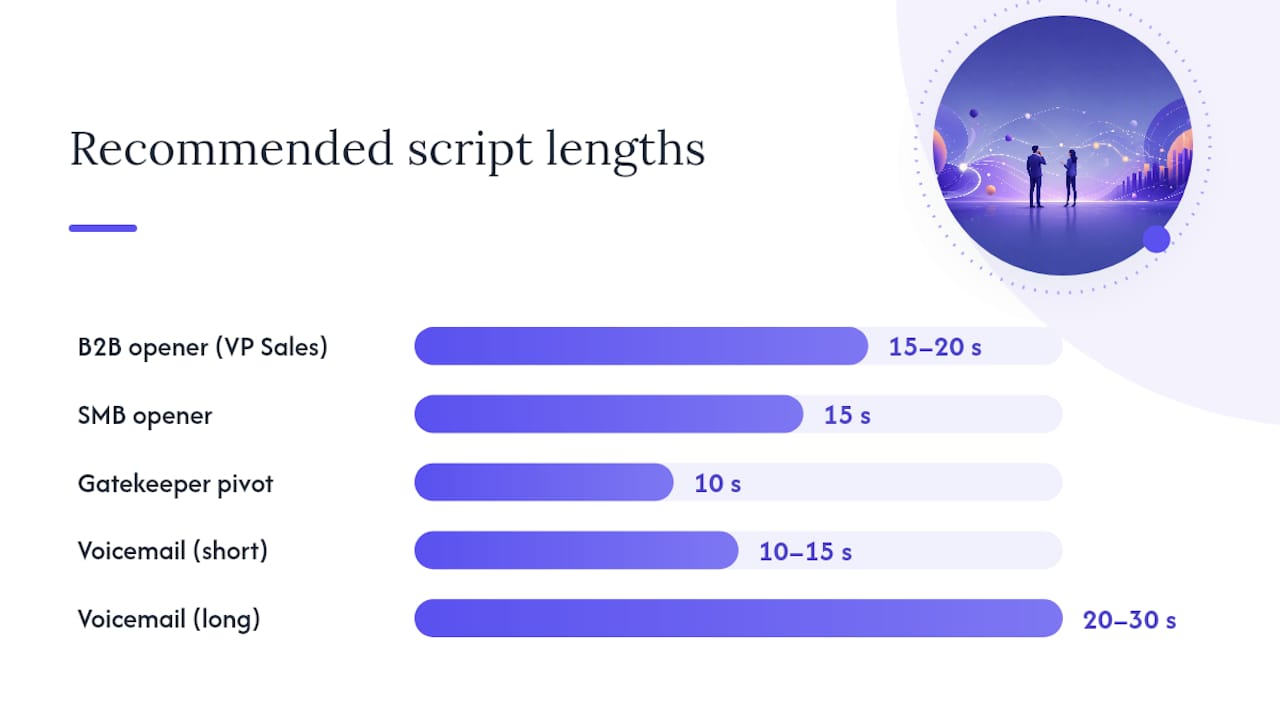
B2B opener: VP of Sales (15–20 seconds, goal: permission to continue) "Hi [Name], this is [Rep] at [Company]. I'll be quick. We work with VP Sales teams at [industry] companies to cut ramp time for new reps by fixing the first 30 seconds of their cold calls. Is that something you're currently working on?"
B2B opener: SMB owner (15 seconds, goal: permission) "Hi [Name], [Rep] from [Company]. We help [trade/service] owners in [city] book more jobs from cold outreach without adding headcount. Worth 90 seconds?"
Gatekeeper pivot (10 seconds, goal: warm transfer or callback time) "Totally understand. Could you tell me the best time to reach [Name] directly, or is there someone else who handles [specific function]?"
Voicemail: 10–15 seconds (goal: callback curiosity) "[Name], [Rep] at [Company]. We help [persona] with [specific outcome]. Call me back at [number] if that's relevant. [Number] again."
Voicemail: 20–30 seconds (goal: callback or email open) "[Name], [Rep] at [Company]. Reason I'm calling: [trigger event]. We helped [similar company] [specific result]. If [problem] is on your radar, I'd love 15 minutes. [Number]. I'll follow up by email too."
LinkedIn quick call-in request (goal: permission for a call) "Hi [Name], saw you're expanding your [team/market]. We've helped similar teams with [outcome]. Would a 10-minute call this week make sense? Happy to work around your schedule."
First follow-up after voicemail (goal: reply or meeting) "[Name], following up on my voicemail from [day]. Still think [specific outcome] could be worth a quick conversation. Are you open Thursday or Friday afternoon?"
Calendar-confirmation close (goal: lock the meeting) "Perfect. I'll send a calendar invite for [day] at [time]. Just to confirm: you'll have [decision-maker] on the call as well?"
Persona-to-opener mapping:
- VP of Sales → B2B opener with ramp time or quota attainment trigger
- SMB owner → local-market opener with cost or capacity trigger
- Operations lead → efficiency or compliance trigger opener
- Gatekeeper → warm transfer pivot, never pitch
- Voicemail (first touch) → 10–15s curiosity version
- Voicemail (second touch) → 20–30s with social proof token
Personalization tokens that move the needle:
- Trigger event: "I saw you just hired three new AEs" / "Noticed you expanded to [market]"
- Metric: "Teams like yours typically see [outcome] in the first 30 days"
- Role-specific pain: "Most [title]s I talk to say [specific frustration] is their biggest time drain"
| Scenario | Template | Desired outcome |
|---|---|---|
| First cold call, decision-maker | B2B opener (VP Sales or SMB) | Permission to continue |
| Gatekeeper answers | Gatekeeper pivot | Warm transfer or callback time |
| No answer, first touch | Voicemail 10–15s | Callback curiosity |
| No answer, second touch | Voicemail 20–30s | Callback or email open |
| LinkedIn outreach | Quick call-in request | Permission for a call |
| Post-voicemail follow-up | First follow-up template | Reply or booked meeting |
| Meeting agreed verbally | Calendar-confirmation close | Confirmed calendar invite |
How to handle the 8 most common objections
Every objection is a question in disguise. The rep's job is not to argue; it is to acknowledge, reframe, and ask one question that keeps the conversation moving.
1. "Not interested." Acknowledge-reframe: "That's fair. Most people I call say the same thing before they hear the one thing that's relevant to them. Can I ask: is [specific pain] something you're dealing with right now?" Pivot: "If not, I'll let you go. But if it is, 10 minutes could be worth it."
2. "No budget." Acknowledge-reframe: "Completely understand. Budget's tight everywhere. Out of curiosity, if [problem] were costing you [X] per month, would that change the conversation?" Pivot: "Happy to show you what the ROI looks like before you decide."
3. "Bad timing." Acknowledge-reframe: "Makes sense. When would be a better time to revisit this?" Pivot: "I'll put a note to follow up in [timeframe]. Does [specific month] work?"
4. "We already use something." Acknowledge-reframe: "Good to know. What do you like most about it? And what's the one thing you wish it did better?" Pivot: "That gap is exactly what we built [feature] to solve."
5. "Send me an email." Acknowledge-reframe: "I will. Before I do, what's the one thing that would make you actually open it?" Pivot: "I'll make it specific to that and send it within the hour."
6. "Gatekeeper: they're not available." Acknowledge-reframe: "No problem. Is there a better time to reach them directly?" Pivot: "Could you let them know I called about [specific topic]? I'll try back [day/time]."
7. "I'm not the decision-maker." Acknowledge-reframe: "Appreciate you telling me. Who would be the right person to loop in on something like this?" Pivot: "Would you be open to a quick intro call with both of you?"
8. "Your price is too high." Acknowledge-reframe: "I hear that. What are you currently paying to solve [problem], including the time your team spends on it?" Pivot: "Once we factor that in, the comparison usually looks different."
Pro Tip: After asking a reframe question, stop talking. Count to three silently. The prospect who fills that silence is the one who just told you what actually matters to them. Reps who interrupt that pause lose the signal every time.
Manager role-play cue: Run each objection as a 60-second drill. Rep delivers the objection, manager responds with the pivot, then they switch. Five minutes per objection, twice a week, builds the muscle faster than any script review.
Voicemail best practices and a 6-step follow-up cadence
Most voicemails get deleted in under three seconds. The ones that get called back share two traits: they are short, and they name something specific to the prospect's situation.
Voicemail rules:
- State your name and company in the first three words
- Name the specific reason you called (trigger or pain), not a generic "checking in"
- Give your number once, slowly, at the end
- Never ask for a meeting in a voicemail; ask for a callback or signal curiosity
- 10–15 seconds for a first touch; 20–30 seconds only when you have social proof to include
6-step follow-up cadence:
| Day | Action | Goal |
|---|---|---|
| Day 1 | Cold call + voicemail (10–15s) | First contact, curiosity |
| Day 3 | Email referencing voicemail | Open and reply |
| Day 5 | Cold call, no voicemail | Live connect |
| Day 8 | LinkedIn connection request | Warm the relationship |
| Day 12 | Call + voicemail (20–30s with social proof) | Second callback attempt |
| Day 15 | Final email: breakup or re-engage | Close loop or get a "not now" |
Timing matters as much as sequence. Calling between 4–5 PM has outperformed late-morning windows in controlled experiments. For best calling windows, early morning (8–9 AM) and late afternoon (4–5 PM) consistently outperform midday slots when prospects are in back-to-back meetings.
After Day 15 with no response, stop the active sequence. Mark the account for a 60-day re-entry. When you come back, lead with a new trigger: a product update, a relevant news item about their company, or a new case study from their industry. Re-entering with the same opener you used in the original sequence signals you have nothing new to say.
Pro tip on follow-up cadence: Mix channels deliberately. A prospect who ignores two calls may reply to a LinkedIn message the same day. The channel switch signals persistence without feeling like harassment.
How to test your talk track with metrics and A/B experiments
A talk track you never measure is a guess you keep repeating. The goal of testing is to find which specific block is working and which one is killing the call.
Core metrics to track for every talk track test:
- Connect rate: calls answered divided by total dials
- Meetings booked %: meetings booked divided by connects
- Call-to-next-step rate: any agreed next step (email, callback, meeting) divided by connects
- Average call length: longer calls usually mean better engagement, but track by outcome
- Objection frequency: which objection appears most often, and at what point in the call
- Downstream pipeline conversion: of meetings booked, how many become qualified opportunities
A/B test checklist:
- Hypothesis: "Changing the opener from a feature statement to a trigger-based question will increase meetings booked %."
- Variable: One change only. Never test two things at once.
- Sample size: Minimum 30 connects per variant before drawing conclusions.
- Duration: Two weeks minimum; four weeks if call volume is low.
- Primary metric: Meetings booked % (or call-to-next-step rate if volume is low).
- Win condition: Variant B outperforms Variant A by at least 15% on the primary metric across the full sample.
Call-scoring template (score each behavior 1–3):
- Opener clarity: did the rep state who they are and why they called in under 10 seconds?
- Permission ask: did the rep ask if it was a good time or use a pattern-interrupt opener?
- Discovery depth: did the rep ask at least two situation or problem questions before pitching?
- Value frame: did the value statement name a specific outcome for that persona?
- Objection handling: did the rep acknowledge, reframe, and ask a question (not argue)?
- Ask for next step: did the rep ask for a specific date and time, not "sometime next week"?
Score each call out of 18. Calls scoring 15 or above that did not book a meeting are worth reviewing for timing or fit issues. Calls scoring below 10 that did book a meeting are worth reviewing for what the rep did differently.
Tracking outcomes consistently is what turns a two-week test into a reliable signal. Log every call immediately: outcome, objection raised, call length, and next step agreed. Without that data, you are comparing impressions, not results.

The Dialedsales playbook for fast logging and weekly iteration
The fastest way to improve a talk track is to review 20 calls every Friday and update one block before Monday. That loop only works if logging takes seconds, not minutes.
Minimal logging template (five fields, every call):
- Name + company: who you called
- Outcome: connected/voicemail/no answer/meeting booked
- Pain signal: one phrase the prospect used that signals a real problem
- Decision authority: are they the buyer, an influencer, or a gatekeeper?
- Next step: exact date and action agreed, or "no next step"
Each field serves a specific purpose in iteration. Pain signals become the language in your next opener draft. Decision authority tells you whether to run the full discovery sequence or pivot to a referral ask. Next step logged means nothing falls through the cracks.
Weekly iteration workflow:
- Pull the top 20 calls from the week (by outcome: meetings booked and live connects)
- Read the pain signals and objections logged across all 20
- Identify the two or three phrases that appeared in multiple winning calls
- Update the value statement or qualifying question in the talk track to reflect that language
- Re-deploy the updated track Monday morning
Dialedsales makes this loop practical at any call volume. Log a call in 10 seconds with customer name, outcome, and notes. Follow-up reminders surface automatically on your dashboard when a callback is due. Per-rep stats and a live pipeline view let managers spot which reps are booking meetings and which are stalling at the same objection every time. The built-in AI assistant can summarize call activity and draft follow-up messages, so your weekly review takes 15 minutes instead of an hour. See how it works.
15-minute weekly iteration meeting checklist (for managers):
- Review connect rate and meetings booked % from the past week (2 minutes)
- Play two recorded calls: one win, one stall (5 minutes)
- Identify one phrase from the win call to add to the talk track (2 minutes)
- Identify one moment from the stall call where the rep lost momentum (2 minutes)
- Update one block in the talk track and confirm the change with the team (2 minutes)
- Set one metric to watch for next week (2 minutes)
Pro Tip: When you listen to top-performer calls, pay attention to where they deviate from the baseline track. Those deviations are not mistakes; they are usually the highest-confidence improvements available. If your best rep consistently skips the feature mention and goes straight to the impact question, that deviation belongs in the next version of the track.
Common mistakes that kill talk-track adoption and results
Most talk tracks fail before the first call ends. Here is where it goes wrong and how to fix it.
Mistakes to stop making:
- Opener too long: if your opener runs past 20 seconds, the prospect has already decided you are a telemarketer. Cut to 10 seconds.
- Skipping the permission ask: jumping straight into a pitch without asking if it is a good time signals you do not respect their schedule. One sentence fixes it.
- Weak close: "I'll let you think about it" is not a CTA. Ask for a specific date and time every single time.
- No personalization: using the same opener for a VP of Sales and an SMB owner tells both of them you did not do your homework.
- Zero objection prep: reps who have not practiced objection pivots improvise under pressure and either argue or fold. Write the pivots before you dial.
- Over-talking in discovery: asking a question and then answering it yourself is one of the most common rep habits. Ask, then stop.
What top performers do differently:
- They use planned silence after every question. Three seconds of quiet is not awkward; it is the prospect thinking.
- They follow the 40:60 rule: they talk 40% of the time and listen 60%. If your average call has you talking more than half the time, your discovery is actually a pitch.
- They run micro-practice drills: two minutes of opener delivery before the first call of the day, out loud, not in their head.
- They capture winning language from recordings and add it to their personal version of the talk track within 24 hours of the call.
For managers auditing in 10 minutes: Pull three calls from the past week. Check whether the rep asked a qualifying question before the value statement. Check whether the close named a specific date. Check whether the rep acknowledged the first objection or argued it. Those three behaviors predict booking rate better than call volume alone.
Building a usable talk track in 30 minutes
The biggest reason reps never build a talk track is that they think it takes a full day. It does not. Here is a 30-minute session that produces a testable first draft.
Minutes 0–5: Persona mapping. Write down the job title, company size, and the one trigger event that makes your call timely right now. One persona only. Do not try to cover everyone.
Minutes 5–10: Opener draft. Write three versions of a 10-second opener. Read each one aloud. Pick the one that sounds like something you would actually say to a stranger. The other two go in a folder for future A/B tests.
Minutes 10–15: Three discovery questions. Write one situation question, one problem question, and one impact question. Keep each under 12 words. If you cannot say it naturally in one breath, shorten it.
Minutes 15–20: Three objection pivots. Pick the three objections you hear most often. Write one acknowledge-reframe sentence and one follow-up question for each. Read them aloud. If they sound defensive, rewrite them until they sound curious.
Minutes 20–25: Two-minute role-play. Grab a colleague or do it solo with a voice memo. Run the full track from opener to CTA. Time it. If it runs past 90 seconds before the prospect says anything, cut something.
Minutes 25–30: Logging plan. Decide what you will log after every call: outcome, one pain signal, decision authority, next step. Pick the tool you will use. If you do not have a system, Dialedsales logs a call in 10 seconds and surfaces follow-ups automatically.
One thing to scrap immediately: any opener that starts with "I'm just calling to check in" or "I wanted to reach out because." Both signal you have no specific reason to call. Replace them with the trigger event every time.
The metric to track in your first two weeks is call-to-next-step rate, not meetings booked. Early in testing, you want to know whether the conversation is moving at all. Meetings booked is the right metric after you have confirmed the track generates engagement.
Sources
- How to Develop a Sales Talk Track: Step-by-Step Guide | SyncGTM
- SDR Talk Tracks That Sound Natural & Book Meetings — QUOTA Training
- How to Create a Sales Talk Track | Vozah
- B2B Sales Scripts and Talk Tracks That Actually Convert | Lead The Way
- Talk Tracks: Templates & Tips for Every Sales Stage (2026)