
Say this: "Hi [Name], this is [You] with [Company]. I noticed [specific trigger], and I put together [outcome] for teams like yours. I'll send a quick email titled '[subject line]' right after this. If you'd rather just call back, I'm at [phone number], again that's [phone number]." That single script, under 30 seconds, tied to a real trigger, is the foundation of every voicemail below.
It works for two reasons. Length discipline keeps prospects listening instead of deleting halfway through. Pairing it with a same-day email gives the prospect a second, lower-friction way to respond on their own schedule.
- Fill in the trigger with something you actually researched, not a generic compliment.
- Match the email subject line word-for-word to what you say in the voicemail, so the connection is obvious.
Key Takeaways
A voicemail script works when it stays under 30 seconds, names a specific trigger, states one outcome, and hands off to a same-day email with a matching subject line.
| Point | Details |
|---|---|
| Keep it short | Stay under 25 to 30 seconds so prospects listen through instead of deleting the message. |
| Pair with email | Send a same-day email using the exact subject line you named in the voicemail. |
| Repeat the number twice | State your phone number slowly, pause, then repeat it once more at the end. |
| Personalize with a trigger | Reference a specific, recent event rather than a generic compliment or "just checking in." |
| Match script to scenario | Use different templates for cold, follow-up, referral, competitor-intel, and no-show situations. |
Table of Contents
- What Is a Sales Voicemail Script, Really?
- Do Sales Voicemails Actually Get Callbacks?
- What Makes a Sales Voicemail Script Actually Work?
- Scenario-Based Voicemail Scripts You Can Copy Today
- When Should You Actually Leave a Voicemail?
- How Do You Practice a Voicemail Script Before Recording It?
- What Should You Test Next in Your Voicemail Strategy?
- The Mistake I See Reps Make Over and Over
- Frequently Asked Questions About Sales Voicemail Scripts
- Sources
What Is a Sales Voicemail Script, Really?
A sales voicemail script is a written, pre-planned message designed to earn a callback or push a prospect toward your follow-up email. It's not a mini pitch. The components that make it work are simple: who you are, why you're calling, one clear value point, a single call to action, and your phone number repeated twice. Voicemail is one node in a longer cadence. It doesn't close deals by itself, and treating it like a closing tool is where most reps waste their best 25 seconds.
Do Sales Voicemails Actually Get Callbacks?
Yes, and the numbers back it up. Practitioner research cited by ZoomInfo shows scripted voicemails can lift callback rates by roughly 22% compared to improvised ones, and each additional voicemail attempt in a sequence adds around 10% more callback probability on top of the last.
The numbers: Scripted voicemails can boost callbacks by about 22%, with each extra attempt adding roughly 10% more probability of a return call.
That compounding effect is the reason a single voicemail rarely tells you much. Treat voicemail as a scheduled touchpoint across your cadence, not a one-off gamble on attempt one.
What Makes a Sales Voicemail Script Actually Work?
Run every message against this checklist before you hit record:
- Hook in the first four seconds. Say your name, company, and something specific enough to prove you're not a robocall.
- Name one real trigger. A funding round, a new hire, an expiring contract. Something that couldn't apply to a random list of 500 companies.
- State a single outcome. Not three benefits. One. "Cut onboarding time by two weeks" beats a paragraph of features.
- Give one CTA tied to email. Tell them the subject line they'll see in their inbox in the next few minutes.
- Repeat your number twice, slowly. Once in the middle, once at the end.
- Stay under 30 seconds. HubSpot's own voicemail research found messages under 25 to 30 seconds are far more likely to be heard all the way through instead of deleted mid-sentence.
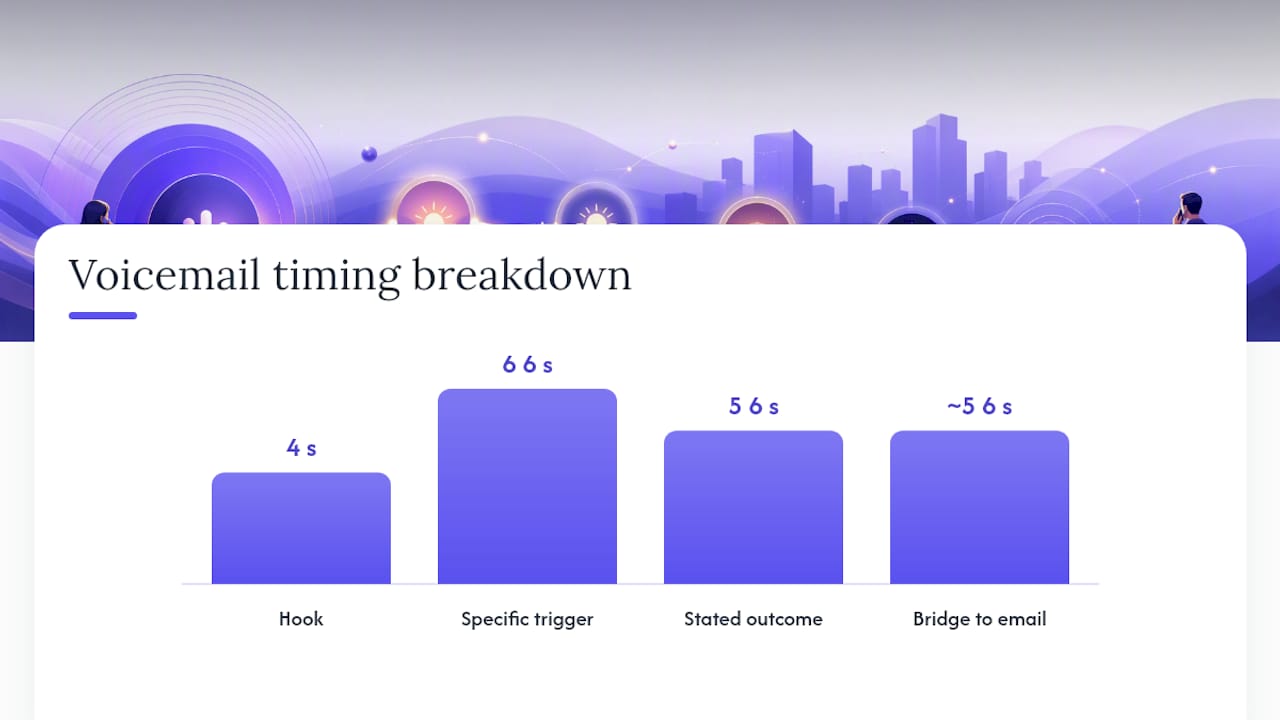
Practitioner playbooks converge on a similar structure: four seconds for the hook, six to eight seconds naming the specific trigger, five or six seconds stating the outcome, and a final few seconds bridging to email, landing the whole thing around 22 seconds total.
Pro Tip: Record yourself on your phone's voice memo app and read the transcript out loud. Most voicemail systems now auto-transcribe messages, and prospects read the text more often than they listen. If it reads like a run-on sentence, it'll sound like one too.
On pacing: slow down more than feels natural, especially around your phone number. Rushing forces a prospect to replay the message just to catch the digits, and most won't bother. If you're on attempt three or later in a sequence and the prospect has a habit of checking missed calls without listening to voicemail, you can skip leaving a message entirely on some touches. But when you do leave one, the number always gets repeated twice.
Timing matters as much as wording. A voicemail dropped without a same-day email behind it loses most of its power. HubSpot's guidance and SalesTap's framework agree on this: the email is not optional follow-through, it's the second half of the mechanism. Send it within minutes, not hours, while your name and voice are still fresh.
Scenario-Based Voicemail Scripts You Can Copy Today
Different moments in your cadence call for different scripts. Here's a set organized by the situation you're actually in, based on the template patterns SalesGravy and Cognism both document across their roundups.
First-touch cold voicemail. "Hi [Name], [You] with [Company]. I work with [industry] teams on [specific problem], and wanted to share something relevant to [trigger]. Sending a quick note titled '[subject]' in a minute, or call me back at [number], again [number]." Research the prospect's recent LinkedIn activity or a company announcement before recording. CTA: reply to the email if a call feels premature. Use this on your first or second voicemail attempt, not your fifth.
Follow-up after no response. "Hi [Name], following up on the note I sent about [specific topic] last week. I know timing might be off. If [outcome] isn't a priority right now, a quick reply saying so helps me stop bugging you. Otherwise, I'm at [number], [number] again." Personalization hint: reference the exact subject line from your first email so the connection is obvious. CTA: a reply, even a "no," counts as a win here.
Competitor-intel or displacement. "Hi [Name], [You] with [Company]. I've been talking with a few [role] leaders switching away from [category of tool] because of [specific pain point]. Wanted to see if that's showing up for your team too. Emailing you '[subject]' shortly, or reach me at [number], again [number]." Research what tool they currently use before recording this one. Use around attempt three or four, once you've built some name recognition.
Callback-optimized. "Hi [Name], quick one. I found [specific data point about their business] and think it's worth five minutes. I'm at [number], repeating that, [number]. Also sending '[subject]' to your inbox right now." This version leans hardest on urgency and a hard number, best used when you have something genuinely time-sensitive to share.
Referral-anchored. "Hi [Name], [Referrer's name] suggested I reach out. I help [role] with [outcome], and thought it made sense to connect given what you're working on. I'll send '[subject]' shortly, or call me at [number], again [number]." Always name the referrer first. This script converts better than almost any other because trust is already borrowed.
Meeting no-show. "Hi [Name], we had time booked for [time/date] and I didn't want to assume the worst. Happy to reschedule if something came up. Sending '[subject]' with a new link, or grab a time directly at [number]." Keep this one light, not accusatory.
Break-up or last attempt. "Hi [Name], last note from me on this. If [outcome] isn't a fit right now, I'll close the file, but the door's open anytime. Sending a final email titled '[subject]' in case timing changes." This one often outperforms every other script because it removes pressure entirely.
When Should You Actually Leave a Voicemail?
Voicemail earns its keep once a prospect has already seen your name somewhere else, usually after an email or two, not on the very first touch of a cold sequence. Leaving a voicemail before any other contact often reads as more intrusive than it needs to.
A workable six-touch cadence looks like this:
- Email 1 (Monday): intro, subject line referencing the trigger.
- Email 2 (Wednesday): short follow-up, same subject thread.
- Call + voicemail (Friday): first-touch cold script, same-day email titled to match.
- Call + voicemail (following Tuesday): follow-up-after-no-response script.
- Call + voicemail (following Thursday): competitor-intel or referral script, depending on what you've learned.
- Break-up email + final voicemail (the next Monday).
- Don't leave a voicemail on every single call attempt. Alternate with silent dials logged as missed-call touches.
- Don't reuse the exact same script twice in one cadence. Repetition signals a template, and prospects notice.
- Space voicemails at least two to three days apart so you're not building fatigue instead of familiarity.
How Do You Practice a Voicemail Script Before Recording It?
Time yourself out loud before you ever leave the message for a real prospect. Aim for 18 to 25 seconds, not the full 30 you're allowed. Hold your phone slightly below your mouth rather than directly against it, cut filler words like "um" and "just," and read the script as if someone will only see the transcription, not hear your voice.
- Read the script aloud once for timing, once for clarity, once for tone.
- Cut any sentence that doesn't survive being read as plain text.
- Pause deliberately before and after your phone number.
Pro Tip: Do a dry run into your own voicemail first. Listening back catches rushed numbers and mumbled words faster than reading the script ever will.
What Should You Test Next in Your Voicemail Strategy?
The strongest signal across practitioner sources is consistent: an 18 to 30 second window, a trigger-based personalization, and a same-day email handoff outperform generic "just checking in" messages, with some practitioner data showing personalized, trigger-driven voicemails driving roughly 22% higher engagement than non-personalized versions.
Personalized voicemails tied to a specific trigger event can drive meaningfully higher engagement than generic follow-up messages.
Run a simple 30-day split test: half your list gets a trigger-personalized script, half gets a generic version, everything else held constant. Log the outcome of every call, whether it's a callback, an email reply, or nothing, and track callback rate as your primary KPI. A call tracking habit makes this comparison possible instead of anecdotal.
- Log outcome, script variant, and trigger type on every dial.
- Compare callback rate and email reply rate weekly, not just at the end.
- Kill the losing variant fast and reallocate the calls.
The Mistake I See Reps Make Over and Over
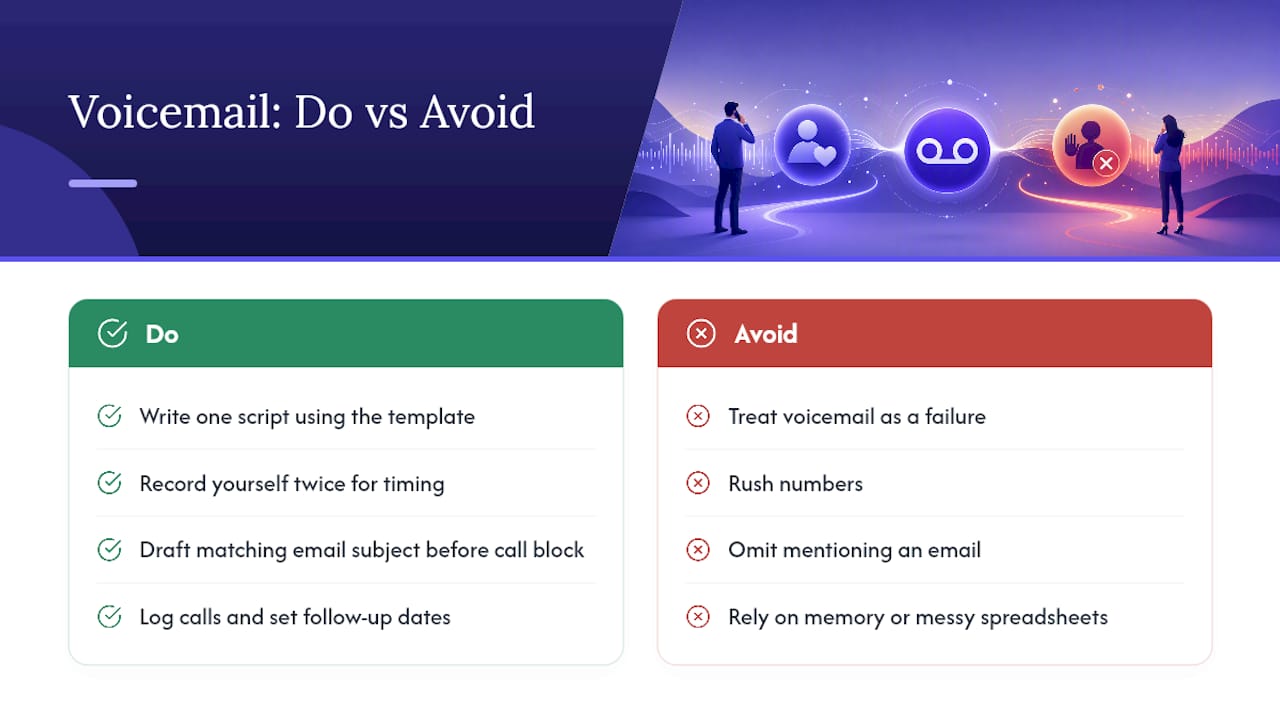
Most reps treat a voicemail as a failure state, something you mumble through because the call didn't connect, then rush off the phone embarrassed. That mindset shows up in the recording: rushed numbers, no clear outcome, no mention of an email at all.
The fix takes ten minutes. Write one script using the template above, record yourself twice for timing, and draft the matching email subject line before your next call block. Do it once, and it becomes your default for every voicemail after. For more on sequencing these correctly, see the cold call follow-up guidance on pairing calls with email.
If you're logging outcomes by memory or a messy spreadsheet, you'll never know which script variant actually moved your callback rate. Dialedsales was built for exactly this gap: log a call in about ten seconds with the customer name, outcome, and a note, set a follow-up date that surfaces automatically on your dashboard, and watch which voicemail scripts actually convert over time instead of guessing. Field teams in industries like solar, insurance, and HVAC use it to track which scripts and cadences move the needle without adding admin work to a rep's day. Try Dialed Sales to see your voicemail-to-callback rate laid out on one screen.
Frequently Asked Questions About Sales Voicemail Scripts
How long should a sales voicemail be? Keep it between 18 and 30 seconds. Anything longer risks getting cut off or deleted before the prospect hears your CTA.
Should I always leave a voicemail on a cold call? Not every time. Voicemail works best once a prospect has seen your name in an email first, and alternating voicemail with silent missed-call touches avoids sounding repetitive.
What's the single biggest mistake in sales voicemail scripts? Rambling without a clear outcome or CTA, and rushing the phone number so the prospect has to replay the message just to write it down.
Do I need a different script for every prospect? No, but you need different scripts for different scenarios, cold, follow-up, referral, no-show, rather than one universal script for every situation.
How do I know if my voicemail script is working? Track callback rate and email reply rate by script variant over a set period, at least 30 days, so you're comparing real volume instead of a handful of calls.
Sources
- 19 Tips to Leave the Perfect Sales Voicemail
- B2B Voicemail Scripts That Get Callbacks | SalesTap
- Sales Voicemail Scripts That Work in 2026 | Vozah
- 10 of the Best Voicemail Scripts for Cold Calling in 2026
- 7 Sales Voicemail Scripts That Get Your Calls Returned