
That's the whole system. Everything below just shows you how to run each piece.
- Schedule: phone-first call blocks + 8 to 12 touch sequence over 21 days
- Logging: name, outcome, one-line note, follow-up date, in under 10 seconds
- Territory health: rebalance any rep who drifts past a +/-20% workload variance, checked quarterly
Key Takeaways
A repeatable territory calling plan combines phone-first weekly call blocks, an 8 to 12 touch multichannel sequence, 10-second CRM logging, and quarterly capacity rebalancing triggered when workload variance is significant compared with the team average.
| Point | Details |
|---|---|
| Structure the week around phone blocks | Run Tier 1 and Tier 2 prospecting Monday, Wednesday, and Friday mornings; reserve Tuesday and Thursday for follow-up calls. |
| Match sequence weight to account tier | Use a 5 to 6 touch short sequence for executives, a 10-touch standard for most accounts, and a heavy 12-plus touch version for high-volume SDR motions. |
| Time calls for real connects | Call during 10 to 11 AM and 2 to 3 PM local windows, and staff the 9 to 11 AM window for next-day voicemail callbacks. |
| Rebalance territories on a data trigger | Recalculate the balance index quarterly and reassign accounts once any rep's score drifts past a 20% variance from the team average. |
| Keep logging light with Dialed Sales | Dialed Sales lets reps log a call in about 10 seconds and auto-surfaces follow-up reminders so the plan survives past the first month. |
Table of Contents
- What Does a Weekly Territory Calling Plan Actually Look Like?
- What Should Your Opening Script Actually Say?
- What CRM Fields and Rules of Engagement Do You Need?
- How Do You Size a Territory So Workload Is Actually Fair?
- Which Metrics Actually Tell You the Plan Is Working?
- How Do You Customize the Plan by Industry or Buyer Persona?
- How Should Phone Fit Alongside Email and Social Outreach?
- What Tools Should You Use to Run This Without Friction?
- How Do You Keep Reps From Calling the Same Accounts?
- What's the Right Way to Handle Time Zones and Call Timing?
- A Manager's Note on Rolling This Out
- Run the Plan With Dialed Sales
- Sources
What Does a Weekly Territory Calling Plan Actually Look Like?
Reps who fragment prospecting across every day of the week end up doing neither prospecting nor follow-up well. A phone-first weekly structure with dedicated call blocks for top-tier accounts, and separate days for follow-up and research, keeps reps from bouncing between modes all day.
Here's the weekly skeleton:
- Monday, Wednesday, Friday, 9 to 11 AM: Tier 1 and Tier 2 prospecting blocks. New accounts and cold outreach only.
- Tuesday and Thursday mornings: Follow-up calls tied to CRM reminders from the past week's sequence steps.
- Afternoons (2 to 3 PM daily): A second live-connect window, plus email and LinkedIn touches for accounts in an active sequence.
- Friday afternoon: Research and list-building for next week's territory sweep.
Run three sequence weights depending on account tier. A short sequence (5 to 6 touches over 10 days) fits executive or C-suite targets where volume backfires. The standard sequence, 10 touches across 21 days, is the default for most territory accounts and matches what modern outbound cadences run: 8 to 12 touches, 4 to 5 channels, spread over 21 to 28 days. A heavy sequence (12+ touches, compressed into 14 days) works for high-volume SDR motions chasing lower-value accounts where speed matters more than polish.
Timing matters more than most reps think. The best windows for live phone connects sit at 10 to 11 AM and 2 to 3 PM local time, and voicemail callbacks cluster heavily between 9 and 11 AM the next morning. If your territory spans multiple time zones, stagger your campaign start times so a 9 AM Eastern block doesn't land as a 6 AM wake-up call on the West Coast. Leave voicemails only on attempts 1 and 4 of the sequence. Every other attempt should be a silent hang-up followed by an email or LinkedIn touch.
Pro Tip: Front-load your sequence with three touches in the first five days. Sequences that open fast see noticeably better engagement than ones that trickle out one touch per week.
What Should Your Opening Script Actually Say?
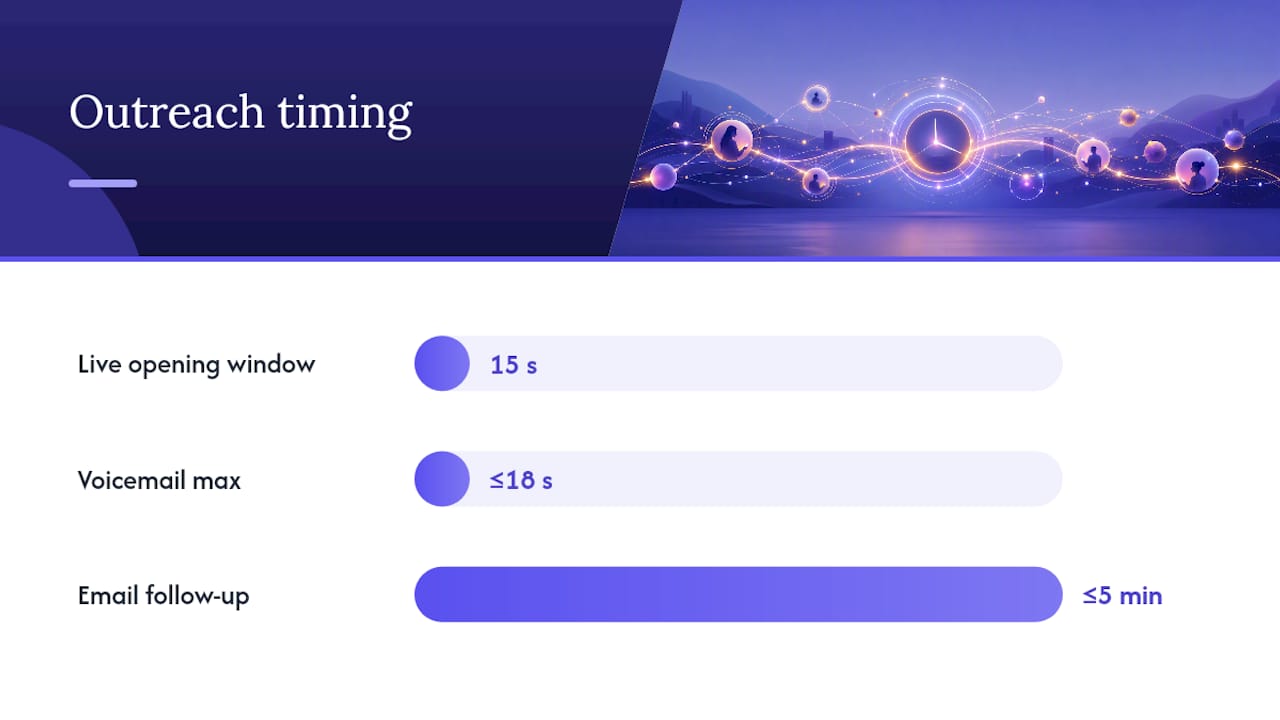
The first 15 seconds of a cold call decide whether you get 90 more. Skip the "how are you today" filler and go straight to a pattern interrupt: their title plus a specific trigger. Something like, "I saw your team just expanded into the Denver market, and that's actually why I'm calling." That's it. Then ask permission: "Do you have 30 seconds?" Then give one sentence on why you're calling. Three moves, no wasted words.
Voicemails follow a tighter formula because nobody replays a 45-second message. State your name, one line on why you're calling, and a fast handoff to email, all in under 18 seconds. "This is [name] with [company]. I'm reaching out about [specific reason]. I'll follow up by email right after this so you have my info." Then actually send that email within five minutes; that's the pairing that improves recognition and reply rates more than either channel alone.
Objections need a three-step move: acknowledge, reframe, redirect.
- "We're not looking right now." Acknowledge: "Makes sense, most teams aren't shopping cold." Reframe: "This isn't really about switching today, it's about having a benchmark for when you are." Redirect: "Worth 15 minutes to compare notes?"
- "Send me info." Acknowledge: "Happy to." Reframe: "Info without context usually gets buried." Redirect: "Can I ask two quick questions first so what I send actually fits?"
On a live connect that goes well, don't try to sell the whole deal on the phone. Ask three to five discovery questions built solely to earn the next meeting: current process, biggest friction point, timeline for change, who else weighs in, and what a good outcome looks like for them.
Pro Tip: Write your objection responses on an index card taped to your monitor for the first two weeks. Reps who memorize the acknowledge/reframe/redirect shape stop sounding defensive almost immediately.
What CRM Fields and Rules of Engagement Do You Need?
A territory plan collapses the moment two reps call the same account in the same week. Fix that with a small set of mandatory CRM fields and clear ownership rules, not a bloated data-entry process nobody follows.
Track these fields on every account:
- Account owner (rep name, not just team)
- ICP tier (1, 2, or 3, tied to sequence weight)
- Parent/subsidiary relationship, so a call to one location doesn't trigger a duplicate call to a sister site
- Last contacted date and channel
- Next follow-up date
- Engagement status (new, active sequence, nurturing, closed lost)
Each call log should take about 10 seconds: customer name, outcome code, one-sentence note, and a follow-up date. Anything longer than that and reps start skipping logs entirely, which is exactly how territory data rots.
Rules of engagement need to be explicit, not assumed. Define who owns net-new outreach (typically SDRs), who owns qualified deals (AEs), and who owns renewals or expansion (AMs). Set no-fly zones for named accounts that sit with a specific rep regardless of tier, and build auto-exit conditions into sequences: a hard no, a wrong number, or a closed-lost status should immediately pull an account out of active cadence.
This is exactly the workflow Dialed Sales was built around. Quick logging, auto-surfaced follow-up reminders, a live dashboard showing who owns what, and a leaderboard that makes ownership visible to the whole team, not just the manager.
How Do You Size a Territory So Workload Is Actually Fair?
Most territory disputes come from geography-first thinking: draw a map, divide it into regions, done — ignoring the sales territory design that actually balances workload. That approach ignores the one variable that actually predicts whether a rep can hit quota, which is selling time. A capacity-first design starts with hours available and works backward into account count.
Here's the math. Say a rep has 25 selling hours a week after meetings, admin, and travel. If a Tier 1 account needs 45 minutes of combined call and follow-up time per week during active sequencing, and a Tier 2 account needs 20 minutes, you can back into a maximum load: roughly 20 Tier 1 accounts or 60 Tier 2 accounts, or some blended mix that fits the 25-hour ceiling.
- Calculate weekly selling hours per rep after subtracting meetings, travel, and admin.
- Estimate workload minutes per account by tier, based on sequence weight and expected touches.
- Divide available hours by weighted workload to get a maximum account count per rep.
- Build a balance index using 3 to 5 variables: opportunity value, account count, estimated workload hours, and travel time, then normalize every territory's score to a team average of 100.
- Flag any territory whose index drifts beyond the trigger range for review.
That trigger range is not arbitrary. Alexander Group's research sets it at plus or minus 20% of the team average, and treating territory design as an ongoing operating system rather than an annual event improves sales productivity by 10 to 20% compared with planning that only happens once a year.
Run the rebalancing check quarterly, not annually. When you do move accounts, hand them off carefully: a short note or warm introduction from the outgoing rep preserves relationship equity that a silent account transfer destroys. A structured territory design process that defines objectives, segments accounts, and monitors the balance index on a recurring basis outperforms one-off planning every time.
Which Metrics Actually Tell You the Plan Is Working?
Three numbers matter more than the rest: revenue per territory, quota attainment by territory, and coverage ratio, meaning the percentage of assigned accounts that got a real touch this cycle. Everything else is supporting detail.
Underneath those three, watch the operational layer: calls logged per rep, touches per account, and meetings booked per dial block. A rep who's logging plenty of calls but booking zero meetings has a script or targeting problem, not an activity problem, and those two issues need completely different coaching conversations.
Run a short weekly check:
- Pull the top three metrics for every rep, not just the team average
- Watch for coverage ratio dropping below expectation, which usually means a rep is over capacity
- Escalate to a rebalancing review if a rep's numbers stay off for two consecutive weeks, rather than waiting for the quarterly cycle
When you sit down with a rep, show the numbers plainly rather than leading with judgment. "Your connect rate is solid but your meeting rate is half the team's" opens a coaching conversation. A vague "keep pushing" doesn't.
How Do You Customize the Plan by Industry or Buyer Persona?
The skeleton stays the same across industries, but the weighting shifts hard depending on who you're calling and how they buy.
Home services and HVAC territories often run on urgency and short sales cycles, so a heavy sequence with fast follow-up (same-day voicemail-to-email pairing) beats a slow-build cadence. Insurance and financial services accounts, by contrast, tend to need a longer trust-building arc. A standard or even extended sequence with more educational touches, and fewer hard asks early, performs better there.
Solar sales territories usually split between homeowner outreach (evenings and weekends, when decision-makers are actually home) and commercial B2B accounts (standard business-hours windows). Running one calling schedule across both segments wastes call attempts on the wrong hours for half your list.
Real estate and B2B SaaS accounts split by persona more than industry. A cold call to a VP looks nothing like a cold call to a procurement manager. Adjust your discovery questions accordingly: executives respond to strategic framing ("how are you thinking about this for next year"), while operational buyers respond to specifics ("what's breaking in your current process right now").
The practical move is to build two or three named "playbooks" inside your standard territory plan, each with its own sequence weight, timing window, and opener style. Tag accounts by segment when you load them into the sequence, and let the tag decide which playbook applies. Reps shouldn't have to reinvent the approach account by account. Reviewing prospect types and what opens each one before you assign playbooks saves a lot of trial and error later.
How Should Phone Fit Alongside Email and Social Outreach?
Phone should lead the sequence, not run parallel to it. Every cadence step needs a defined channel and order, and the mistake most territory plans make is treating email and LinkedIn as backup rather than reinforcement.
A workable order for a standard 10-touch sequence: call, voicemail plus immediate email, LinkedIn connection request, call, email, call, LinkedIn message referencing the earlier connection, call, breakup email, final call. Phone still carries the weight, connect-to-meeting conversion on a live call runs 3 to 5 times higher than email alone, but email and LinkedIn keep your name visible between calls, which matters because pickup rates stay low no matter how good your list is.
Coordinate timing so channels don't collide badly. Sending a LinkedIn request the same hour as a cold call can look coordinated in a good way; sending three emails in one day reads as spam. Space the non-phone touches so each one lands two to three days apart, and always pair a voicemail with an email sent within minutes, since that pairing is what actually drives the reply-rate lift.
The channels need to share the same account record, or you'll have a rep calling an account that marketing already burned out on email last week. Whatever tool logs your calls should be the single source of truth for last-contact date and channel, regardless of which channel touched the account most recently.
What Tools Should You Use to Run This Without Friction?
The plan above only works if logging a call takes seconds, not minutes. Heavy CRM entry is where most territory calling plans quietly die: reps skip logging because it's tedious, follow-up dates never get set, and by week three nobody actually knows who called whom.
A lightweight call tracker solves the friction problem directly. Log the account name, outcome, and a one-line note in about 10 seconds, set the follow-up date once, and let it auto-surface on a dashboard when it's due rather than relying on a rep's memory or a sticky note. That single habit change, from "log everything eventually" to "log it now, in seconds," is what separates a plan reps actually follow from one they abandon by month two.

Beyond logging, look for automation on the repetitive parts: sequence enrollment that auto-advances a contact through voicemail and email steps, dial-block scheduling that respects time zones, and reminders that fire the moment a follow-up date arrives instead of sitting in a report nobody opens. Reviewing call activity tracking methods built specifically for cold callers, rather than adapting a general CRM workflow, tends to close that gap faster.
How Do You Keep Reps From Calling the Same Accounts?
Overlap kills trust fast. An account that gets called by two reps in the same week assumes your company is disorganized, and that impression is hard to undo.
The fix starts with the ownership field discussed earlier, but ownership on paper only works if reps actually check it before dialing. Build a habit of a five-minute daily glance at the shared dashboard before starting a call block, not just a weekly team meeting where overlaps get discovered after the fact.
Set clear geographic or account-list boundaries and put them somewhere visible to the whole team, not buried in a spreadsheet one person maintains. When territories get rebalanced quarterly, announce the change to the full team the same day, not just to the two reps directly affected, since a rep working an adjacent territory needs to know the boundary moved too.
Leaderboards help here in a way people don't expect. When call activity and outcomes are visible across the team, duplicate outreach gets caught by peers almost immediately, someone notices "wait, I called that account last Tuesday" before it becomes an awkward moment with the prospect. Managers running a structured pipeline review with the full team present, rather than one-on-one only, catch these overlaps earlier and reinforce the ownership rules without needing a formal audit.
What's the Right Way to Handle Time Zones and Call Timing?
A territory spanning three or four time zones needs a scheduling approach, not just good intentions about "calling at reasonable hours."
Segment your account list by time zone before you build the week's call blocks, and set your dial windows to that zone's local time rather than your own. A rep based on the East Coast calling into Pacific accounts should shift their afternoon block later, not earlier, to hit that 10 to 11 AM and 2 to 3 PM local sweet spot on the West Coast.
Voicemail callback timing deserves its own attention. Most callbacks land between 9 and 11 AM the morning after a voicemail, so make sure a rep, or a teammate covering for them, is actually available to answer during that specific window for each time zone they've seeded with voicemails the day before. A voicemail dropped in a zone where nobody's watching the phone the next morning wastes the callback entirely.
If your territory plan runs across international accounts, treat business hour overlap as a hard constraint on sequence design rather than an afterthought. Shrink the touch count for zones where your live-call window barely overlaps with the prospect's workday, and lean more heavily on email and LinkedIn for those accounts since phone access is genuinely limited.
A Manager's Note on Rolling This Out
Don't flip the whole team onto a new cadence at once. Pilot it with two or three reps for three weeks, watch coverage ratio and connect rate, then expand.
Expect pushback on logging, most reps hear "new CRM habit" as "more busywork." The counter is showing them the 10 second version live, not describing it. If full data hygiene isn't there yet, a minimum viable version, name, outcome, follow-up date, beats a perfect field list nobody fills out.
— Garrett
Run the Plan With Dialed Sales
The plan above only holds together if the logging and follow-up piece is frictionless, and that's exactly the gap Dialed Sales was built to close. Every feature maps directly onto the daily execution work this article just walked through: log a call in about 10 seconds with customer name, outcome, and a note; set a follow-up date once and let it auto-surface on your dashboard the moment it's due; watch team activity and outcomes on a live leaderboard instead of hunting through a spreadsheet for who called whom.
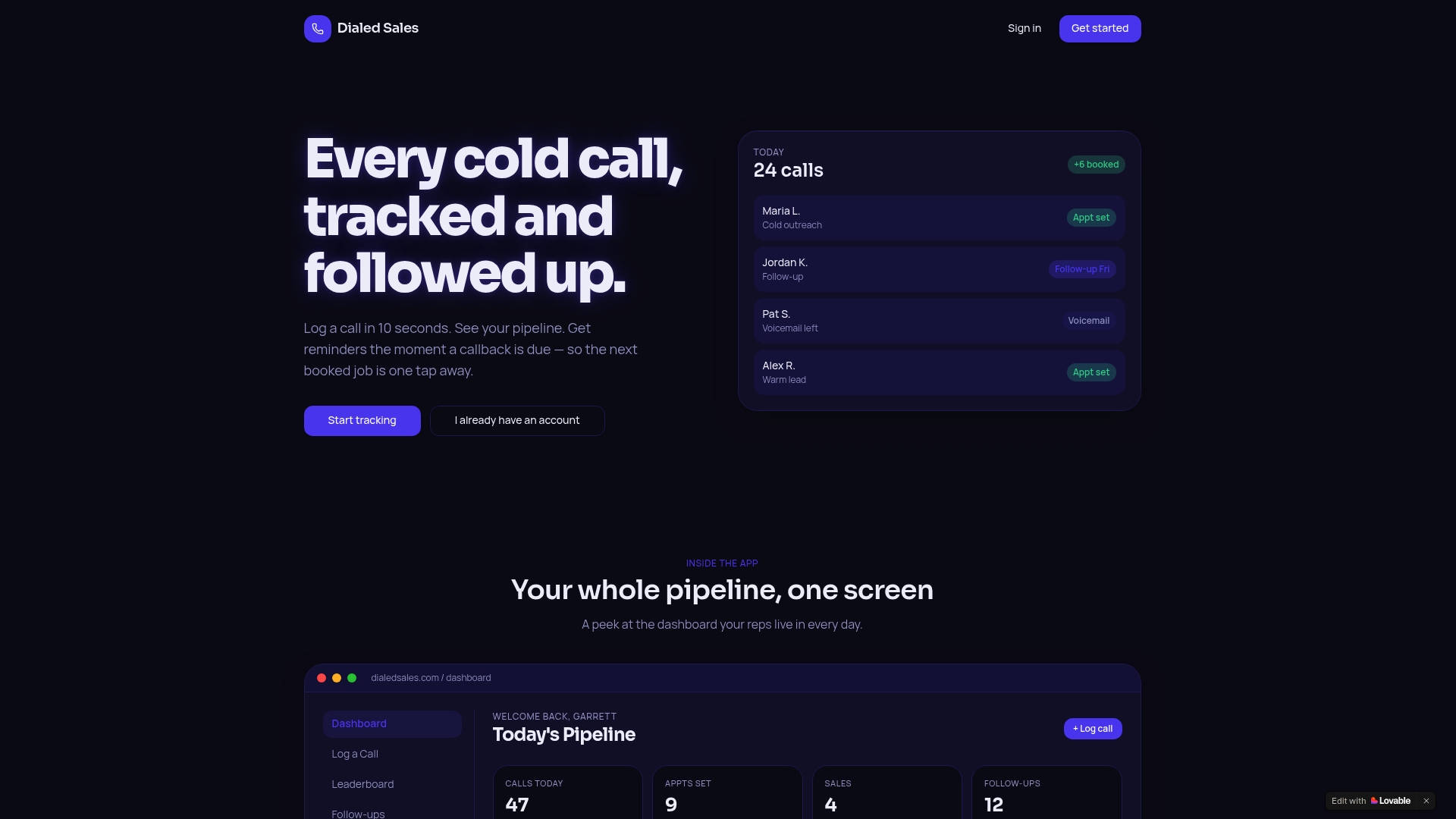
A heavy CRM asks reps to fill out a dozen fields for a five-minute call. That's the exact friction that makes territory plans fall apart by week three. A lightweight tracker built specifically for cold callers skips the overhead and keeps the habit alive because it takes seconds, not minutes, per entry. Start a trial of Dialed Sales to run your weekly call blocks with real logging behind them, or go straight to the Follow-ups feature to see how the auto-reminder system keeps every promised callback from slipping through the cracks.
Sources
- Territory design: the gateway to increased sales productivity — Alexander Group
- How do mid-market SDR teams structure outbound territory and account assignments — Apollo
- Outbound sales sequencing: the complete 2026 cadence framework — Nimitai
- High-volume outbound sales playbook for SDR teams — Aloware
- Sales territory management: practitioner's playbook (2026) — Prospeo