
The National Do Not Call Registry prevents covered telemarketers from calling any number registered on it unless a specific exception applies. The Federal Trade Commission (FTC) runs the Registry through DoNotCall.gov, enforces it via the Telemarketing Sales Rule (TSR), and coordinates with the FCC on related telemarketing regulations. Registration is free and permanent, but it is not a call blocker. It targets legal telemarketers, not scammers who ignore the law entirely.
What the Registry does:
- Prohibits covered sellers and telemarketers from calling registered numbers without a valid exception
- Requires telemarketers to scrub their call lists against the Registry at least every 31 days
What the Registry does not do:
- It does not physically block calls or filter them at the carrier level
- It does not stop illegal robocallers, scammers, or overseas fraud operations
For consumers: Register at DoNotCall.gov or call 1-888-382-1222 from the number you want listed. If illegal calls keep coming, hang up without pressing any keys and report at Reportfraud. Your number appears on the Registry quickly, but telemarketers have up to 31 days to update their lists.
For telemarketers: Subscribe to the Registry, scrub your call lists within 31 days of each update, maintain an entity-specific internal Do Not Call list, and keep documented records of Established Business Relationships (EBRs) and written consent.
Key Takeaways
The National Do Not Call Registry prevents covered telemarketers from calling registered numbers, but registration alone will not stop scammers, and telemarketers have up to 31 days to scrub updated lists.
| Point | Details |
|---|---|
| Registry timeline | Your number appears quickly, but telemarketers have up to 31 days to stop calling after registration. |
| EBR expiration windows | The exemption based on business relationships lasts different periods depending on the type of relationship |
| Per-call penalties | Illegal calls to registered numbers can reach tens of thousands of dollars per call, with each call counted separately. |
| Report violations | File complaints at reportfraud.ftc.gov; the FTC uses reports to identify patterns and support enforcement. |
| Dialedsales | Dialedsales logs calls, flags opt-outs, and auto-suppresses DNC numbers from active dial lists for outbound sales teams. |
Table of Contents
- What the National Do Not Call Registry is and how it works
- How to register your number and when calls should stop
- Who can still call you: the key exceptions to the Do Not Call rules
- What telemarketers and sellers must do to comply with Do Not Call rules
- Robocalls, scams, and what the Registry won't stop
- How consumers can report violations and what to expect
- Operational compliance playbook for businesses and telemarketing teams
- Why compliance is worth more than the fine you're trying to avoid
- Dialedsales helps you track calls and stay organized
- Sources
What the National Do Not Call Registry is and how it works
The National Do Not Call Registry is a federal database of phone numbers whose owners have asked not to receive unsolicited telemarketing calls. The FTC administers it; the FCC enforces related rules under the Telephone Consumer Protection Act (TCPA). Both agencies share jurisdiction, which is why you will sometimes see references to both when reading about no call list guidelines.
The Registry's role is narrow but consequential. It is a list that covered telemarketers must consult before dialing. It does not route calls, filter them, or notify your carrier. A telemarketer who calls a registered number anyway is violating federal law. A scammer who calls a registered number is also violating federal law, but they were never going to check the list in the first place. That distinction matters for setting realistic expectations.
The governing framework has two main pillars. The Telemarketing Sales Rule covers sellers and telemarketers engaged in campaigns to sell goods or services via interstate calls, imposing Do Not Call obligations, disclosure requirements, and recordkeeping duties. The TCPA, enforced by the FCC, adds restrictions on autodialed calls, prerecorded messages, and texts. Both apply regardless of the technology a caller uses, whether that is a traditional dialer, a predictive dialer, or a modern outbound call-tracking platform.
How to register your number and when calls should stop
The registration process takes under two minutes. Here is how it works:
- Go to DoNotCall.gov. Click "Register Your Phone" and enter up to three phone numbers along with your email address. You will receive a confirmation email; click the link within 72 hours to complete registration.
- Register by phone if you prefer. Call 1-888-382-1222 from the number you want listed. The call must come from that specific number for registration to work. A TTY option is available at 1-866-290-4236.
- Confirm your number is listed. You can verify registration at DoNotCall.gov by entering your number. Registration does not expire, so you only need to do this once per number.
- Understand the timeline. Your number shows up on the Registry quickly, but telemarketers have up to 31 days to update their call lists. Sales calls from covered telemarketers should stop within that window.
- Remove a number if needed. If you want to remove a number, visit DoNotCall.gov and follow the removal instructions. Once removed, covered telemarketers may resume calling after the next scrub cycle.
One practical note: if you get a new phone number, you need to register it separately. Porting a number to a new carrier does not carry the registration over automatically.
Who can still call you: the key exceptions to the Do Not Call rules
Registration does not mean zero calls. Several categories of callers are exempt from the national Registry, and understanding them helps you tell a legal call from a violation.
Political organizations and campaigns. Calls from political candidates, parties, and PACs are not covered by the TSR's Do Not Call provisions. The Registry does not apply to them. You can ask individual organizations to stop calling you, and they should honor that request, but there is no federal mandate forcing them to consult the national list.
Charitable solicitations. Nonprofits calling on their own behalf are generally exempt. The exemption does not extend to for-profit telemarketers calling on a charity's behalf. Those calls are covered, and the telemarketer must follow the Registry rules. The FTC has challenged organizations that used nonprofit labels while effectively generating leads for commercial sellers.
Debt collection. Calls from a creditor or debt collector attempting to collect a debt you owe are not telemarketing under the TSR and are therefore not subject to the Registry. Separate rules under the Fair Debt Collection Practices Act govern those calls.
Surveys and purely informational calls. A call that collects survey data without selling anything, or that delivers a purely informational message (a flight delay notification, a prescription reminder), is generally exempt. The moment a sales pitch enters the call, the exemption disappears.
Business-to-business calls. The Registry covers calls to residential numbers. Most B2B calls to business lines are not covered, though individual state laws may apply.
Established Business Relationship (EBR). This is the exception that trips up the most compliance teams. Under the FTC's TSR guidance, a company may call a consumer with whom it has an EBR for up to 18 months after a purchase, delivery, or payment, and for up to three months after an inquiry or application. The clock resets with each new transaction or inquiry.
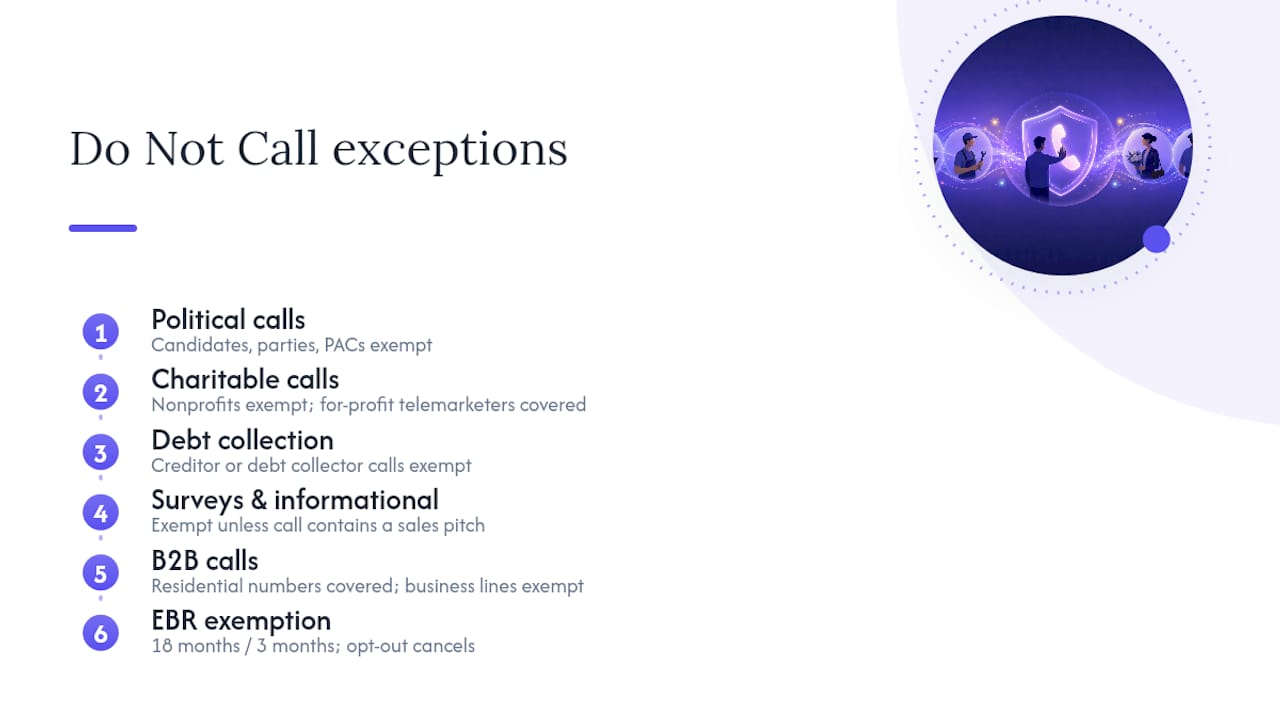
The EBR exemption has a hard override: if a consumer asks to be placed on a company's internal Do Not Call list, the EBR is gone for that company. A post-purchase follow-up call 10 months after a sale is legal. The same call after the customer has asked you to stop is a violation, regardless of the EBR window.
What telemarketers and sellers must do to comply with Do Not Call rules
Compliance is not a one-time setup. It is an ongoing operational process. Here is the core checklist:
- Register with the National Do Not Call Registry. Access the Registry through Telemarketing. You must certify that you will use the data only to prevent telemarketing calls to registered numbers. Misuse of Registry data can result in legal action.
- Subscribe by area code. Registry downloads are organized by area code. You pay subscription fees for each area code you need. Calling numbers in area codes you have not subscribed to exposes you to liability even if those numbers happen not to be registered.
- Scrub your call lists at least every 31 days. Download updated lists and remove any newly registered numbers before each calling campaign. A 31-day scrub cycle is the legal minimum; many compliance teams run weekly scrubs to reduce risk.
- Maintain an entity-specific internal DNC list. The national Registry is not enough. The FTC requires every seller to keep its own internal Do Not Call list. Any consumer who asks your company to stop calling must be added to that list immediately, and the EBR exemption no longer applies to them.
- Capture and document written consent. If you are calling registered numbers based on prior express written consent, that consent must be documented and stored. Verbal consent is not sufficient for calls to registered numbers.
- Enforce call-hour rules. No calls before 8:00 AM or after 9:00 PM local time at the called party's location. This applies regardless of whether the number is on the Registry.
- Identify yourself promptly. Callers must state the seller's name, the purpose of the call, and a phone number or address where the seller can be reached. Caller ID must display a number the consumer can call back.
- Preserve records. Keep documentation of consent, EBR dates, scrub logs, and internal DNC list updates. If a complaint is filed, your records are your defense.
Penalties are serious. Companies that illegally call numbers on the Registry can face fines that reach tens of thousands of dollars per violating call, and each call is treated as a separate violation. A campaign that dials 500 registered numbers without scrubbing is not one violation. It is 500.
The 2024 Federal Register amendments to the TSR clarified inbound-call exemptions and updated coverage for certain tech-support telemarketing categories, so teams relying on older compliance manuals should review those updates.
Safe harbor. A telemarketer may avoid liability for calling a registered number if it can show: it has written procedures for DNC compliance, it trains personnel on those procedures, it monitors compliance, it maintains a list of numbers it may not call, and the call was the result of an error. Safe harbor is not a free pass. It requires documented, routine business practices, not a retroactive claim.
Robocalls, scams, and what the Registry won't stop
Registering your number will not stop robocalls from overseas scam operations, spoofed-number fraud rings, or any caller who simply ignores the law. The Registry targets legal telemarketers who have something to lose by violating it. Criminals do not.
Two myths circulate widely and both cause harm. First, there is no three-digit code you can dial to block spam calls universally. No such code exists. Second, pressing "1" to be removed from a list or pressing "9" to opt out of a robocall is almost always a trap. The FTC explicitly warns that interacting with illegal robocalls by pressing keys confirms your number is active and typically increases the volume of calls you receive. Hang up. Do not engage.
For practical defenses, your carrier is your first line of protection. Most major carriers offer free call-labeling and spam-blocking tools. AT&T's ActiveArmor, T-Mobile's Scam Shield, and Verizon's Call Filter all flag likely spam before your phone rings. Third-party apps like Nomorobo and Hiya add another filtering layer. None of these are perfect, but they reduce the noise significantly.
FCC consumer guidance covers carrier-based blocking options in detail and explains the limits of Do Not Call protections against illegal robocallers. The FCC has pushed carriers to implement STIR/SHAKEN call authentication, which helps identify spoofed numbers, though implementation is still uneven across smaller carriers.
When a call gets through anyway, hang up and report it at reportfraud.ftc.gov. The FTC uses those complaints to identify patterns, build enforcement cases, and share data with law enforcement partners.
How consumers can report violations and what to expect
If you believe a telemarketer has violated the Do Not Call rules, here is how to act on it:
- Confirm your number is registered. Before filing a complaint, verify your number is listed at DoNotCall.gov and that at least 31 days have passed since registration.
- Collect evidence before you report. Note the date and time of the call, the number that appeared on caller ID (even if spoofed), the name of the company if given, and what was said. Screenshot any texts. If you recorded the call, check your state's recording consent laws before using it.
- File a complaint with the FTC at reportfraud.ftc.gov. This is the primary federal reporting channel. The FTC does not resolve individual complaints, but it uses the data to identify violators and support enforcement actions.
- Report to the FCC for robocalls and texts. The FCC handles complaints about autodialed calls, prerecorded messages, and texts under the TCPA. File at fcc.gov/consumers/guides/filing-informal-complaint.
- Contact your state attorney general. Many states have their own Do Not Call laws with separate enforcement mechanisms. Some states allow consumers to file complaints directly and may pursue civil penalties on their behalf.
On enforcement outcomes: the FTC and FCC can impose administrative fines and seek civil penalties. Individual consumers generally cannot sue under the TSR directly, but the TCPA does allow private lawsuits with statutory damages of $500 per violation (up to $1,500 for willful violations). Those cases are worth discussing with an attorney, since TCPA litigation has specific procedural requirements and class-action dynamics that are not straightforward to navigate alone.
Enforcement timelines vary. The FTC does not notify individual complainants when an investigation opens or closes. If you want to track whether action has been taken against a specific company, the FTC's press releases and case database at ftc.gov/enforcement are publicly searchable.
Operational compliance playbook for businesses and telemarketing teams
Getting compliant once is not the same as staying compliant. Here is what a functional compliance workflow looks like for outbound sales teams:
Lead intake and verification. Every new lead entering your system should be checked against the national Registry and your internal DNC list before it is added to a calling queue. Build this check into your lead intake process, not as an afterthought before a campaign launches.
Consent and EBR documentation. For each lead, record the source, the date of the last transaction or inquiry, and whether written consent was obtained. EBR expiration dates should be calculated and stored automatically. A purchase-based EBR expires 18 months from the last transaction; an inquiry-based EBR expires after three months. Missing those dates is one of the most common compliance violations teams face.
Scheduled scrubs. Set a recurring calendar task to download updated Registry lists and re-scrub your active calling lists. Every 31 days is the legal minimum. Weekly is better for high-volume teams. Log each scrub with a timestamp so you have documentation if a complaint is filed.
Internal DNC list management. Any opt-out request, whether verbal during a call or written via email, must be logged immediately and the number suppressed from future dialing. Integrate DNC flags directly into your call-tracking tool so flagged numbers are automatically excluded from dial lists. This is not optional. The FTC requires it.
Vendor controls. If you use a third-party call center or lead vendor, your compliance obligations do not transfer to them. You remain liable for calls made on your behalf. Require vendors to certify Registry compliance in writing, include DNC compliance SLA language in contracts, and audit their scrub logs periodically.
Call-hour enforcement. Build time-zone logic into your dialing system. A call placed at 8:30 PM Eastern to a California number is a violation. Automated call-hour enforcement at the system level eliminates this category of error entirely.
Pro Tip: Integrate DNC flags directly into your call-logging workflow. When a rep logs a call and the customer requests no further contact, that flag should auto-suppress the number from every future dial list, not just the one currently active. Central opt-out logging, tied to your cold call activity tracking system, is the difference between a defensible compliance record and a liability.
The Telemarketing Sales Rule applies regardless of the technology your team uses, so compliance systems and call-tracking tools must integrate DNC protocols natively. Mapping your sales prospecting workflow to include a compliance checkpoint at lead intake and again before each dial session is the cleanest way to operationalize this.

Why compliance is worth more than the fine you're trying to avoid
The conversation about Do Not Call compliance usually starts and ends with penalties. That framing misses the more practical argument.
Every call your team makes to a number that does not want to hear from you is a wasted dial. It burns rep time, degrades your caller ID reputation (carriers track complaint rates and label numbers accordingly), and produces zero pipeline. The Registry, when used correctly, is actually a filtering tool that improves targeting efficiency. Scrubbing a list of 10,000 numbers and removing the 2,000 registered ones means your reps spend their time on 8,000 people who are at least legally reachable.
The EBR rules deserve more attention than most sales managers give them. Teams that track EBR expiration dates carefully are not just staying compliant. They are also identifying the window when a past customer is most likely to be receptive to a follow-up. An 18-month purchase-based EBR is a relationship asset, not just a compliance clock.
For managers, three things move the needle immediately: automate your scrub schedule so it cannot be skipped under deadline pressure, log every opt-out centrally the moment it happens, and train reps on EBR timing so they understand why a call that was legal last month might not be legal today.
Dialedsales helps you track calls and stay organized
This section is informational and does not constitute legal advice. Consult qualified legal counsel for TCPA compliance questions specific to your business.
Staying on top of Do Not Call obligations means having a system that logs every call, flags opt-outs, and surfaces follow-ups at the right time. That is exactly what Dialedsales is built for.
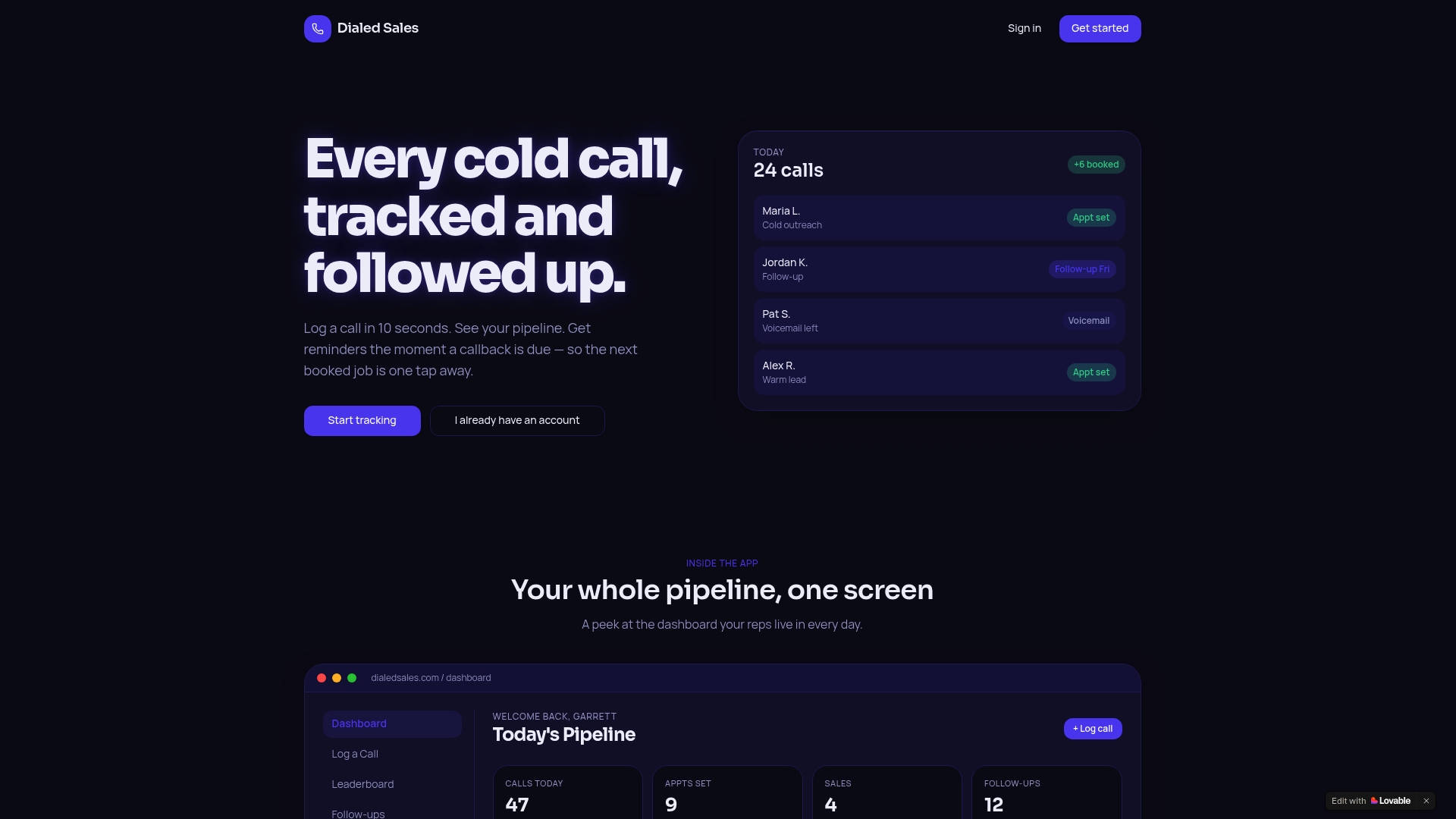
Dialedsales is a lightweight cold call tracking app for sales reps and field teams across regulated outbound industries including home services, solar, insurance, and real estate. Log a call in 10 seconds with the customer name, outcome, and notes. Set a follow-up date and it surfaces automatically on your dashboard when it is due. Built-in opt-out flags keep DNC numbers out of your active dial lists, and team dashboards give managers a live view of call activity and outcomes. There is no complicated setup and no long-term contract. Start a free trial at Dialedsales and see how much cleaner your compliance workflow gets when your call log and your DNC flags live in the same place.
Sources
- National Do Not Call Registry FAQs | Consumer Advice
- Complying with the Telemarketing Sales Rule | Federal Trade Commission
- National Do Not Call Registry
- Reportfraud
- Federal Register: Proposed and final amendments to TSR (Dec. 10, 2024)
This article is general information, not a substitute for advice from a qualified lawyer. Consult a qualified legal professional about your own circumstances before acting on anything here.