
Three actions fix most caller pipeline problems within a week. First, update the deal after every meaningful call with a dated next step, a one-line outcome, and the evidence the buyer actually gave you, not what you hope they meant. Second, turn on automation: a push-counter field that tracks close-date changes and a stale-deal rule that auto-closes opportunities nobody has touched. Third, run a short weekly hygiene sweep and score it with a Pipeline Integrity Score so you can see whether things are improving or just feeling better.
Do these three and your forecast stops lying to you. Skip them, and you're managing a pipeline built on wishful thinking.
- Log a dated next step, outcome, and buyer evidence after every call
- Turn on push-counter tracking and stale-deal auto-close rules
- Run a weekly hygiene sweep and track a Pipeline Integrity Score
Key Takeaways
Pipeline hygiene for callers works when every call ends with a dated next step, automation removes the excuse to skip logging, and a weekly score tracks whether things are actually improving.
| Point | Details |
|---|---|
| Log after every call | Capture outcome, dated next step, and buyer evidence before moving to the next dial. |
| Automate the boring parts | Push-counter tracking and stale-deal auto-close remove manual policing from managers. |
| Run a weekly sweep | A 45-minute review with four pulled lists catches stale deals before they rot. |
| Score it weekly | Track a Pipeline Integrity Score across stale-deal ratio, missing fields, and stage-age outliers. |
| Use a caller-first tool | Dialed Sales logs calls in 10 seconds and auto-surfaces reminders straight into your pipeline. |
Table of Contents
- What Pipeline Hygiene Means for Callers
- A Prioritized Checklist for Cleaning Up Your Pipeline
- Running a 45-Minute Weekly Hygiene Review
- Automation Recipes That Reduce Manual Cleanup
- Measuring Hygiene: The Pipeline Integrity Score
- Making Hygiene Stick Through Culture, Not Audits
- Rolling Out Hygiene Practices for Call-Heavy Teams
- Sources
What Pipeline Hygiene Means for Callers
Pipeline hygiene is the discipline of keeping your CRM data accurate, current, and tied to something the buyer actually did or said, not to how the call felt. AskElephant defines it around a specific field set: close date, a next step with an actual date attached, a stage that matches real buyer behavior, and activity that's recent enough to trust.
For call-driven teams, this gets simpler and stricter at the same time. Every field on a deal traces back to a phone call. There's no marketing touch, no self-service signup muddying the data. That means callers control hygiene more directly than almost any other sales role, and they also break it faster when they skip a field.
The fields that matter most for a caller:
- Next step with a date — not "follow up," but "callback Thursday 2pm re: budget approval"
- Last activity timestamp — when did a human actually talk to this buyer
- Close date with buyer evidence — tied to something the prospect said, not a guess
- Contact role — decision maker, influencer, gatekeeper
- Stage matching buyer behavior — not stage matching how good the call felt
A pipeline stays clean or goes stale based entirely on what callers log after they hang up. Nobody else touches these fields with the same frequency.
A Prioritized Checklist for Cleaning Up Your Pipeline
Start with what costs almost nothing and produces results by Friday. Then move to the automation projects that need a RevOps ticket and a week of setup.
Low-friction fixes (do this week):
- Require a dated next step before a rep can save any call log. No date, no save.
- Shorten the logging workflow to under 15 seconds: outcome code, one note field, next-step date.
- Build a short list of outcome codes (no answer, callback requested, not interested, demo booked) so reps click instead of type.
- Set a minimal required-field list on every opportunity: close date, next step, contact role. Nothing else is mandatory.
Medium and longer-term fixes (need RevOps or admin support):
- Add push-counter tracking on close dates so every push gets logged automatically instead of silently overwritten.
- Auto-close stage-zero opportunities that show no activity for 21 days, with a manager override checkbox for genuine exceptions.
- Lock down who can create new opportunities so duplicate or premature deals stop cluttering the pipeline.
- Auto-assign contact roles based on call notes or org chart data pulled from enrichment tools.
Which of these you tackle first depends on team size. A five-person team can enforce the low-friction fixes through manager spot checks alone. A fifty-person call floor needs the automation layer, because no manager has time to police 200 opportunities by hand. Automation recipes like push-counters and auto-close rules deliver quality gains almost immediately once they're switched on, mainly because they remove the judgment call from the rep.
Pro Tip: Pilot the auto-close rule on stage-zero deals only. Reps trust the system faster when they see it kill obvious dead weight before it starts touching deals they actually care about.
Running a 45-Minute Weekly Hygiene Review
A weekly cadence beats a quarterly audit because it catches problems while they're still small and while the caller still remembers the conversation. A short weekly manager review that produces a concrete decision for each flagged deal changes rep behavior faster than any once-a-quarter cleanup ever will.
Before the meeting, pull four lists:
- Opportunities with no logged activity in 14 or more days
- Opportunities with no next step entered
- Deals sitting in a stage well past its typical age
- Deals with a close date already in the past
Run the meeting on a strict clock:
- Minutes 0 to 5: Open with the current Pipeline Integrity Score and the trend line from last week.
- Minutes 5 to 35: Walk the stale-deal list. For each one, ask what the buyer said or did last, not what the rep thinks will happen.
- Minutes 35 to 45: Assign one of four outcomes to every flagged deal: advance, re-engage, park, or close.
Every deal leaves the meeting with a decision attached. None get "we'll revisit next week" as an answer, because that's how stale deals become permanently stale. Keep the tone diagnostic, not disciplinary. You're checking the pipeline's pulse, not auditing anyone's performance in front of the team.
Automation Recipes That Reduce Manual Cleanup
Automation works when it removes friction for the rep instead of adding another checkbox to babysit. Prospeo's playbook makes this point directly: build automation to help reps move faster, not to police them after the fact.
A few recipes worth building into your CRM:
- Stage-zero auto-close: Any opportunity with zero activity for 21 days moves to closed-lost automatically, with a manager-override checkbox for the rare exception worth keeping alive.
- Push-counter field: Increments every time a rep changes a close date. Hit three pushes and the deal gets flagged for the manager, no waiting for the weekly review to catch it.
- AI call-summary population: Conversation intelligence tools can auto-fill the next-step field straight from the call transcript, which fixes the single most-skipped field in most CRMs.
- Slack or Teams prompts: A one-click "update this deal" button pushed to the rep's messaging app for reps who avoid opening the CRM directly.
Pro Tip: Set the push-counter alert threshold low at first, even at two pushes. You'll catch chronic re-schedulers before they become a forecasting problem instead of after.
Measuring Hygiene: The Pipeline Integrity Score
You can't fix what you don't measure, and pipeline hygiene is no exception. A Pipeline Integrity Score combines four inputs into one weekly number between 0 and 100: stale-deal ratio, stage-age outliers, missing close dates, and overall field completeness.
| KPI | Target / Red Flag |
|---|---|
| Opportunities with no activity in 14+ days | Below 15% is healthy; above signals a stale pipeline |
| Missing close date | Should approach 0% on any deal past discovery |
| Missing next step | Same standard, near 0% on active deals |
| Stage-age outliers | Flag anything sitting 2x longer than typical stage duration |
A score that climbs week over week tells you coaching and automation are working. A score stuck flat, even after a hygiene push, usually means the automation isn't reaching the reps who need it most, or the weekly review skipped its follow-through. Gartner's guidance on pipeline management backs this multi-layer approach, combining activity evidence with historical conversion data rather than trusting either signal alone.
Making Hygiene Stick Through Culture, Not Audits
Technical fixes only get you halfway. Behavioral research on forecasting discipline shows that culture, not tooling, is usually the real root cause when hygiene efforts stall out.
The fix starts with separating belief from evidence. Instead of accepting "I think this closes Friday," require a one-line answer to "what did the buyer say or do that supports that date?"
- Ask "what evidence do you have?" instead of "how do you feel about this deal?"
- Replace punitive hygiene audits with visible, public recognition for reps who keep clean records
- Track push counts as a coaching signal, not a punishment trigger
- Make the weekly review about deals, never about individual reps in front of peers
Pro Tip: Post the team's Pipeline Integrity Score somewhere visible, like a shared dashboard. Reps who see their hygiene reflected in a number tend to self-correct faster than reps who only hear about it in a private one-on-one.
Rolling Out Hygiene Practices for Call-Heavy Teams
Start small. Build a call-log structure with short outcome codes, a templated next-step field, and a mandatory follow-up date, and cap notes at two or three sentences so reps actually fill them in.
- Pilot with one team or pod for two to four weeks using a lightweight call-tracking app like Dialed Sales that auto-surfaces reminders and feeds fields straight into your CRM.
- Measure the Pipeline Integrity Score and update cadence before and after the pilot window.
- Scale the winning workflow across the full floor once the pilot shows a measurable score improvement.
Why hygiene has to be a rhythm, not a cleanup project
A team I worked alongside years back ran one big pipeline cleanup, felt great for two weeks, then watched the same stale deals pile back up by month three. The fix wasn't a bigger cleanup. It was a smaller one, repeated weekly, tied to a number everyone could see. Forecast reliability improved once hygiene stopped being an event and became a habit built into every call.
— Garrett
Dialed Sales Fixes Hygiene at the Point Where It Breaks
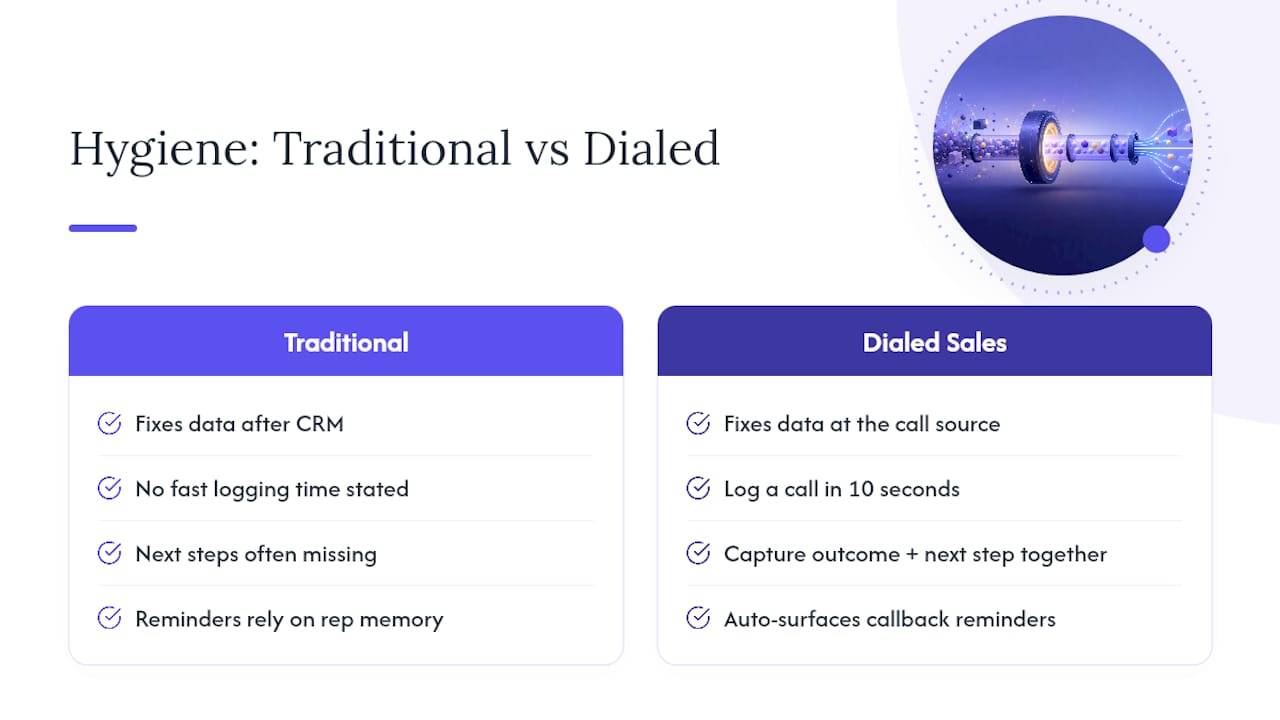
Most hygiene tools try to fix bad data after it's already in the CRM. Dialed Sales fixes it at the source: the call itself. Log a call in 10 seconds flat, capture the outcome and next step in the same motion, and let the app auto-surface the reminder the moment a callback is due instead of relying on a rep's memory.
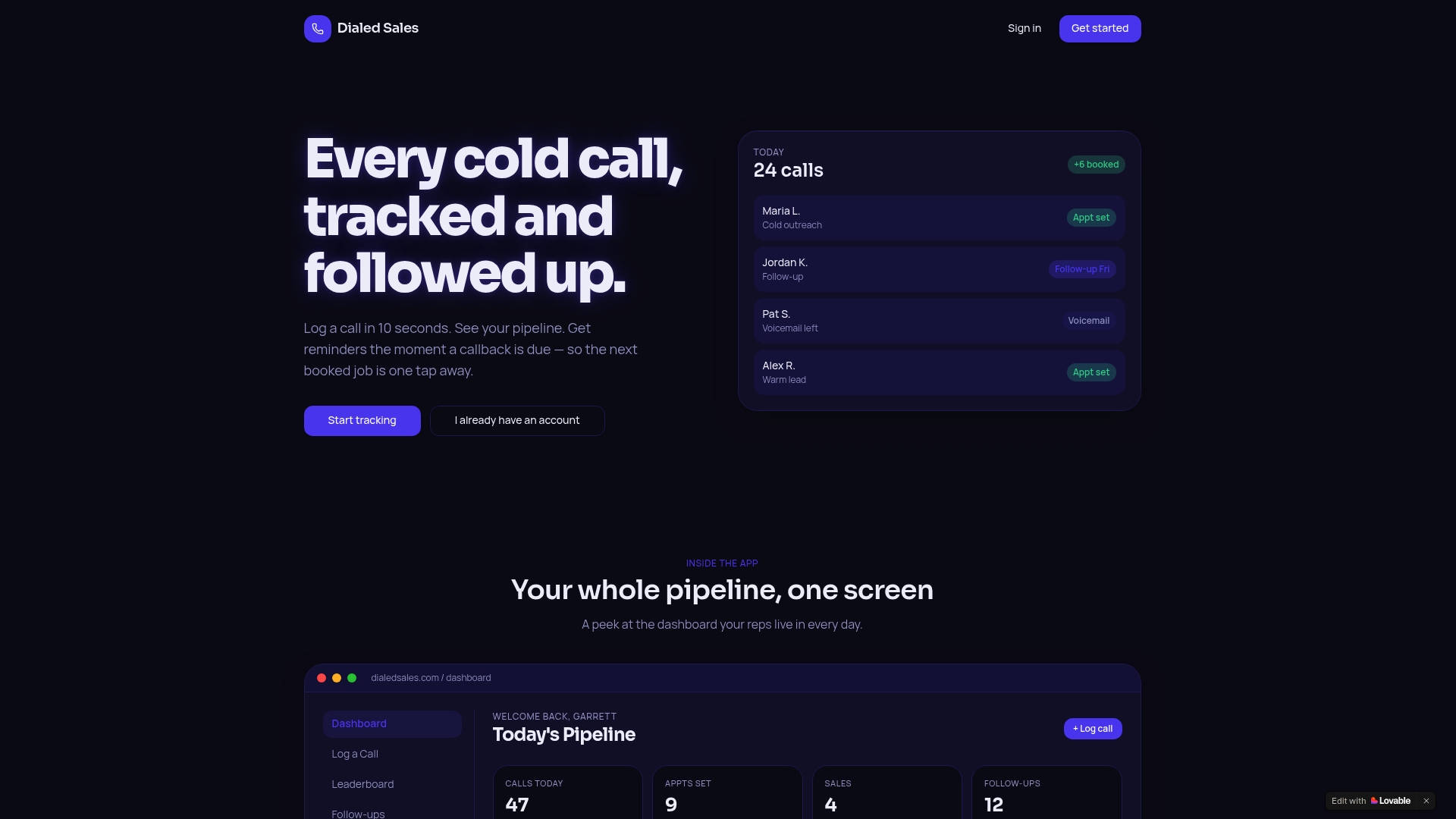
That structure solves exactly the problems this article walked through: missing next steps, stale close dates, and reps who avoid the CRM because logging takes too long. Per-rep activity stats and a live pipeline dashboard give managers the stale-deal visibility a weekly review needs without pulling four separate reports first.
Run it with one pod for two weeks. Pull your Pipeline Integrity Score before you start and again after, and watch what changes when logging a call stops feeling like a chore. Start with Dialed Sales and see the difference in your next weekly review.
Sources
For deeper standards and cadence templates, see Inveo's four hygiene standards and Gartner's pipeline management guidance.
- Pipeline Hygiene: The 2026 Playbook for Clean Data — Prospeo
- What Is Pipeline Hygiene? — AskElephant
- Gartner — Pipeline management guidance