
A warm lead has recent, relevant engagement with your brand or problem space. A cold lead has none. A hot lead is actively signaling purchase intent right now. Those three states determine how fast you respond, how much you personalize, and which rep handles the call.
Cold leads need low-cost, research-driven outreach before any senior AE time is spent. Warm leads need a fast, context-aware follow-up that moves them toward a qualification call. Hot leads need a response within minutes, not hours, and a clear path to a decision. Temperature is an operational state, not a quality score. A cold lead can be a perfect ICP fit. A warm lead can be completely unqualified. Treat them as separate dimensions.
Key Takeaways
Temperature tags are only useful if they are current, timestamped, and separated from qualification stage in your CRM.
| Point | Details |
|---|---|
| Cold vs. warm vs. hot | Cold has no context; warm has recent engagement; hot has explicit purchase intent. |
| Score and threshold | Use a fit-plus-engagement rubric: 0–20 = cold, 21–40 = warm, 41+ = hot. |
| SLA by temperature | Warm leads: respond within 48 hours. Hot leads: respond within one business hour. |
| Temperature decays | A warm tag older than 30 days should step down automatically in your CRM. |
| Dialedsales | Logs calls in under 10 seconds and auto-surfaces follow-ups so warm signals never go cold. |
Table of Contents
- What is a warm vs. cold lead? Definitions and quick signals
- How to recognize cold leads and run a research-driven outreach cadence
- How to spot warm leads and accelerate qualification
- What hot leads look like and how fast you need to move
- A simple lead-scoring rubric you can use in any CRM
- A practitioner workflow for logging calls and catching warm signals
- How lead temperature affects your sales cycle length
- How to measure and track lead temperature over time
- Conversion rate differences by lead type
- Common mistakes when categorizing leads
- How to move leads from cold to warm to hot
- The triage habit most SDRs skip
- Dialedsales keeps warm signals from slipping through the cracks
- Sources
What is a warm vs. cold lead? Definitions and quick signals
Temperature tells you what to do next, not whether the deal is worth chasing.
Cold leads
- No prior interaction with your brand, content, or team
- Contact sourced from a list, database, or manual research
- No demonstrated awareness of the problem you solve
- Typical action timeline: 6–12 touch outreach cadence over 4–6 weeks before any response expectation
Warm leads
- Has engaged with your content, replied to an email, attended a webinar, or been referred by a known contact
- Context, not just clicks, creates warmth: a post about a problem, a question in a community, or a direct recommendation counts more than a single anonymous page view
- Aware of the problem and, often, aware of you
- Typical action timeline: qualify within 24–48 hours of signal detection
Hot leads
- Explicit purchase intent: demo request, pricing question, procurement timeline shared, or direct inbound call
- Often ready to decide within a 30–90 day window
- Typical action timeline: contact within the same business day, ideally within the hour
Pro Tip: Temperature is not the same as qualification. Track them as separate CRM fields: source, temperature, signal type, and timestamp. Mixing the two confuses attribution and makes your pipeline reports meaningless.
How to recognize cold leads and run a research-driven outreach cadence
Cold leads are not bad leads. They are simply leads with no context yet.
Recognition signals:
- Sourced from a purchased list, LinkedIn Sales Navigator export, or manual prospecting
- No email opens, no site visits, no social engagement on record
- No mutual connections or referral path
- First contact is entirely outbound and unsolicited
A 5-touch cold cadence (example):
- Day 1: Personalized email referencing a specific trigger (company news, job posting, industry trend)
- Day 3: LinkedIn connection request with a one-line note tied to the same trigger
- Day 7: Follow-up email with a short insight or relevant resource, no ask
- Day 14: Phone call, leave a voicemail if no answer
- Day 21: Final email with a soft opt-out option ("If this isn't relevant, just say the word")
Pro Tip: Batch your cold research. Pull 20 accounts at a time, note one trigger per account in your CRM before you write a single email. You will move faster and your messages will be sharper.
How to spot warm leads and accelerate qualification
Warm signals are not equal. A pricing page visit outweighs a broad ebook download. A direct email reply outweighs a webinar registration. Signals vary in strength, and weighting them correctly is what separates a rep who chases noise from one who closes.
High-value warm signals:
- Direct email reply, even a short one
- Referral from a current customer or known contact
- Pricing or case study page visit (multiple times in one session)
- Product trial activity or feature engagement
- Event conversation where they described a specific problem
Lower-value warm signals:
- Single ebook or content download
- Webinar registration without attendance
- One anonymous site visit
Prioritization checklist before you reach out:
- Fit: Does this person match your ICP on role, company size, and industry?
- Freshness: Did the signal happen in the last 72 hours? Last week? Last month?
- Channel: Did they engage on a high-intent channel (pricing page, trial) or a low-intent one (social like)?
- Signal strength: Is this one data point or a cluster of related behaviors?
Pro Tip: Route warm leads to your fastest responder, not your most senior rep. Speed matters more than seniority at this stage. A reply within two hours of a warm signal converts at a meaningfully higher rate than one sent the next morning.
What hot leads look like and how fast you need to move
Hot leads are not just engaged. They are signaling a decision is coming, and they want to talk now.
Hot signals to watch for:
- Demo request submitted
- Direct question about pricing, contract terms, or implementation timeline
- Procurement documents requested or shared
- Multiple high-intent page visits in a single session (pricing, case studies, integrations)
- Inbound call or chat asking about next steps
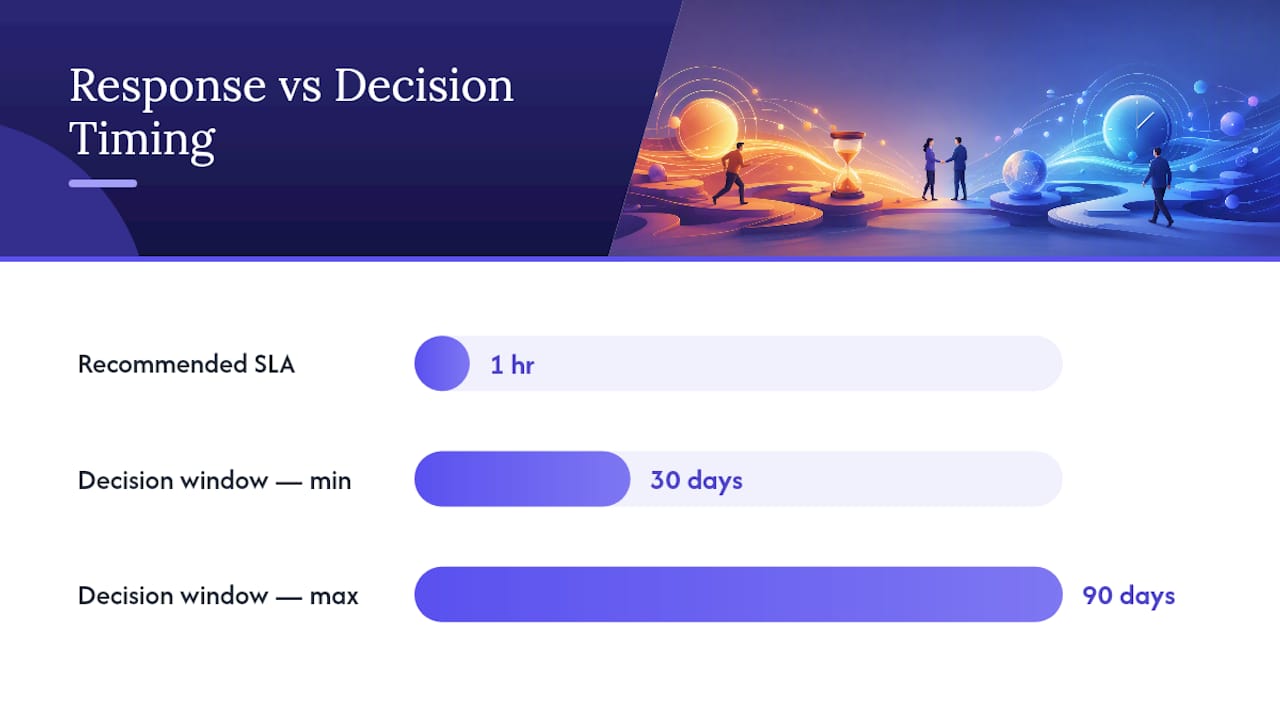
Hot leads frequently show intensive content consumption and explicit purchase intent, and many are operating on a 30–90 day decision window. That window closes fast if you are slow.
Recommended SLA: Contact a hot lead within one business hour of the signal. Studies on response time consistently show that the first rep to respond wins the meeting at a disproportionate rate.
Closing checklist for hot leads:
- Confirm budget authority (who signs?)
- Confirm timeline (when do they need a solution live?)
- Confirm the decision process (is there a committee, a procurement step?)
- Agree on a concrete next step before ending the call
One caveat: hot signals can be false positives. A competitor doing research, a student writing a paper, or a current customer checking renewal terms can all trigger the same signals as a genuine buyer. A single verification question on the first call ("Are you evaluating solutions for a current project?") filters most of them out without killing the momentum.
A simple lead-scoring rubric you can use in any CRM
A scoring model that combines fit, engagement, and intent actions produces reliable temperature tags when you include timestamps and thresholds. Here is a lightweight version you can implement today.
Temperature thresholds:
- 0–20 points: Cold. Add to a nurture sequence.
- 21–40 points: Warm. Prioritize for outreach within 48 hours.
- 41+ points: Hot. Contact within one business hour.
Qualification questions for a first call or email:
- What prompted you to look at this now?
- Who else is involved in the decision?
- What does your timeline look like?
- What would a successful outcome look like in 90 days?
Automation triggers to move records between buckets:
- Pricing page visit + email reply in the same week: Cold → Warm
- Demo request submitted: Warm → Hot (regardless of score)
- No activity for 60 days: Warm → Cold (reset the sequence)
Track temperature as a separate CRM field from qualification stage. Mixing the two confuses measurement and attribution, especially when you are trying to understand where your best deals actually started.
A practitioner workflow for logging calls and catching warm signals
The best scoring rubric in the world fails if reps log calls two days late or forget to set a follow-up. The workflow has to be fast enough that it happens in real time.
Quick call logging workflow:
- Log the call immediately after hanging up: customer name, outcome (answered/voicemail/no answer), and one-line note on what was said or observed
- Set the follow-up date before closing the record, not later
- Tag the temperature based on what you heard or observed on the call
- If a warm signal emerged during the call (they mentioned a pain point, asked a follow-up question), escalate the temperature tag and notify the account owner
Pro Tip: Log calls in under 10 seconds by using a fixed outcome dropdown and a one-line notes field. Full paragraphs in call notes are almost never read. One sentence is enough to jog your memory and hand off context.
Setting follow-up reminders at the time of the call is the single habit that separates reps who lose warm leads to silence from reps who close them.
How lead temperature affects your sales cycle length
Cold leads take longer to close. That is not a surprise, but the mechanism matters. A cold lead requires multiple touches just to establish awareness, then more to build credibility, then more to surface intent. Each of those stages adds time. A warm lead enters the funnel with awareness already established, which compresses the early stages of the cycle significantly.
A referral-sourced warm lead often reaches a qualification call in one or two touches. A cold lead sourced from a purchased list may need five to eight touches before a meaningful conversation happens. The difference is not the rep's skill. It is the starting context.
This is why resource allocation by temperature matters. Spending senior AE time on cold leads before they have been warmed by an SDR motion is one of the most common and expensive pipeline mistakes in outbound sales.
How to measure and track lead temperature over time
Temperature is not a one-time tag. It decays. A lead who visited your pricing page three months ago and never replied is not warm anymore. A lead who went cold six months ago and just replied to a reactivation email is warm again.
Track temperature with a timestamp on every change. Your CRM should record: the current temperature tag, the date it was last updated, the signal that triggered the change, and the source of the original lead. That four-field setup lets you run a simple report: which temperature states are converting, how long leads stay in each state, and where the biggest drop-offs happen.
Review temperature tags weekly, not monthly. A 30-day-old warm signal is borderline cold. A 60-day-old one is cold. Build a decay rule into your automation so records that have not had a new signal in 30 days automatically step down one temperature level.
Conversion rate differences by lead type
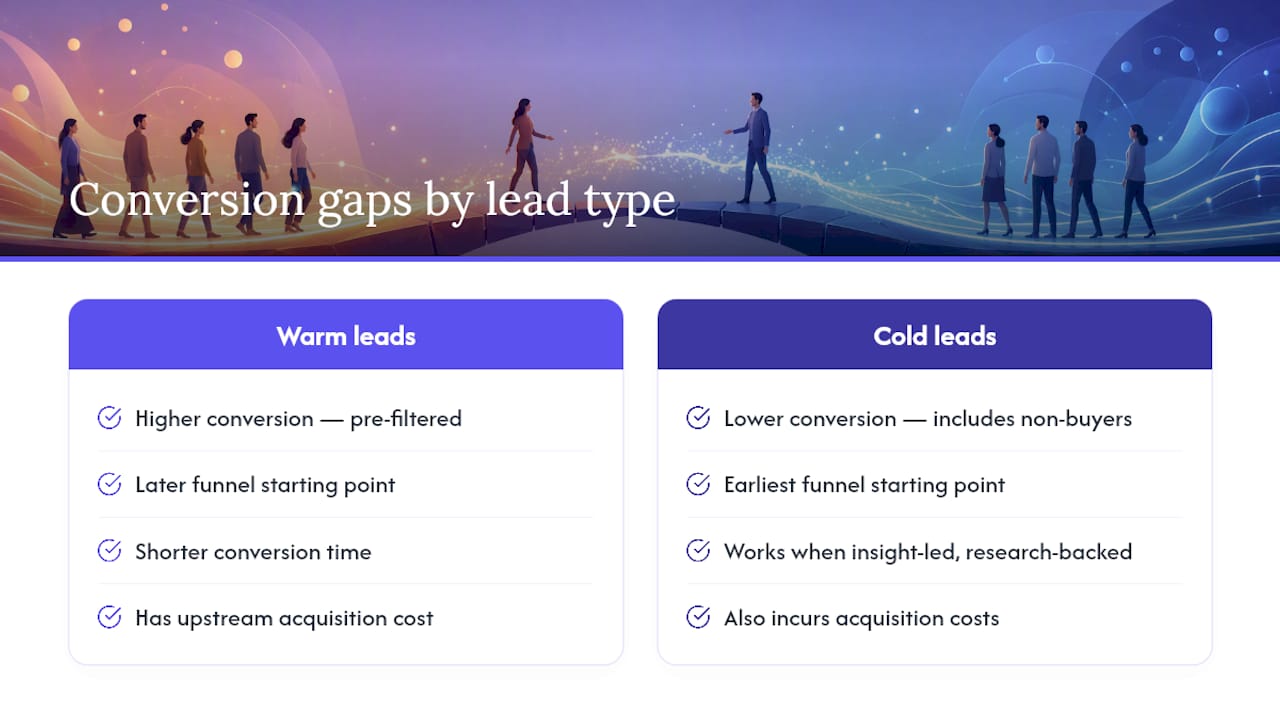
Warm leads convert at higher rates than cold leads. That is consistent across industries. But the conversion gap reflects selection bias and funnel starting points, not a universal multiplier you can apply to your pipeline math.
Warm leads are pre-filtered. They have already demonstrated some level of interest or fit before you count them. Cold leads include everyone, including people who will never buy. Comparing raw conversion rates between the two without accounting for that starting difference overstates how much "warmth" itself drives conversion.
Cold outreach still works when it is insight-led and research-backed. Warm outreach shortens conversion time but can hide upstream cost if attribution is not tracked. A referral program that generates warm leads has a cost. A content engine that generates inbound warm signals has a cost. Neither is free, and neither should be compared to cold outreach without accounting for those costs.
Common mistakes when categorizing leads
The most expensive mistake is treating temperature as a permanent label. A lead tagged cold in January and never revisited is not necessarily cold in June. Reps who do not update temperature tags are flying blind.
The second most common mistake is conflating temperature with qualification. A warm lead who is not a decision-maker, has no budget, and is not evaluating solutions is still unqualified. Routing them to an AE wastes everyone's time. Run a quick qualification check before escalating any warm lead, regardless of how strong the signal looks.
Third: over-weighting low-intent signals. A single content download is not a warm lead. A webinar registration from someone who never attended is not a warm lead. Context, not just clicks, creates warmth. One strong signal beats five weak ones.
How to move leads from cold to warm to hot
The path from cold to hot is a deliberate sequence of value exchanges, not a waiting game.
Cold to warm: deliver something useful before you ask for anything. A relevant insight, a short case study, a connection to someone in their network. The goal is to give them a reason to engage. One genuine reply moves a lead from cold to warm faster than ten generic follow-ups.
Warm to hot: surface buying intent by asking a direct question. "Are you evaluating solutions for this right now?" or "Would it make sense to walk through how we handle this for teams like yours?" A warm lead who says yes to either of those is hot. One who says "not yet, but keep me posted" goes into a low-touch nurture sequence with a 30-day check-in.
The nurture sequence for warm-but-not-ready leads should be light: one touchpoint every three to four weeks, alternating between a useful resource and a brief personal check-in. The goal is to stay visible without being annoying. When their situation changes, you want to be the first name they think of.
The triage habit most SDRs skip
Most SDRs spend roughly equal time on cold and warm queues. That is the wrong ratio.
A warm lead who engaged in the last 48 hours is worth five times the attention of a cold lead who has never heard of you. The math is simple: your conversion probability is higher, your cycle is shorter, and the context you have makes the conversation easier. Yet most reps treat their queue as a flat list and work it top to bottom.
The reps who consistently outperform their peers do one thing differently: they triage before they dial. Every morning, they pull the warm queue first, sort by signal recency, and work those records before touching anything cold. Cold outreach fills the gaps, not the priority slots.
Three things worth changing today: stop working your queue in the order it was created, start tagging temperature at the time of every call, and build a 30-day decay rule into your CRM so warm tags do not sit stale. If your warm queue is empty, that is a content and inbound problem, not a cold-calling problem.
Dialedsales keeps warm signals from slipping through the cracks
Every warm signal you miss is a deal that closes with someone else. The gap between logging a call and setting the follow-up is where most of them disappear.
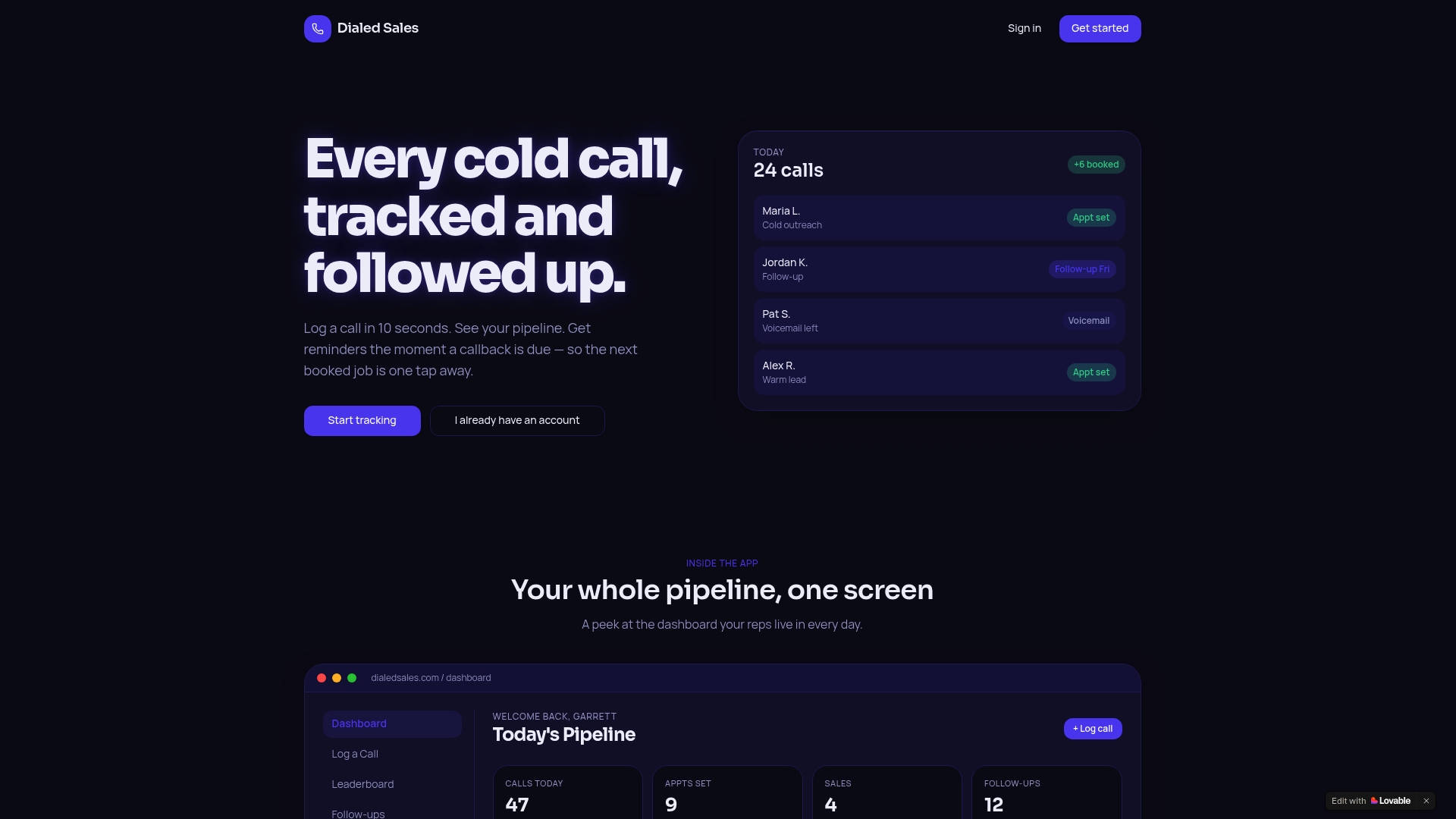
Dialedsales is built for exactly this workflow. Log a call in under 10 seconds, set a follow-up reminder before you hang up, and let the dashboard surface every due callback the moment it is due. Warm signals get flagged automatically, per-rep activity stats show who is following up and who is not, and the built-in AI assistant helps draft context-aware messages without starting from scratch. No complex CRM setup, no missed callbacks, no warm leads going cold because someone forgot to follow up.
Start your free trial at Dialedsales and see how fast your warm queue gets easier to manage.
Sources
- What Are Warm Leads? Cold vs Warm Leads for Service Founders | Signado
- How to Identify Warm Leads: Complete System for 2026
- Cold vs Warm Leads: Learn to Prioritize Your Pipeline | Vonsel
- Monday